Dirty Linen: The Troubles in my home place, by Martin Doyle

Summary: An outstanding portrait of the pity of war

Margaret Yeaman has never seen her grandchildren. She lost her sight on 15 March 1982 when a no-warning car bomb exploded close to her workplace in Banbridge, County Down, causing splintering glass to lacerate her face. 

Margaret’s story, of being in the “wrong place at the wrong time” is just one amongst many that Martin Doyle explores in his book, Dirty Linen. The book also takes exception to that “wrong place, wrong time,” line. So many of the people whose stories Doyle recounts were just doing their jobs, providing for family and community, or just trying to have a bit of craic. It was the paramilitaries who were in the wrong place at the wrong time for these ordinary people.

Some will still argue that atrocities such as the ones recounted in this book were necessary to advance justice in the North of Ireland. But as Margaret and people like her tell their stories of how their families were devastated by violence, these should bring shame to that notion: as if the British government was ever going to be moved to change policy by Paddies butchering Paddies on the country roads of Ireland. It’s why they introduced “Ulsterisation” to begin with.

Dirty Linen is, in part a memoir, and Doyle gives an honest accounting of his experiences coming of age amidst such carnage, including the miserable abuse he sometimes suffered as a young Catholic in that religiously mixed part of County Down. 

This book could also act as something of an introduction to the art of the North of Ireland. As literary editor of the Irish Times, Doyle is able to draw upon the work of so many writers and artists, from Seamus Heaney to F E McWilliams and Colin Davidson, to help him give voice to the depth of the human tragedy that the Troubles represented.

But, as a result of Doyle’s sensitive interviews with Margaret and people like her, his book is also an exemplary work of journalism and a deeply important contribution to understanding the history of the Troubles. It offers an unflinching portrait of the pity of war by exploring the trauma and courage of the victims of both loyalist and “republican” paramilitaries. 

Some of those victims whose stories Doyle explores also became perpetrators, or at least sympathetic to the idea of revenge. But so many more refused to become as twisted as those who mutilated them and their families. Instead. they often begged for no retaliation and strove for forgiveness, or at least toleration. Theirs are stories that are so much more heroic than anything that could ever be written about the paramilitaries who pressed the triggers or planted the bombs.  

If this was all that Doyle did, then the book would be a marvel. But his painstaking accumulation of detail across the book also builds a picture of the pervasiveness of collusion between British state forces and the loyalist Glenanne gang. Perhaps other writers and researchers have done similar work. But I have not read such a convincing indictment of the breadth of British collusion anywhere else. So, if you want to understand why the British government is so keen to stop Troubles era criminal investigations, read this book.

At a time when the Troubles seem to be giving rise to some exemplary non-fiction, Doyle’s book could well stand out as a classic. 


My top ten reads for 2023

Summary: in case anyone is looking for reading or gift ideas

In chronological order of reading:

  1. Hitler, by Ian Kershaw: an exceptional work of historical biography and the definitive work on the pathetic monster who brought cataclysm to Europe.
  2. My Father’s House, by Joseph O’Connor: an outstanding historical thriller of Hugh O’Flaherty – “the Irish Schindler” – and Europeans united against the Nazis
  3. The Restless Republic, by Anna Keays: an elegantly written, though overwhelmingly Anglo-centric and bizarrely affectionate account of “Oliver’s” genocidal dictatorship
  4. Sword of Honour, by Evelyn Waugh (Men at Arms; Officers and Gentlemen; Unconditional Surrender): Waugh’s war, told with his trademark combination of high comedy and profound melancholy: classics for a reason.
  5. Empireland, by Sathnam Sanghera: a gripping and elegantly written survey of the bloody British empire and its echoes in the present day
  6. The Secret Hours, by Mick Herron: An superb prequel to the Slough House series: 1990s Spook Straße, Berlin, Moscow Rules very much apply
  7. Five Decembers, by James Kestrel:  a surprising and compelling crime story, with a strong echo of Vonnegut’s Slaughterhouse Five, to the backdrop of WW2 in the Pacific.
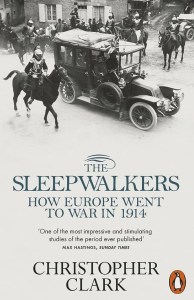
  8. The Sleepwalkers: how Europe went to war in 1914, by Christopher Clark: an extraordinarily adept and compelling elucidation of the complexities of European politics and alliances that led to the outbreak of World War 1. Basically, it was everyone’s fault… but mostly Serbia.
  9. A History of Water, by Edward Wilson-Lee:  a fascinating exploration of an aspect of Portuguese history and attitudes at the outset of Europe’s colonial plunder of the global South
  10. Killing Thatcher: the IRA, the manhunt, and the long war on the Crown, by Rory Carroll: insight on the Troubles through the prism of a gripping account of one bloody incident

Killing Thatcher: the IRA, the manhunt, and the long war on the Crown, by Rory Carroll

Summary: insight on the Troubles through the prism of a gripping account of one bloody incident

Patrick Magee did not kill Thatcher when the bomb he planted in the Grand Hotel, Brighton exploded. She emerged from the wreckage with her reputation burnished by an extraordinary display of courage and self-possession for one who had just survived an assassination attempt.

Magee did kill Jeanne Shattock, Anthony Berry, Eric Taylor, Muriel Maclean and Roberta Wakeham. Most were sleeping when the bomb exploded but were not killed instantly. Instead they suffocated, terrified and alone, in the rubble that scythed through the hotel, unleashed by the explosion. Others were grievously injured, including former nurse, Margaret Tebbitt, who was left quadriplegic. More would probably have died were it not for the startling courage of the firefighters who attended the scene and broke protocol by insisting on searching for survivors before the building was declared free of explosives.

Killing Thatcher is Rory Carroll’s gripping narrative of the events leading up to this 1984 bombing and the subsequent hunt for the bombers. Its principal focus is on Magee, but it is also an account of the others, from Magee’s victims to the bomb disposal experts and cops who he came into interaction with during the course of his involvement in the IRA’s often vicious campaign in England.

Magee is in many respects a hugely impressive individual. After release from prison, in which he earned a PhD, he showed considerable moral courage in meeting and subsequently working with Anthony Berry’s amazing daughter, Jo. This initial meeting, he admitted, was the first time he realised that he had been responsible for the death of a fine person. But in spite of his apparently genuine regrets, he continues to insist that the Brighton bombing was a legitimate act of war.

Following her callous handling of the 1981 hunger strikes, Thatcher was a hate figure in much of Ireland. So, the Brighton bombing was principally an act of revenge rather than a strategic move coolly calculated to advance war aims. Justice in Ireland was instead advanced by the diplomacy of Taoiseach Garret Fitzgerald, who convinced Thatcher to sign the Anglo-Irish agreement the year after the bombing. This laid the foundations for the Good Friday Agreement of 1998.

Reading this book as thousands of women, children and men are suffocating to death in the bombed out rubble of Gaza, I imagine that, like Magee before he met Jo Berry, Netanyahu, Hamas and their cheerleaders in the British parliament and American Congress do not trouble themselves to think of the dying as fine human beings. But I doubt that any of them would have the integrity of the likes of Patrick Magee to face their victims, or of Thatcher to put in the groundwork for a political solution, in spite of personal feelings.

So, for all that is repellent about British and IRA policy and actions during the Troubles, Magee and Thatcher appear now as moral paragons by comparison with many contemporary political figures with their weasel words in defence of war crimes.

The Sleepwalkers: how Europe went to war in 1914, by Christopher Clark

Summary: So… it was everyone’s fault… but mostly Serbia.

The historian AJP Taylor in his celebrated BBC lectures, How Wars Begin, stated that everyone knows why the Second World War began, but not when, and everyone knows when the First World War began, but not why.

The Sleepwalkers, Christopher Clark’s detailed examination of the origins of the First World War clears up some of that “why” question, but not in any simple way. He describes an interconnected system of “great” European powers – and Serbia – who all took for granted their right to interfere in the affairs of other nations and which developed enormously complex systems of alliances and interests to allow them to do so.

Bizarre imperial attitudes to other countries were not the only strange notions to infest the chancelleries of Europe pre-1914. Many of the denizens of these corridors of power talked seriously of the idea of “preventative war”, which remains, to put it crudely, as much a contradiction in terms as the idea of fucking for virginity.

Hence at the outset of the 20th Century, Europe represented not so much a house of cards destined to collapse sooner rather than later, but a tangle of explosive devices being randomly hit with hammers by supercilious poshos with Napoleonic delusions.

The spark that finally triggered to conflagration was, of course, the assassination of Archduke Franz Ferdinand and his wife, Sophie, in Sarajevo, by the young Serbian nationalist Gavrilo Principe. This was done at the behest of elements in the Serbian government which feared Franz Ferdinand’s intent to increase Slavic representation in the Austro-Hungarian empire. This, Belgrade felt, threatened their dream of a greater Serbia. Franz Ferdinand’s assassination also removed one of the most pacific members of the Austro-Hungarian government and made their impetus towards a war of vengeance all the more assured. From the rubble, of course, Yugoslavia was fashioned, so maybe some Serbs felt the price was worth paying. And didn’t that turn out well.

Some of the dangerously fanciful notions that sparked the cataclysm may have dissipated from Europe, particularly since the rise of the European Union, which was fashioned to make war “not only unthinkable but materially impossible.” However, Clark notes that other dangerous impulses are still at play. Referencing the Euro crisis of 2009/10, Clark describes how, just as in 1914, some countries were prepared in negotiations to use the risk of catastrophic failure for all to advance local interests for some. Similar short-term, selfish interests threaten progress on the climate crisis, which may yet dwarf the carnage of the First World War.

So, a bleak book, but an engaging and thought provoking one, snappily written and frequently gripping.

The Secret Hours, by Mick Herron

Summary: 1990s Spook Straße, Berlin: Moscow Rules very much apply

While not quite a Slough House book as readers have come to know them, The Secret Hours is something of a prequel. It tells the story of a questionable British operation in 90s Berlin undertaken by an experienced British intelligence officer known as “Myles”. Readers of the Slough House series will understand the importance of the detail that this particular officer is known to fart a lot.

The story of this operation is told in flashback to an enquiry into malpractices by the intelligence services. Naturally, of course, the ancient history related to this operation has its repercussions in the present. Just because some people are dead, does not mean the past is. As the story evolves, it becomes plain, as Faulkner well understood, that it is not even past.

To say too much more risks exposing some of the deeply satisfying plot twists and narrative sleights of hands that Herron employs in this book. Suffice to say, it is a glorious addition to the Slough House universe and one of the best, to date, in the series.

Finding the Telling Detail: Understanding a Photograph, by John Berger; On Photography, and Regarding the Pain of Others, by Susan Sontag.

Summary: on trying to learn how to take a photograph

In 2004, the Finnish-American photographer, Arno Minkkinen, presented to the world his Helsinki Bus Station Theory of Photography. In summary, he argued that just as all the buses from the Helsinki bus terminal stop at the same first three stops before going to wildly different places, that the work of any photographer, over the first three years of their career, is going to be derivative of the work of somebody else. This is irrespective of what genre the photographer chooses to specialise in, from nudes to landscape to war photography: somebody will have been there before. Originality only emerges after persistence and practice over years. Or, as Minkkinen put it, if you “stay on the fucking bus,” rather than give up as soon as you recognise who your work is aping.

That is all well and good if you know which bus you want to get on in the first place. That is why people read Susan Sontag and John Berger: to work out what sort of photographer they want to be.

For me, John Berger provided an initial inspiration with his observation that some photographers work with “emancipatory” intent. After half of my professional career in humanitarian response and development, and the other half in human rights and anti-slavery work, this idea struck a chord with me, but still left me short of ideas of how to proceed.

Sontag’s photography books, paradoxically lacking any photographs, are not short of ideas. She writes of the philosophy of photography and photographers. Both of her books are enormously rich and challenging affairs. In particular, I found that On Photography required more than one reading to come anywhere close to fully appreciating the depth of her thought on the subject. Regarding the Pain of Others, perhaps because I have some experience of living and working in war zones, perhaps because I had read On Photography first, I found much more accessible.

Photography, Sontag observes, like sex, cooking and dancing, is a democratic art form that anyone can participate in. But just because anyone can press a button does not mean that anyone can take a good photograph. So, Sontag explores why some photographers not only take good photographs but take photos that are sometimes deemed worthy of putting in a museum.

And, there appear to be as many answers to this question as there are such photographers. Nadar reckoned the best portraits he took were of people he knew. Avedon reckoned his best portraits were of people he did not know. Cartier-Bresson reckoned you should think before and after taking a photograph, but definitely not during.

That successful photographers work to such diverse, sometimes mutually exclusive, ideas is one of the paradoxes of good photography. Perhaps I found an explanation from Berger’s own reflections on Sontag, “The camera saves a set of appearances from the otherwise supersession of further appearances…before the invention of the camera nothing could do this, except in the mind’s eye, the faculty of memory.”

So, perhaps what makes a photographer good is when they learn to capture with the camera that which they would wish to remember, or perhaps wish others to remember.

That gave me an idea.

One of my first experiences working in Africa was a visit to a poor neighbourhood in Addis Ababa, Kebele 37. Amidst the open sewers and crumbling mud houses densely packed together amidst a warren of streets I saw that someone had planted a geranium outside their door, in a salvaged cooking oil tin from a food distribution. There was something about that telling detail which seemed to me to encapsulate the indomitability of humanity, even in the midst of such dire poverty.

As a student of photography, that is the sort of image – the telling detail – that I want to capture, to emancipatory purpose when I can.

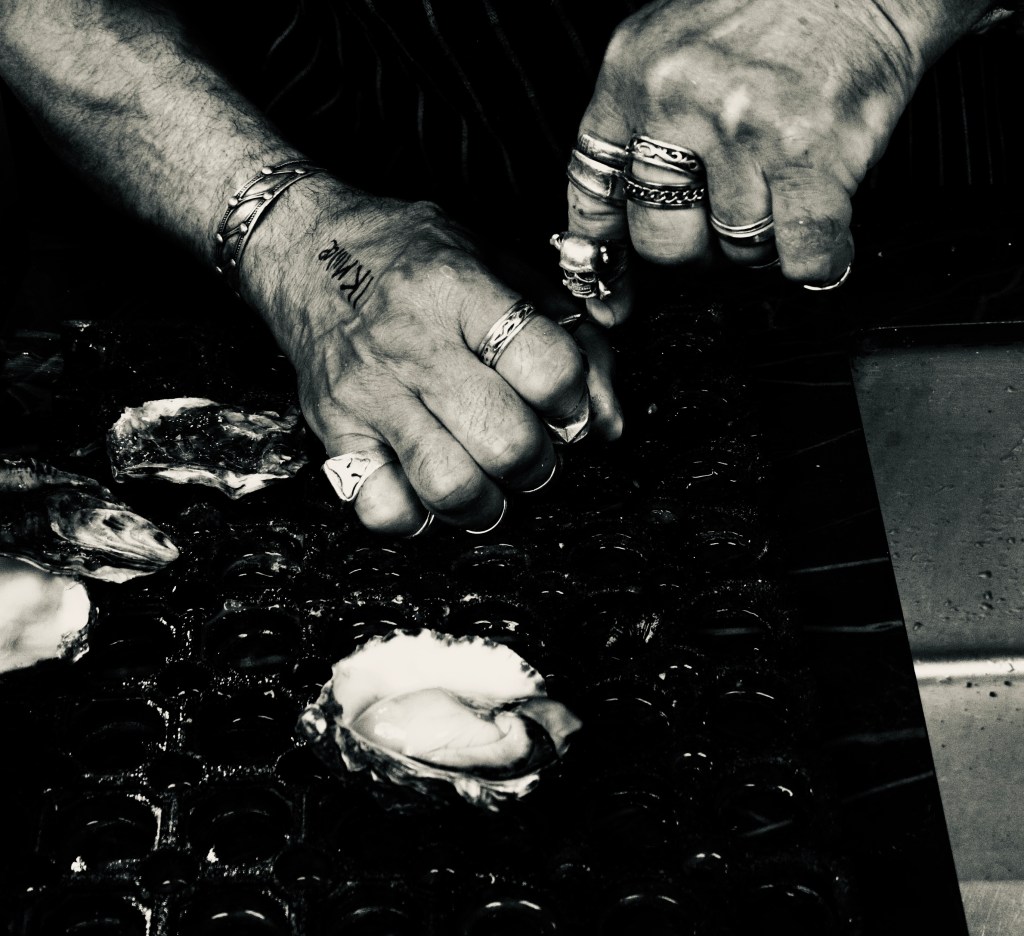
The Oyster Shucker

With that thought in mind I went for a walk in Borough Market and took the first photo that I think begins to express the sort of photographer I want to be.

Of course, after looking at it a while I thought, “That’s rather derivative of Salgado.” But that’s okay. I think that is the bus I want to be on. Let’s see where it takes me now.

Artificial Intelligence and Ethical Leadership

The warning on 30 May 2023 by industry experts that Artificial Intelligence (AI) might lead to human extinction was a sobering moment. Given this, I wondered again what are the ethical leadership challenges – relating to the protection of human rights and restoration of the environment – this new technology poses?

I started by asking a “Large Language Model” (LLM) AI system ChatGPT:

“1. Ensuring data privacy: …; 2. Promoting responsible use of AI: Leaders should ensure that AI systems are being used in a responsible way, free from bias and discrimination. 3. Developing AI systems ethically: Leaders should ensure that AI systems are developed with ethical considerations in mind, including avoiding the use of algorithms that have the potential to cause harm. 4. Addressing job displacement: ….; 5. Ensuring accountability: Leaders should ensure that AI systems are held accountable for their actions, and that any mistakes made by AI systems are addressed. 6. Encouraging responsible innovation: Leaders should encourage the responsible use of AI and the development of ethical AI systems.”

It’s okay in so far as it goes, and a bit more candid about risks associated with AI than, for example, Microsoft’s happy-clappy advertising for “Co-pilot”, the AI that it is embedding into its Office suite. This focuses on the undeniable promise of productivity that AI brings, for some
professionals at least.

But the ethical choice-making that ChatGPT asserts is so important in AI is dependent on
morality, and it is not at all clear what is the moral basis upon which AI algorithms are being
constructed.

In the April 2023 edition of the Economist, the paper noted that some AI systems “produced
strange results. Bing Chat suggested to a journalist that he should leave his wife. ChatGPT
has been accused of defamation by a law professor. LLMs produce answers that have the
patina of truth, but often contain factual errors or outright fabrications.
” I found that when I
asked ChatGPT about myself: some biographical details were correct, such as that I have
written two books, but it could not find anything close to their correct names and so just
made stuff up. I think that may be the sort of thing that Microsoft, euphemistically, calls
“usefully wrong.”

But these are trivial enough errors: they are not going to cause an existential crisis for
humanity. But, as leading experts have already warned, AI itself might yet. In April 2023 the Economist reported that, “The degree of existential risk posed by AI has been hotly debated. Experts are divided. In a survey of AI researchers carried out in 2022, 48% thought there was at least a 10% chance that AI’s impact would be “extremely bad (eg, human extinction)”. But 25% said the risk was 0%; the median researcher put the risk at 5%. … researchers worry that future AIs may have goals that do not align with those of their human creators.”

A 5% risk is not a trivial one. This sort of risk was a matter that Isaac Asimov famously pondered when he developed his laws of robotics in the 1940s. Having formulated three laws, including his first, that, “A robot may not injure a human being or, through inaction, allow a human being to come to harm.” Asimov realised, as any viewer of the movie, I Robot, will remember, that something was missing. So, he formulated his “Zeroth Law”: “A robot may not harm humanity, or, by inaction, allow humanity to come to harm.”

There is an argument that you cannot, and some would say should not, build morality into
machines.
For example, Asimov’s first law would incapacitate some of the lethal hardware
so beloved of armchair militarists. But it seems incontestable, indeed inconceivable, that
any AI should be permitted without some robust moral systems to constrain its most dangerous excesses.

There may be better moral systems to guide AI than Asimov’s laws. But if AI is trying to
break up marriages on a whim or defaming a law professor, or anyone else for that matter,
it appears that it does not yet have any moral guidance at all.

So, here’s the rub. If programmed from the outset with some key moral principles, computers will not forget to remember them, as they write increasingly advanced programs for future AI generations. However, it seems that many of the human beings initiating these AI processes have sometimes eschewed moral principles in the rush to technological advance.

This should not, perhaps, be surprising. In recent years we have seen a number of controversies in relation to the use of information technology: In the UK, for example, a group of wealthy ideologues convinced a plurality of British voters, in part through the manipulation of information systems, to vote for Brexit unconcerned with the damage it would do to the economy, to Irish peace, and to the fragile bonds that hold their own country together. Similar information manipulation was at play in the election of Donald Trump in 2016. Yet more seriously still, the manipulation of information systems was also a major factor in instigating the genocide against the Rohingya people in Myanmar that same year.

When confronted with the issues arising from these events, some of the leading industry
figures involved have proven themselves moral vacuums. And these are the people who will
be leading much of the industrial development of AI. Will they be as concerned as Asimov
was about any potential threats to humanity arising from their work?

In spite of the information industry’s warning about the risk of human extinction, I would not want to bet my life on this. The leaders of so many other industries are already overseeing an environmental collapse with no discernible concern for a future that will threaten the lives and livelihoods of their children and grandchildren. The 30 May 2023 warning of the perils of AI aside, tech leaders have so far proven themselves no more concerned with the consequences of the moral choices that they are making for their businesses. For some, the scientific innovation associated with it will be just too fascinating to eschew. Others will not be concerned with the future if they can make lots of money now.

The Economist reports that the EU is considering robust regulation on the development of
AI, and the Biden administration has started a consultation on the same thing. These are
positive moves, but no one should rest easy yet. Unsurprisingly, for a government (and
opposition) that lacks the moral courage to tell the truth about the realities of Brexit, the UK
has until now been proposing a “light touch” approach to AI regulation. This is in the hope of attracting some unregulated tech businesses to compensate somewhat for the industries that their Brexit has already devastated.

In the face of such a pusillanimous abrogation of responsibilities, ethical leaders in business
and the citizenry alike need to respond: to make different professional choices that ensure
that the preservation of life and the restoration of the environment are at the heart of their
organisational strategies, and, through protest and political engagement, to demand that
politicians do the right thing not the easy one.

Protest is, and always has been leadership. But, given the crises facing humanity currently, it
has never been so urgent. And, given the rapidity of AI’s development, the moment at which
it can be constrained by law, regulation and morality may be receding as quickly as the opportunity to stave off ecological collapse.

Caesar, by JFC Fuller

Summary: a concise biography, particularly insightful on the military aspects of Caesar’s career.

JFC Fuller was a military theorist, highly influential, in particular, on the Wehrmacht’s use of armoured warfare. However, as a man with pronounced fascist leanings he was excluded from allied military command during the Second World War.

So, instead he wrote.

Among his oeuvre then is this biography of Caesar. Perhaps Fuller was drawn to the subject because of his far-Right leanings: Mussolini also loved Caesar and thought himself his bloated successor.

Given Fuller’s professional interests there is a strong focus on the military aspects of Caesar’s career. But additional entertainment is to be had from Fuller’s waspish sense of humour: how terrible it would be, Fuller muses, if some newly discovered piece of papyrus were to suggest that one of history’s most erotic scenes – the delivery of Cleopatra to Caesar’s bedchamber in a laundry basket – was a myth? Or, discussing Caesar’s prospects in his unrealised plans to invade Parthia, Fuller reckons that Caesar would likely have been routed by the arrows of the Parthians, just as Crassus had been earlier, and Antony would be later: So the Ides of March was probably the luckiest thing that could have happened to Caesar: at least his military reputation survived.

There is an interesting duality to Caesar’s military career: throughout his life, from the Cataline conspiracy to the civil wars, Caesar showed a marked reluctance to shed Roman blood. By contrast Caesar’s conduct of the Gallic Wars, and his later campaigns in Spain, were practically genocidal in their ferocity, and they provided the slaves whose trafficking ensured Caesar’s fortune. For Caesar, it seems, like the British and French imperialists of later centuries, war was merely the logical extension of racism.

A sub theme in this book is Caesar’s relationship with Decimus Brutus, cousin of the more famous, Marcus. It was Decimus Brutus, who convinced Caesar to attend the Senate on the Ides of March. He has been a close lieutenant to Caesar during the Gallic and Civil Wars, and Caesar adopted him alongside Octavian in his will. And yet as every reader of Shakespeare will know Decimus also put a knife into Caesar on the Ides. So, it seems likely, as Robert Harris suggested in his Cicero novels, that Caesar’s last, plaintive cry, “You too, my son?” related to Decimus rather than Marcus.

Overall, not as good as Adrian Goldsworthy’s account of Caesar’s life, but not without merit.

Small Things Like These, by Claire Keegan

Summary: already a modern classic

In the middle 1980s, Bill Furlong is a fuel merchant in the town of New Ross in the South-East of Ireland. He is doing alright in difficult financial times. But on the verge of middle age, this father of five daughters is beset with the usual worries, about money, about the future of this daughters, about getting them into the good school in town. Perhaps, he feels these worries more keenly than others because, this is the only family he has, his mother having died when he was a child and never knowing his father.

In the run up to Christmas, Furlong’s work brings him all sorts of places, including to the laundry that the nuns run, where they take care of girls who have become pregnant out of wedlock. This was a fate Bill’s mother avoided because of the kindness of her employer, a Protestant woman farmer who made sure this didn’t happen.

Small Things Like These is a very small book about an enormous thing. It is a beautifully written and intensely moving story of an ordinary man in an ordinary place, finding the courage to do something properly heroic. There are books fifty times the length of this one that have less to say, less memorably.

This book is sure to achieve the status of a modern classic and justly so. It is an outstanding piece of work, utterly exquisite.

Summer Loving; and A Recipe for Love, by Nicola Yaeger

Summary: rom-coms that show us how the world can be a better place

Once, many years ago, when he was still “The Joan Collins’ Fan Club”, I went to see a performance by Julian Clary. Large chunks of his material were old jokes, deliberately chosen, and with charm and elegance he would imbue every other line with salacious double entendres. I don’t think I laughed as much that whole year… but it was Belfast in the middle of the Troubles when it rained all the time. So there was that.

I was reminded of that Julian Clary show reading Nicola Yaeger’s books: they are unashamed romantic comedies, so you know pretty much what the plot is going to be from the first page. That is the nature of romantic comedies – apart from The Love Letter: man that is the bleakest romantic comedy I have ever sat through. Don’t watch it if you are feeling fragile. Try something more light-hearted like Calvary instead.

Because sometimes the joyful assurance of the romantic comedy is exactly what you need: when I worked in Angola during the civil war there I used to hire a pile of romantic comedy movies every weekend just to have something to remind me that there were kinder places and people than the warlords who plagued one of the most beautiful countries on earth.

But I digress. Much as Ms Yaeger occasionally does in her wonderfully entertaining books. Read these and you’ll learn about art, Eastern European tall tales, surfing, and cooking in such a way as to make you want to book a surfing lesson or buy a new book about French cuisine.

Nicola Yaeger is a charming and extremely funny writer, the sort who rarely bothers with the double bit of the entendre. Like Julian Clary at his best, like all of literature if we are being honest, she retells old stories in elegant, new ways, reminding us there are kinder places and people out there, people who will make you laugh and care about your well-being.

In a world full of complete feckers who are busy brexiting up our fragile planet for all they are worth, it is good to be reminded of this sometimes. And Nicola Yeager does that in glorious fashion.