Finding the Telling Detail: Understanding a Photograph, by John Berger; On Photography, and Regarding the Pain of Others, by Susan Sontag.

Summary: on trying to learn how to take a photograph

In 2004, the Finnish-American photographer, Arno Minkkinen, presented to the world his Helsinki Bus Station Theory of Photography. In summary, he argued that just as all the buses from the Helsinki bus terminal stop at the same first three stops before going to wildly different places, that the work of any photographer, over the first three years of their career, is going to be derivative of the work of somebody else. This is irrespective of what genre the photographer chooses to specialise in, from nudes to landscape to war photography: somebody will have been there before. Originality only emerges after persistence and practice over years. Or, as Minkkinen put it, if you “stay on the fucking bus,” rather than give up as soon as you recognise who your work is aping.

That is all well and good if you know which bus you want to get on in the first place. That is why people read Susan Sontag and John Berger: to work out what sort of photographer they want to be.

For me, John Berger provided an initial inspiration with his observation that some photographers work with “emancipatory” intent. After half of my professional career in humanitarian response and development, and the other half in human rights and anti-slavery work, this idea struck a chord with me, but still left me short of ideas of how to proceed.

Sontag’s photography books, paradoxically lacking any photographs, are not short of ideas. She writes of the philosophy of photography and photographers. Both of her books are enormously rich and challenging affairs. In particular, I found that On Photography required more than one reading to come anywhere close to fully appreciating the depth of her thought on the subject. Regarding the Pain of Others, perhaps because I have some experience of living and working in war zones, perhaps because I had read On Photography first, I found much more accessible.

Photography, Sontag observes, like sex, cooking and dancing, is a democratic art form that anyone can participate in. But just because anyone can press a button does not mean that anyone can take a good photograph. So, Sontag explores why some photographers not only take good photographs but take photos that are sometimes deemed worthy of putting in a museum.

And, there appear to be as many answers to this question as there are such photographers. Nadar reckoned the best portraits he took were of people he knew. Avedon reckoned his best portraits were of people he did not know. Cartier-Bresson reckoned you should think before and after taking a photograph, but definitely not during.

That successful photographers work to such diverse, sometimes mutually exclusive, ideas is one of the paradoxes of good photography. Perhaps I found an explanation from Berger’s own reflections on Sontag, “The camera saves a set of appearances from the otherwise supersession of further appearances…before the invention of the camera nothing could do this, except in the mind’s eye, the faculty of memory.”

So, perhaps what makes a photographer good is when they learn to capture with the camera that which they would wish to remember, or perhaps wish others to remember.

That gave me an idea.

One of my first experiences working in Africa was a visit to a poor neighbourhood in Addis Ababa, Kebele 37. Amidst the open sewers and crumbling mud houses densely packed together amidst a warren of streets I saw that someone had planted a geranium outside their door, in a salvaged cooking oil tin from a food distribution. There was something about that telling detail which seemed to me to encapsulate the indomitability of humanity, even in the midst of such dire poverty.

As a student of photography, that is the sort of image – the telling detail – that I want to capture, to emancipatory purpose when I can.

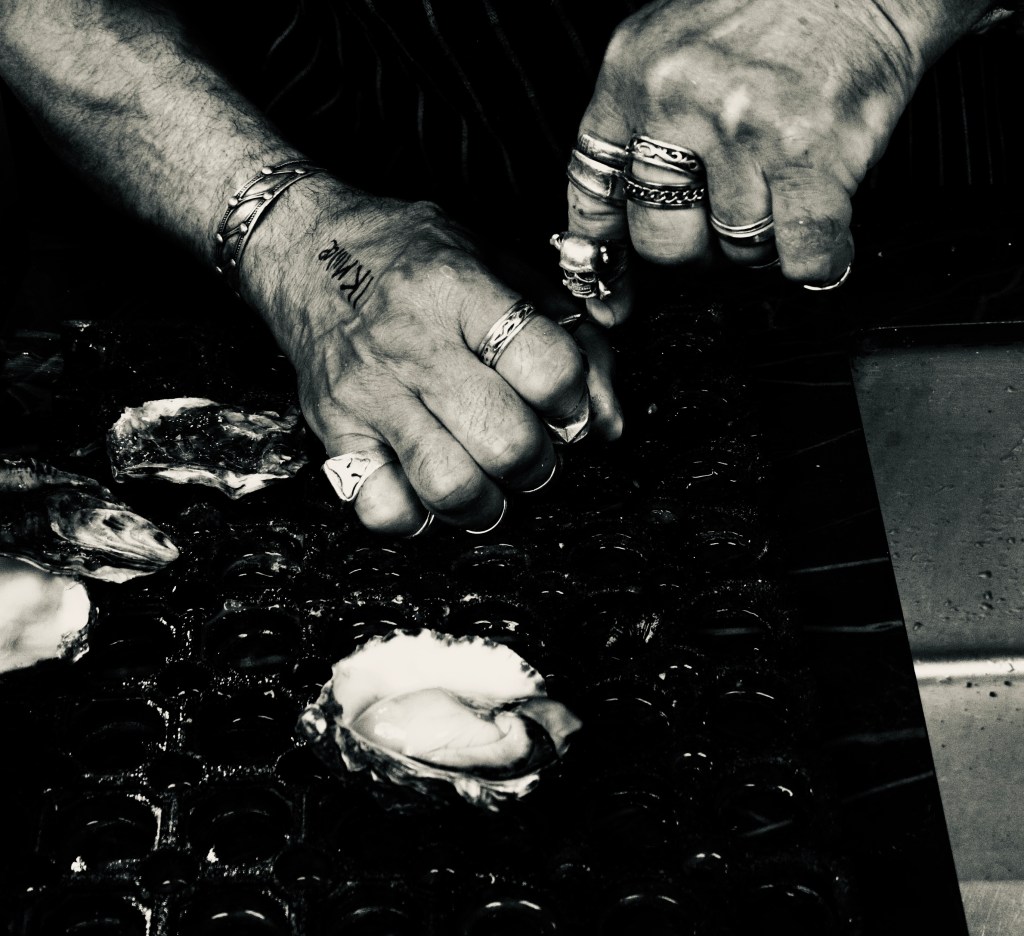
The Oyster Shucker

With that thought in mind I went for a walk in Borough Market and took the first photo that I think begins to express the sort of photographer I want to be.

Of course, after looking at it a while I thought, “That’s rather derivative of Salgado.” But that’s okay. I think that is the bus I want to be on. Let’s see where it takes me now.

Artificial Intelligence and Ethical Leadership

The warning on 30 May 2023 by industry experts that Artificial Intelligence (AI) might lead to human extinction was a sobering moment. Given this, I wondered again what are the ethical leadership challenges – relating to the protection of human rights and restoration of the environment – this new technology poses?

I started by asking a “Large Language Model” (LLM) AI system ChatGPT:

“1. Ensuring data privacy: …; 2. Promoting responsible use of AI: Leaders should ensure that AI systems are being used in a responsible way, free from bias and discrimination. 3. Developing AI systems ethically: Leaders should ensure that AI systems are developed with ethical considerations in mind, including avoiding the use of algorithms that have the potential to cause harm. 4. Addressing job displacement: ….; 5. Ensuring accountability: Leaders should ensure that AI systems are held accountable for their actions, and that any mistakes made by AI systems are addressed. 6. Encouraging responsible innovation: Leaders should encourage the responsible use of AI and the development of ethical AI systems.”

It’s okay in so far as it goes, and a bit more candid about risks associated with AI than, for example, Microsoft’s happy-clappy advertising for “Co-pilot”, the AI that it is embedding into its Office suite. This focuses on the undeniable promise of productivity that AI brings, for some
professionals at least.

But the ethical choice-making that ChatGPT asserts is so important in AI is dependent on
morality, and it is not at all clear what is the moral basis upon which AI algorithms are being
constructed.

In the April 2023 edition of the Economist, the paper noted that some AI systems “produced
strange results. Bing Chat suggested to a journalist that he should leave his wife. ChatGPT
has been accused of defamation by a law professor. LLMs produce answers that have the
patina of truth, but often contain factual errors or outright fabrications.
” I found that when I
asked ChatGPT about myself: some biographical details were correct, such as that I have
written two books, but it could not find anything close to their correct names and so just
made stuff up. I think that may be the sort of thing that Microsoft, euphemistically, calls
“usefully wrong.”

But these are trivial enough errors: they are not going to cause an existential crisis for
humanity. But, as leading experts have already warned, AI itself might yet. In April 2023 the Economist reported that, “The degree of existential risk posed by AI has been hotly debated. Experts are divided. In a survey of AI researchers carried out in 2022, 48% thought there was at least a 10% chance that AI’s impact would be “extremely bad (eg, human extinction)”. But 25% said the risk was 0%; the median researcher put the risk at 5%. … researchers worry that future AIs may have goals that do not align with those of their human creators.”

A 5% risk is not a trivial one. This sort of risk was a matter that Isaac Asimov famously pondered when he developed his laws of robotics in the 1940s. Having formulated three laws, including his first, that, “A robot may not injure a human being or, through inaction, allow a human being to come to harm.” Asimov realised, as any viewer of the movie, I Robot, will remember, that something was missing. So, he formulated his “Zeroth Law”: “A robot may not harm humanity, or, by inaction, allow humanity to come to harm.”

There is an argument that you cannot, and some would say should not, build morality into
machines.
For example, Asimov’s first law would incapacitate some of the lethal hardware
so beloved of armchair militarists. But it seems incontestable, indeed inconceivable, that
any AI should be permitted without some robust moral systems to constrain its most dangerous excesses.

There may be better moral systems to guide AI than Asimov’s laws. But if AI is trying to
break up marriages on a whim or defaming a law professor, or anyone else for that matter,
it appears that it does not yet have any moral guidance at all.

So, here’s the rub. If programmed from the outset with some key moral principles, computers will not forget to remember them, as they write increasingly advanced programs for future AI generations. However, it seems that many of the human beings initiating these AI processes have sometimes eschewed moral principles in the rush to technological advance.

This should not, perhaps, be surprising. In recent years we have seen a number of controversies in relation to the use of information technology: In the UK, for example, a group of wealthy ideologues convinced a plurality of British voters, in part through the manipulation of information systems, to vote for Brexit unconcerned with the damage it would do to the economy, to Irish peace, and to the fragile bonds that hold their own country together. Similar information manipulation was at play in the election of Donald Trump in 2016. Yet more seriously still, the manipulation of information systems was also a major factor in instigating the genocide against the Rohingya people in Myanmar that same year.

When confronted with the issues arising from these events, some of the leading industry
figures involved have proven themselves moral vacuums. And these are the people who will
be leading much of the industrial development of AI. Will they be as concerned as Asimov
was about any potential threats to humanity arising from their work?

In spite of the information industry’s warning about the risk of human extinction, I would not want to bet my life on this. The leaders of so many other industries are already overseeing an environmental collapse with no discernible concern for a future that will threaten the lives and livelihoods of their children and grandchildren. The 30 May 2023 warning of the perils of AI aside, tech leaders have so far proven themselves no more concerned with the consequences of the moral choices that they are making for their businesses. For some, the scientific innovation associated with it will be just too fascinating to eschew. Others will not be concerned with the future if they can make lots of money now.

The Economist reports that the EU is considering robust regulation on the development of
AI, and the Biden administration has started a consultation on the same thing. These are
positive moves, but no one should rest easy yet. Unsurprisingly, for a government (and
opposition) that lacks the moral courage to tell the truth about the realities of Brexit, the UK
has until now been proposing a “light touch” approach to AI regulation. This is in the hope of attracting some unregulated tech businesses to compensate somewhat for the industries that their Brexit has already devastated.

In the face of such a pusillanimous abrogation of responsibilities, ethical leaders in business
and the citizenry alike need to respond: to make different professional choices that ensure
that the preservation of life and the restoration of the environment are at the heart of their
organisational strategies, and, through protest and political engagement, to demand that
politicians do the right thing not the easy one.

Protest is, and always has been leadership. But, given the crises facing humanity currently, it
has never been so urgent. And, given the rapidity of AI’s development, the moment at which
it can be constrained by law, regulation and morality may be receding as quickly as the opportunity to stave off ecological collapse.

Caesar, by JFC Fuller

Summary: a concise biography, particularly insightful on the military aspects of Caesar’s career.

JFC Fuller was a military theorist, highly influential, in particular, on the Wehrmacht’s use of armoured warfare. However, as a man with pronounced fascist leanings he was excluded from allied military command during the Second World War.

So, instead he wrote.

Among his oeuvre then is this biography of Caesar. Perhaps Fuller was drawn to the subject because of his far-Right leanings: Mussolini also loved Caesar and thought himself his bloated successor.

Given Fuller’s professional interests there is a strong focus on the military aspects of Caesar’s career. But additional entertainment is to be had from Fuller’s waspish sense of humour: how terrible it would be, Fuller muses, if some newly discovered piece of papyrus were to suggest that one of history’s most erotic scenes – the delivery of Cleopatra to Caesar’s bedchamber in a laundry basket – was a myth? Or, discussing Caesar’s prospects in his unrealised plans to invade Parthia, Fuller reckons that Caesar would likely have been routed by the arrows of the Parthians, just as Crassus had been earlier, and Antony would be later: So the Ides of March was probably the luckiest thing that could have happened to Caesar: at least his military reputation survived.

There is an interesting duality to Caesar’s military career: throughout his life, from the Cataline conspiracy to the civil wars, Caesar showed a marked reluctance to shed Roman blood. By contrast Caesar’s conduct of the Gallic Wars, and his later campaigns in Spain, were practically genocidal in their ferocity, and they provided the slaves whose trafficking ensured Caesar’s fortune. For Caesar, it seems, like the British and French imperialists of later centuries, war was merely the logical extension of racism.

A sub theme in this book is Caesar’s relationship with Decimus Brutus, cousin of the more famous, Marcus. It was Decimus Brutus, who convinced Caesar to attend the Senate on the Ides of March. He has been a close lieutenant to Caesar during the Gallic and Civil Wars, and Caesar adopted him alongside Octavian in his will. And yet as every reader of Shakespeare will know Decimus also put a knife into Caesar on the Ides. So, it seems likely, as Robert Harris suggested in his Cicero novels, that Caesar’s last, plaintive cry, “You too, my son?” related to Decimus rather than Marcus.

Overall, not as good as Adrian Goldsworthy’s account of Caesar’s life, but not without merit.

Small Things Like These, by Claire Keegan

Summary: already a modern classic

In the middle 1980s, Bill Furlong is a fuel merchant in the town of New Ross in the South-East of Ireland. He is doing alright in difficult financial times. But on the verge of middle age, this father of five daughters is beset with the usual worries, about money, about the future of this daughters, about getting them into the good school in town. Perhaps, he feels these worries more keenly than others because, this is the only family he has, his mother having died when he was a child and never knowing his father.

In the run up to Christmas, Furlong’s work brings him all sorts of places, including to the laundry that the nuns run, where they take care of girls who have become pregnant out of wedlock. This was a fate Bill’s mother avoided because of the kindness of her employer, a Protestant woman farmer who made sure this didn’t happen.

Small Things Like These is a very small book about an enormous thing. It is a beautifully written and intensely moving story of an ordinary man in an ordinary place, finding the courage to do something properly heroic. There are books fifty times the length of this one that have less to say, less memorably.

This book is sure to achieve the status of a modern classic and justly so. It is an outstanding piece of work, utterly exquisite.

Summer Loving; and A Recipe for Love, by Nicola Yaeger

Summary: rom-coms that show us how the world can be a better place

Once, many years ago, when he was still “The Joan Collins’ Fan Club”, I went to see a performance by Julian Clary. Large chunks of his material were old jokes, deliberately chosen, and with charm and elegance he would imbue every other line with salacious double entendres. I don’t think I laughed as much that whole year… but it was Belfast in the middle of the Troubles when it rained all the time. So there was that.

I was reminded of that Julian Clary show reading Nicola Yaeger’s books: they are unashamed romantic comedies, so you know pretty much what the plot is going to be from the first page. That is the nature of romantic comedies – apart from The Love Letter: man that is the bleakest romantic comedy I have ever sat through. Don’t watch it if you are feeling fragile. Try something more light-hearted like Calvary instead.

Because sometimes the joyful assurance of the romantic comedy is exactly what you need: when I worked in Angola during the civil war there I used to hire a pile of romantic comedy movies every weekend just to have something to remind me that there were kinder places and people than the warlords who plagued one of the most beautiful countries on earth.

But I digress. Much as Ms Yaeger occasionally does in her wonderfully entertaining books. Read these and you’ll learn about art, Eastern European tall tales, surfing, and cooking in such a way as to make you want to book a surfing lesson or buy a new book about French cuisine.

Nicola Yaeger is a charming and extremely funny writer, the sort who rarely bothers with the double bit of the entendre. Like Julian Clary at his best, like all of literature if we are being honest, she retells old stories in elegant, new ways, reminding us there are kinder places and people out there, people who will make you laugh and care about your well-being.

In a world full of complete feckers who are busy brexiting up our fragile planet for all they are worth, it is good to be reminded of this sometimes. And Nicola Yeager does that in glorious fashion.

Some stocktaking, part 2

Summary: not dead yet

Last year, about 12 months into the lockdown, I thought it would be a good idea to make a note of what I had done to see what it amounted to. Thought it would be a good idea to do the same again as 2022 turns to autumn. So:

1. Finished reading Don Quixote.

2. Wrote another bundle of expert reports on trafficking cases. One (at least) helped force a reverse in the UK’s unjust decision to deport a survivor of slavery.

3. Conducted virtual evaluations of three projects in Myanmar and left in awe of the extraordinary courage of local civil society’s efforts to mitigate the consequences of the military’s brutal onslaught on the country’s ordinary people.

4. Edited a special edition on the Journal of Modern Slavery on slavery in humanitarian crises, with an introductory essay entitled, Older than Troy

5. Read Chimamanda Ngozi Adichie mighty novel of the war in Biafra, Half of a Yellow Sun. Think it might actually be better than War and Peace.

6. Finished writing and published my book, Ethical Leadership: moral decision making under pressure

7. Wrote an article for Open Democracy identifying the UK’s plan to deport migrants to Rwanda as a crime against humanity.

8. In aid of Children in Crossfire, I did my first 10k in years, around Kew Gardens, very badly.

9. Delivered a couple of public lectures in the great city of Belfast, including one at the legendary First Church in Rosemary Street.

10. Managed to go for a swim in Margate. Don’t think I will try that again until the British government decides that dumping raw sewage into the sea is not really much of a Brexit benefit.

11. Read Apeirogon, by Colum McCann, a desperately sad but inspiring perspective on the struggle against apartheid in Israel.

12. Completed a first draft of my second novel, Some Service to the State, about the repercussions from an enquiry into the fate of a missing girl in a newly partitioned Ireland. Started looking for a publisher.

Apeirogon, by Colum McCann

Summary: a desperately sad but hopeful perspective on Israeli Apartheid and the illegal occupation of Palestine

Rami Ethanan, a graphic designer, and Bassam Aramin, a scholar, are friends. They have a lot in common. Both are smokers. Both are former combatants. Both understand the deep, moral corrosiveness of the Israeli occupation of the Palestinian territories. Both understand that peace requires people to talk to each other and try to understand each other’s point of view. Both are the fathers of murdered children: Rami’s daughter, Smadar, was murdered by Palestinian suicide bombers; Bassam’s daughter, Abir, was murdered by Israeli soldiers.

Apeirogon is the story of how, in particular, these two men have sought to advocate for peace by building mutual understanding. But it ranges even more widely, into the lives of their families, including their murdered daughters, and into the cultural and political history of Israel and Palestine.

(From the Guardian)

I finished this book just before Israel launched its latest series of child-killing attacks on Gaza. As usual, in such situations, American politicians are to be found on social media congratulating themselves for the US military support to Israel that allows its leadership to launch such attacks on Gaza with impunity. Such politicians find the slaughter of children with rockets, and American journalists with bullets, much more palatable than the murder of children by suicide bombers. But that is the logic of the US’s military alliance with what the Israeli human rights organisation, B’Tselem, has called an apartheid state.

The asymmetric nature of the warfare between Israelis and Palestinians is very much on display with the latest Israeli attack on Gaza. In prison, for throwing a dud grenade at an Israeli patrol, Bassam realised that responding to Israeli violence with violence, even if only stones, plays into the hands of those who want to sustain the occupation: it allows them to portray Israeli violence and theft as defensive, and the Palestinians as less than human. As a result of this realisation Bassam became committed to the ideal of non-violence.

Rami, recognising the common humanity of Palestinian and Israeli families who had suffered similar losses to his own, came to his own realisation that the status quo offered no real security for Israelis either. His wife, Nurit, a distinguished academic and peace activist, had understood this much earlier: with enormous courage she explicitly and publicly blamed the racist and militaristic policies of Israeli Prime Minister Benjamin Netanyahu for the death of her daughter.

Apeirogon reminds us that as well as the meat-headed terrorists in the high echelons of government and the military, Israel and Palestine also have thousands of people like Rami and Bassam: people committed to non-violence, human rights and dialogue as a path towards justice.

For success such activists need international support. Yet the US and Europe fail utterly to do this, privileging Israel with arms and trade rather than compelling the dialogue that is essential for any meaningful peace to be forged.

Apeirogon is an extraordinarily important book. It is a tribute to the thousands of (asymmetrically) marginalised Palestinians and Israelis who have sought to build peace and fraternity through dialogue and understanding rather than acquiesce in violence. How many more children will be slaughtered before their path is recognised as the only truly viable one?

Photo by Sarah Lee for the Guardian

The Western Canon, by Harold Bloom

Summary: literature as a means to feud

The American academic Wallace Stanley Sayne once allegedly said that, “Academic politics is the most vicious and bitter form of politics because the stakes are so low.”

Harold Bloom, in The Western Canon, seems to take this observation as a platonic ideal for his writing. So, more than literature, the principle focus of this book is other academics and why they are wrong. All of them. Every one who has ever tried to interrogate a text from an alternative theoretic position, from Marxism to feminism to old fashioned conservatism. They are all wrong.

The only basis for engaging with literature, according to Bloom, is in its own terms. But it is not at all clear that this is the basis upon which Bloom discusses the literature that his book focusses upon. Rather there is a cod-psychological theme running through the text relating to the angst with which writers engage with their antecedents. It should not be a surprise then that Freud is dragged into Bloom’s canon but Yeats, who would perhaps not provide as much grist to Bloom’s psychic hobby horse, is not.

This, and his tiresome sniping aside, Bloom’s book is an entertaining one. At its best he shows how Western literature resonates across the centuries. For example, he shows how the character of Beatrice from Dante’s Divine Comedy is perhaps an inspiration for Dulcinea del Toboso in Don Quixote. (Bloom is notably silent, however, on the possibility of “non-Western influences” on Western literature. Part one of Don Quixote, for example, with its structure composed of stories within stories, is particularly reminiscent of the great “Eastern” work, The Thousand and One Nights.) And he shows how Chaucer echoes in Shakespeare and then Shakespeare in everything else.

Bloom loves Shakespeare, and has been seduced by his selfish little anti-hero, Hamlet, forgiving him the trail of carnage that he leaves in his incompetent revolutionary wake because of his eloquent reflections and acute psychological insights.

It is difficult to argue with the idea that Shakespeare is fundamental to the Western canon, and much of the rest of world literature. This book led me to reflect again on the assertion of an army colleague of George McDonald Frazer, reported in his memoir of the war in Burma, Quartered Safe Out Here, that Shakespeare must have been a soldier during his “lost years.” Not only does Shakespeare describe camp life so well, but his appreciations of the machinations of power, of the contempt with which the dreamy prince can treat the lives of others, and the brutality with which the best laid plans can be disrupted by bad luck, does suggest the sensibility of the poor bloody infantry.

Literature should not be, in Bloom’s view, a way to help the reader empathise with the lives of others, something that seems to me a prime function. So, he is dismissive of how some universities teach the likes of Alice Walker for “political reasons” to the exclusion of some authors whose “strangeness” – Bloom’s standard for inclusion into the “canon” – he values more highly.

But Bloom at least acknowledges that the “canon” is evolving, and new literature still grows powerfully out of the old. If he was around today he would certainly recognise that a book like Half of a Yellow Sun carries the strong influence of War and Peace. But I also am sure he would be quite appalled with the notion of someone like me saying that Adichie’s book might be better than Tolstoy’s, and that part of its wonderful strangeness comes from expanding the mental world of the reader sufficiently to make us empathise with the dreadful plight of young Africans caught up in brutal war.

Lonesome Dove, by Larry McMurtry

Summary: A sort of American Don Quixote with less philosophical substance and more genocide

Woodrow Call and Gus McCrae, two retired Texas Rangers decide to take a herd of cattle from Texas to the north west, for no good reason other than they’re bored in a way that can only be alleviated by the risking of their own lives and those of others. On the way they cross paths with thieves, murderers, and impoverished and defeated Native Americans.

Obituaries of Larry McMurtry noted his admiration for Don Quixote, and this shows, superficially at least. Lonesome Dove is also about two characters wandering the countryside talking nonsense, though the meanderings of Gus and Call are considerably more sanguinary than those of Sancho and Quixote.

Lonesome Dove is a beloved novel and a Pulitzer-prize winner. But unlike Don Quixote, there seemed to me little beyond the bickering. McMurtry himself was reported to have lamented the impact of the book, hoping to have written about “a harsh time and some pretty harsh people, but, to the public at large, I had produced something nearer to an idealization… a kind of Gone With The Wind of the West”… which makes me like McMurtry rather more than his book, which is itself way better than Margaret Mitchell’s vile pro-slavery porn.

But whatever my reservations, Lonesome Dove is certainly an entertaining tome, its brutal characters not without charm or humour, and filled with some exciting moments of violence and with brilliant dialogue throughout.

My most read blogs of 2021

Summary: from Irish history to Indian civil rights struggles with a bit of Brexit along the way (all linked to the articles themselves for your reading comfort)

1. What a Bloody Awful Country: Northern Ireland’s Century of Division, by Kevin Meagher

2. “Stop and we’ll fight them”: Collins’ tactics at Beal na mBlath

3. The Silence of the Girls, by Pat Barker

4. Embracing Brexit”, and other nonsense from UK Labour’s leadership

5. The Doctor and the Saint: Arundhati Roy’s introduction to B R Ambedkar’s Annihilation of Caste