Barbarians at the Gate: reflections on the UK and European Union at the abyss

Many years ago I watched a documentary about the life and work of the campaigning American journalist I F Stone. Stone was for his whole life a fighter for justice and a fierce critic of the excesses of his own government, such as its encroachment on civil liberties, its systemic racism, and its illegal invasion of Vietnam.

And yet, when asked towards the end of the film what his overall judgement of his country was, Stone said something I found striking: he said, in effect, that he regarded the American Republic as one of the great flowerings of civilisation, comparable to Athens in the Golden Age.
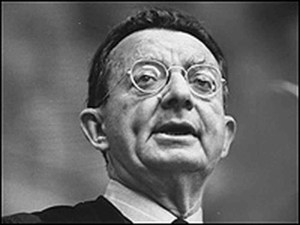
I F Stone

It was a carefully chosen analogy: Stone was also a classical scholar and author of The Death of Socrates. The Athens he contemplated would have been a warts-and-all one, constructed on the injustice of slavery and the subjugation of women, and party, on much too frequent occasion, to war crimes and mob-rule.

And yet in the midst of all this there were new ideas emerging in philosophy, science and the arts, and new politics, in one of the first human stirrings of democracy.

The United States’s bears similar scars to ancient Athens, it’s history marked by slavery and appalling racial prejudice, and by illegal war from Mexico and Nicaragua, to Vietnam and Iraq. But it is also the nation of Abraham Lincoln and Bobby Kennedy, of Harriet Tubman, Martin King and Dorothy Day. It was the country which in the 19th Century showed that democracy was a robust and viable system even in the face of dreadful civil war, and which has produced, like Athens, some of the greatest achievements of the age in science and art.

If it has a rival in the 21st century then I would argue it is the much younger European Union. Like the United States and Athens before it, and every human institution or undertaking before or since, Europe is a flawed, human project. In recent years we have seen one of its most abject failings in its fragmented and often craven efforts to establish a coherent and effective humanitarian policy in response to the refugee crisis in the Mediterranean.

And yet: the European Union represents as vital a political project as the United States. It too represents one of the great flowerings of human civilisation. It has brought enduring peace to a continent that has hitherto been scarred over the centuries by fratricidal war. It is an effort by democratic nations to work together on matters of common interest underpinned by the the principles of human rights, democracy and rule of law. That is a project that is rare in human history and rare in the contemporary world. It is also something that is essential to face the political, environmental, humanitarian and human rights challenges of this fragile and interconnected world. So, for all its flaws, this is a project that is worth fighting for, not running away from in search of some mythic past.
image

Jo Cox

As Jo Cox noted in her maiden speech to Parliament, migration, including the free movement of EU citizens amongst our member states, has immeasurably enhanced the communities and societies that have benefited from it, through a vibrant diversity in food, music and arts as well as business and commerce.

But this cosmopolitan vision of Europe is anathema to some who instead cling to the same nasty rhetoric that was once used to justify colonialism, but which now is put in the service of a poisonous xenophobic populism. This seeks to convince the electorate that the EU and migrants are to blame for social ills that have been the result of domestic policies and failures in government, sometimes perpetrated by the very people scapegoating others

History shows us that such rhetoric can open an abyss, which the UK descended into on the streets of Birstall on 16th June 2016. The assertions which followed rapidly from those pedalling intolerance, that the brutal assassination of Jo Cox had nothing to do with them, still ring hollow.

Jo Cox understood that the European Union, with all its human flaws and imperfections as well as its enormous potential and aspiration, was worth fighting for. And in the months and years following the awful, bloody UK referendum campaign the fate of the UK and the EU itself still seems to hang in the balance as incompetents and charlatans such as Boris Johnson and Jacob Rees-Mogg are treated like perspicacious philosopher-princes by the BBC and other pusillanimous media.

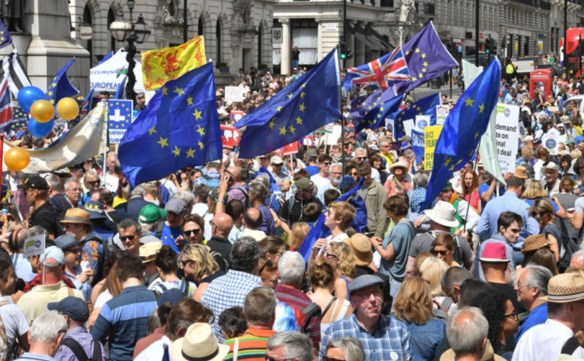
The decency that Jo Cox embodied has not been crushed by the narrow victory in the Brexit referendum of a coalition of racists, delusional imperial nostalgists, disaster capitalists, useful idiots of the Left, and a misled section of the populace. It continues to reassert itself, notably on the streets of London and Belfast on 20th Oct 2018.

Both the UK government, and their tame opposition under Jeremy Corbyn, seem intent on ignoring this demonstration of disgust for their policies by so many people. Instead they seem committed to their process that will eliminate the human and citizens’ rights of tens of millions of people and reek economic devastation in the name of their delusional dreams of Brexit. But they should be careful.

The people of India under Gandhi and Nehru, the African American community of the United States under Martin King, the nationalists of the North of Ireland under Hume and Mallon, showed that ultimately a determined people will, through non-violence, shape the political agenda. And when pan-European progressives achieve that in the UK, as they will, May, Corbyn, their acolytes and their clowns, will all be consigned to the dustbin of history.
178D02E0-0E07-4796-B85E-A0741D10C8B2.jpeg

People’s Vote March, London, 20th Oct 2018


Less certain than death: corporation tax in the modern world

Originally published in Business Fights Poverty:

http://community.businessfightspoverty.org/profiles/blogs/dr-aidan-mcquade-less-certain-than-death-corporation-tax-in-the-m

In the wake of the recent controversies that have been sparked since the announcement of Google’s US $ 130 million settlement with Her Majesty’s Revenue and Customs, it is worth contemplating, of all things, a few interrelated issues of political and moral philosophy; I find they can often help cut through the bluster.

Milton Friedman once declared that the only moral responsibility of business executives was to maximise profits for shareholders within the law.

Friedman was many things, including a brilliant and accessible writer, although many, myself included, would argue, a deeply simplistic one. Even Ronald Reagan was able to grasp the central tenets of his political economics.

We still live in a world crafted by the economic beliefs of Reagan and, in particular, of Margaret Thatcher, which drew deeply on many of Friedman’s core ideas. One consequence was that his view of the ethical responsibilities of business executives has become the dominant moral code amongst business executives across the world.

A further consequence is that many corporate executives see it as a moral responsibility to minimise the tax that their company pays. It is important to understand this as politicians fulminate ineffectually about the “unethical” nature of legal company tax avoidance: that there is a counter-narrative amongst many business people, which asserts that they are doing the right thing, the moral thing, for their shareholders by minimising, or even avoiding, tax.

scrooge mcducI don’t agree with this perspective but my opinion will make little difference when weighed against the vast piles of loot that wholly legal tax avoidance could deliver. In any event that shouldn’t matter. The potential for tension and conflicts between competing moral philosophies was something which Adam Smith already anticipated in The Wealth of Nations (1776) when he argued that it was the state’s responsibility to regulate businesses: how companies can be made to make fair tax contributions is among the most pressing issues of business regulation today.


Certainly this is now a far more complicated issue than it was in Smith’s day as trade is significantly more international. But it is a challenge that must be confronted through extraterritorial law and, perhaps, new tax collection mechanisms, such as those mooted by Nigel Lawson, and the long overdue Robin Hood tax.  New approaches are vital if there is to be any significant progress towards tax justice, greater economic fairness amongst small, medium and large businesses and a balancing of public finances.

This is an issue where the European Union could demonstrate its worth by offering the prize of continued access to EU markets across the entire member states only to those corporations that agree to abide by more transparent and just rules of taxation.

Paradoxically, to get to a position where politicians would be prepared to move on such a project will probably require quite a few more businesses, particularly those who are arguably disadvantaged by not being able to take such a flexible view of where they should be taxed as their giant competitors, demanding such action. Today, very few politicians are prepared to contemplate any significant changes to the globalising political economy without the imprimatur of at least some parts of the business community.

The Dark Side of the Force: Human agency and human belief

 Much of the Star Wars universe is brilliantly executed fantasy. Some of it – think ewoks and bleeding Jar Jar fecking Binks – is execrable. But in the midst of all of this there is at least one important philosophical point: Obi Wan and Vader follow the same religion. The only difference is that Vader’s path is on the “Dark Side”.

Many belief systems have similar “Dark” and “Light” sides. An atheist, for example, can follow the “Light Side” by viewing life as something she had better do right because she will only get one shot at this. Or she can decide that she can do what she likes, given that there are no immortal consequences for even the worst of actions.

Similarly a Christian could follow the “Light” by seeing each of us a human beings in the image of God in spite of our flaws and differences. Or he could take to judging how poorly everyone else appears against his subjective standards and inflicting his notion of righteous vengeance at every opportunity.

Martha Nussbaum, in The Fragility of Goodness, argues that humans often do evil not because they transgress a moral system, but because they privilege one moral system, or perhaps a particular interpretation of a moral system, over another. Christopher Browning demonstrates the depth of depravity that can emerge from such thinking when one group of “Ordinary Men” in Eastern Poland during the Second World War decided to uphold their perceived duties to their Furher over their more fundamental human duties not to butcher unarmed children, women and men in cold blood.

But, in spite of the power of well demonstrated social pressures in such circumstances, human agency, the choices we make based on our beliefs and values, is still at the core of human action. A person can still choose to be a decent person in spite of the social pressures to the contrary. Or, indeed in spite of their underlying belief system: two of the great “rescuers” of the Second World War, Oskar Schindler and John Rabe, were both card-carrying Nazis. So decency, even heroism, does not depend simply on the belief system that we choose. It also depends on how we choose to interpret it.

I have known great and humane atheists. I have known great and humane Christians, Hindus, Muslims, Jews and Buddists. I have also known one person who used their noisy public commitment to vital human rights issues as a cloak to disguise the immense depth of their moral cowardice and venality. And then there are the murderous Crusaders of history, the Nazis, the Maoists and Stalinists, the Klan and their ideological cousins in Islamic State – those who use their beliefs as excuses to choose the darkest and bloodiest paths through life.

the light side

The “Light Side”

Richard Dawkins and his fellow travellers like to blame religion for so many of the world’s ills. But the sprawling silliness of Star Wars, and the mythical universe that it has created, has hit upon a much wiser understanding of human nature. As Shakespeare, the great chronicler of human folly and human evil, also understood: the faults are in ourselves.