The Cut Throat Trial, by the Secret Barrister

Summary: One of these suspects is not like the others …

As aficionados of Rumpole will know, a “cut-throat” trial is one in which co-defendants turn on each other. That is the heart of this novel about three boys accused of murder — a case that also involves a victim nearly decapitated, so there is that sort of throat-cutting too.

This is the first foray into fiction by the Secret Barrister. It is told from multiple perspectives: a defense and the prosecution barrister, the judge, and two of the defendants. Each voice feels distinct, a technical feat that lends the narrative both texture and credibility.

As in their non-fiction, the Secret Barrister’s abiding concerns with the state of the law, society, and the criminal justice system in England and Wales permeate every chapter. Like Wendy Joseph’s Unlawful Killings, it exposes the squalid tragedies of murder committed by children.

Yet for all its artistic achievement and political undercurrent, this is first and foremost a courtroom thriller — and it is a cracking one. It takes a staple of English literature, the red-herring-strewn cosy murder mystery, and serves it up American-hard-boiled. Gone are the familiar comforts of Agatha Christie and the nostalgia-fests of Richard Osman. Instead, we are in a world where the streets are mean, knives wound horrifically, killing is messy, dying is sore, cops and lawyers are flawed, defendants are pathetic, and justice is too often elusive.

By refusing to flinch from the grotesque realities of murder, the Secret Barrister has produced a novel several cuts above much contemporary English crime fiction, and one that, like the best of literature, illuminates the human condition while laying bare some of the failings of our world.

Four Shots in the Night, by Henry Hemming; and Stakeknife’s Dirty War, by Richard O’Rawe

Summary: two books plumbing the depths of the intelligence war during the Troubles

The morally vile, but tactically brilliant, American Confederate general, Nathan Bedford Forrest had a philosophy when giving battle: Get there first with the most.

This philosophy seems to have been taken up with some degree of alacrity by a raft of English politicians and writers who want to capture the history books to rewrite the Irish peace process as a benevolent English achievement. 

Central amongst these has been Peter Taylor whose focus for some years has been on the role of British intelligence in the peace process, particularly the “Back Channel” between MI6 and the IRA. This, as far as he seems to be concerned, was the only strand of the peace process that mattered. Forget the Hume-Adams talks; forget Irish diplomacy and the Downing Street Declaration; forget George Mitchell; forget the European Union; forget Mo Mowlem. Instead, the peace process was something gifted to the quarrelsome Irish by perspicacious spooks, selflessly concerned with Paddy well-being. 

Hemmings’ book gives a nod to diplomacy with mention of the Anglo-Irish Agreement of 1985 – also portrayed as a British initiative. But, like Taylor he is also principally interested in intelligence operations, albeit with a broader perspective. At its core his book explores three parallel but occasionally overlapping British intelligence operations: In addition to MI6 and the Back Channel, Hemmings describes MI5’s efforts to boost Sinn Fein’s electoral fortunes with a view to weaning them away from violence, and the army’s efforts to disrupt the IRA’s military operations through the activities of, in particular, Freddie Scappaticci – Stakeknife. 

Scappaticci was the army’s most important agent in the IRA. A senior figure he was the head of the IRA’s internal security – the Nutting Squad. He was personally involved in the interrogation, torture and murder of dozens of suspected IRA informers. Many of these were, of course, also British agents, like Scappaticci himself. 

The term “British agent” can be a misleading one. It can lead one to think of James Bond, who was an intelligence officer NOT an agent. The agents are the vulnerable people who through blackmail and bribery are recruited by officers to turn traitor on former friends and neighbours. 

The pathetic plight of these desperate people is a central concern of Richard O’Rawe.  O’Rawe, a former IRA man himself, knew Scappaticci. But given the sociopathology that he documents, he records that he is thankful that he did not know him well. 

Scappaticci was an army intelligence operation. But O’Rawe shows, there was an essential unity between the IRA’s Nutting Squad and the “Tasking and Co-ordinating Group”, the senior officials from all British intelligence agencies who oversaw their diverse operations. So much so that it was they, ultimately, who decided who would live and who would die, and gave orders accordingly for favoured British agents like Scappaticci to kill other less valued ones. 

O’Rawe’s past IRA involvement gives him access to other IRA volunteers and his interviews with them provides a broader perspective on the Troubles to Hemmings whose book is more dominated by British sources. O’Rawe also has an altogether more morally clear-sighted view of that squalid war than Hemmings. He is not afraid to use the term “war crime” in his assessment of the savagery of both IRA and British actions. 

Aside from the desperately sad human stories that these books recount, and the important ethical questions relating to the conduct of insurgency and counter-insurgency that they raise, these books also offer valuable insights into some broader historical questions. 

First, the whispered accusation that Martin McGuinness was a tout is effectively discounted. Given the efforts that MI5 was putting in over decades to coaxing the republican movement onto a more constitutional path, compromising McGuinness like that would have risked wholly undermining their efforts. But while he may never have been a tout, the callousness which McGuinness showed towards human life, particularly in diverse killings of suspected informers, means that while he may be an important figure in Ireland’s history, he should never be thought of as a hero. 

Second, the idea that the IRA was beaten is disabused. Even though British intelligence had compromised major parts of the IRA, its rural organization in South Armagh, Tyrone and Fermanagh were still capable of sustaining the killing, even if there was never any hope of military victory. 

This leads us to the third point, that of the importance of the political processes that were running parallel to these intelligence ones. Without those, offering a constitutional framework that, if not giving the IRA all that they wanted, at least gave them some, there would have been nowhere for the Back Channel to go. The British might like to now remember the peace process as a British led affair, one of the great achievements of New Labour as that morally bankrupt party likes to chauvinistically put it. However, without the thread of Irish leadership showing the way, they would still be entangled in the labyrinth of killing typified by their Stakeknife operation.

Both O’Rawe and Hemmings describe with some admiration the efforts of Jon Boutcher’s Kenova enquiry to get to the bottom of the moral morass of the Troubles intelligence operations. Boutcher, who was involved in the police killing of Jean Charles de Menezes may have been expected to do the decent thing by the British Establishment and cover up embarrassing information. Instead, he recommended prosecutions in 28 cases involving both former IRA and senior British personnel. 

The Public Prosecution Service declined to undertake these prosecutions, which seems a travesty. But in that it is hardly surprising. The Stakeknife operation is but one among many war crimes that the British state was involved in: Aside from Ballymurphy and Bloody Sunday there was also extensive collusion with Loyalist death squads across the North. So, this makes it more understandable why past British governments have scrambled to introduce blanket amnesties for all Troubles era killings. It also gives insight into why the current British government of “human rights lawyer” Keir Starmer still strives to prevent a public inquiry into the killing of Sean Brown

Both Hemmings’ and O’Rawe’s books may require some revision – in the details but most probably not in the substance – in the light of Boutcher’s final Kenova report. But they are still fine work, grappling with difficult subjects. O’Rawe’s in particular, while more narrowly focussed than Hemmings, is an elegantly written work, marked by a burning sense of indignation at the scale of the depravity that he describes

Hacks and Leadership

Summary: a not very funny rumination on a very funny tv show

Who wants to read about what the tv series Hacks has to say about leadership? Probably no one. But it has lessons on that subject area as important as those that Buffy and Angel teach on philosophy and morality. So here are a few thoughts.

If you haven’t seen Hacks yet, you are lucky. There are four seasons awaiting your delectation. However, like much writing about humour the following is not all that. Still, this is free to read. So tough.

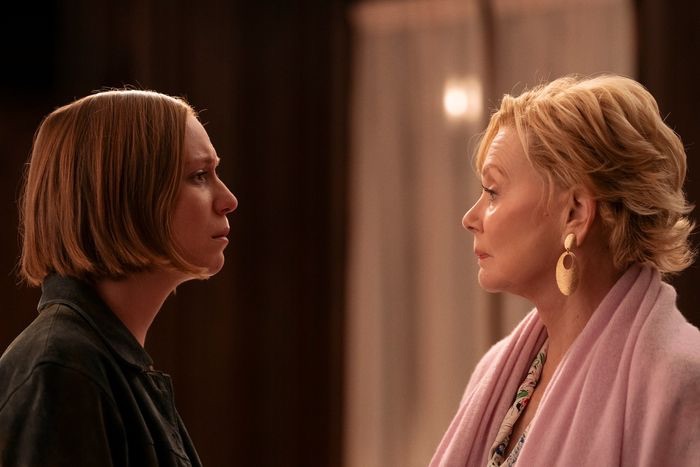
Hacks is about the borderline unhealthy relationship between a legendary comedian, Deborah Vance (played by the legendary Jean Smart) and her new writer, Ava Daniels (the very funny and genuinely admirable Hannah Einbinder). 

While the setting may be the glamourous world of showbusiness, fundamentally it is a workplace comedy. In the workplace that Deborah and Ava find themselves in by season 4 they represent archetypes of bad leadership: Deborah is imperious and ridiculously demanding, with no sense of workers’ rights and frequently forgetting that she has a duty to teach not just perform. Ava is well-meaning but so young she does not know what she does not know. In particular she has not quite grasped that her brilliance as a writer does not necessarily provide her with the knowledge and experience to be a professional leader. 

If you are in any way like me, this will immediately remind you of Lavina Greacen’s book, Chink, her biography of the Irish Second World War general Eric Dorman-Smith.

Just me?

Well, a central theme of that book was that leadership is a collective task, requiring at least two people to have any chance of working. 

This is something that the writers of Hacks also instinctively seem to understand. Neither Ava nor Deborah are necessarily people you would like to know in real life. But together they make each other better as people and as leaders. Of course, they have difficulty admitting this to each other – too much ego getting in the way. And they have even more difficulty realizing that there are others central to what success they have achieved, not least Jimmy, their self-effacing and under-appreciated manager (perhaps the real hero of the show?)

Maybe if they had read a few of Louise Penny’s Inspector Gamache novels they would know that they need to use more the four sentences that achieve wisdom: “I was wrong,” “I’m sorry,” “I don’t know,” and “I need help”. 

But they haven’t. Indeed, not enough people have. That is one of the reasons why there is so little wisdom and empathy among those responsible for leading in today’s world. It is also one of the reasons that moral leadership increasingly falls to the protests of artists like Hannah Einbinder and Kneecap, while so many more respectable pillars of society are silent as gravestones. 

All that aside, Hacks is one of the best portrayals of workplace politics since The Wire. And it’s bleeding funny.  Try it. 

Goodbye to All That, by Robert Graves;  The Great War, by Peter Hart; Catastrophe: Europe goes to war 1914, by Max Hastings;  and The Peacemakers, by Margaret Macmillan

Summary: Diverse, highly readable perspectives on the First World War

Like many of my generation, my introduction to the First World War was at school, studying the sublime poetry of Wilfred Owen. Owen’s writings along with others such as Siegfried Sassoon and Robert Graves, did much to promote the “lions led by donkeys” view of that war. 

This is a perspective on the war that Peter Hart takes considerable exception to. A key theme of his fine narrative history of that war, similar to Hew Strachan, is that the allied generals have been unfairly maligned, made scapegoats by civilian leaders who bore more responsibility for the carnage.

The generals of the Western Front were, he argues, by and large, diligent soldiers, trying to learn the best way to fight an industrial war. This is something that their prior experiences, helping their colonial empires steal other people’s countries and butchering anyone who objected, had not properly prepared them for. 

Better than Strachan, Hart illustrates well the impact of the generals’ decisions on the front line troops of all armies. He quotes extensively from the letters and diaries of the combatants to give a truer sense of their experiences, including of the vicious fighting. This makes it hard to sympathise with Hart’s  broader argument that the generals were doing their best. 

The industrialised trench warfare of the First World War was not quite unprecedented: the Union’s final campaign against Richmond under Grant previewed the sort of warfare that would come to define the Western Front. Grant had realised that an attritional campaign would bleed the South to such an extent that even if he lost every battle the Union would win the war. 

With no extant tactics to breach the fortified lines in a way that would have meaningful strategic impact on the course of the war, the opposing sides settled into a similar war of attrition. This led to regular battles that hoped to inflict such a butcher’s bill on the other side as to make it difficult for them to continue.

Other pressures, not least that of coalition warfare, also demanded action, irrespective of how inadvisable. That is how the British came to attack fortified German positions on the Somme in 1916 – to provide some “relief” to the French under German attack at Verdun. On the first day of the Battle of the Somme the British Army suffered 57,470 casualties, including 19,240 deaths. That still does not seem to me a reasonable price for generals learning on-the-job or offering moral support to an ally. 

By way of contrast, during the Second World War Matthew Ridgeway, an American Airborne general risked his entire career by refusing to lead his troops on what he believed would be a suicidal assault on Rome. This would have entailed dropping his lightly armed forces in the midst of two German heavy divisions.

I suspect most of the allied troops on the frontline of the First World War, such as Owen, Sassoon and Graves, would have happily swapped their “diligent” generals for a few with a fraction of Ridgeway’s moral courage. 

Graves was almost killed in a later stage of the Somme battle. It is striking that in Goodbye to All That, his engaging account of his wartime experiences, he never describes killing anyone, though he hints that he did. The closest he comes is describing a sniping opportunity to kill a bathing German. Graves writes that he could not bring himself to press the trigger on the naked man, so he assigned the task to a subordinate instead.

Graves clearly carried the war with him for decades after. The guilt and trauma of it infuses his account of the Greek Myths, for example.

Given the horror of the war, it is understandable that we all should look for who to blame. This is among the tasks that Max Hastings undertakes in his typically gripping account of the outbreak of the war. Hastings is at pains to point out that Germany more than any other nation was the one that could have put a stop to the descent into cataclysm. Hence in Hastings’ view this is the country that should bear most of the blame. Hart has a similar perspective, noting that Germany believed that as war was inevitable the sooner it began the better it suited them. 

In this Hastings and Hart offer somewhat different perspectives to Christopher Clark’s exceptional book on the same subject, The Sleepwalkers. This lays considerably more of the blame on Serbia, Britain and France’s ally. Margaret Macmillan, whose book, The War that Ended Peace, also explored the dangerous, dizzying array of alliances and egos that shepherded Europe to war. Both these accounts suggest there is plenty more blame to go around all combatant nations. 

With The Peacemakers Macmillan explores the end of the war, specifically the Paris Peace conference that led to the Versailles Settlement. This established much of the contemporary political shape of Europe. Alongside the “Great Power” politics of the Conference, Macmillen’s book is also the story of how the peoples of, in particular, central and eastern Europe shook off the rule of the Great Powers whose blundering had dragged them into catastrophic war. 

But the Versailles settlement also sowed the seeds of future war in Europe, by assigning all the guilt for the war to Germany. This ignored the role of, in particular, Serbia in starting things. It also ignored the fact that the Germany that came to Paris was a different country to the one at the start of the war. Not fundamentally different, of course: as German history since 1919 has shown it a country that has never quite lost its relish for atrocity. But by 1919 it had been through a democratic revolution that was economically crippled by the demand for reparations from the victorious powers. This created the political conditions for the Nazis to emerge. 

In granting to Britain the Palestine mandate the Versailles Settlement also paved the way for a new settler-colonial entity there, and for the Zionist genocide of the indigenous people that, with shameless US, German and British support, continues to this day. 

The First World War remains an example of, as William Faulkner once wrote, the past not even being past. Its dark legacy is a bloody one in the present for millions of defenceless human beings.

So, perhaps Wilfred Owen remains still the most vital voice on the First World War, understanding from that one war the pity of all war, and encouraging a level of empathy for the victims of war that no discussions of causality, strategy or blame ever can.

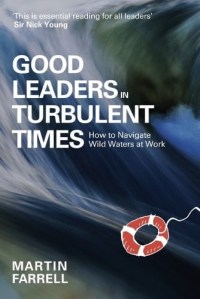
Good Leaders in Turbulent Times: How to Navigate Wild Waters at Work, by Martin Farrell

Summary: “Ever try. Ever fail. No matter. Try again. Fail again. Fail better.”

As a means to educate, stories are as old as humanity. And the best ones endure. That is why, for example, the wisdom of the parables of Jesus still resonates. 

Philip Gourevitch, in his book “A Cold” Case, explored the importance of stories in mentorships, as a way in which leaders share their experience with the next generation of “apprentices”. That is a tradition that Martin Farrell enters with his book, “Good Leaders in Turbulent Times: How to Navigate Wild Waters at Work”. 

As well as having led organisations himself, Farrell has a long background mentoring leaders: he was a particular help to me during one nightmarish phase of my career. So, he has deep understanding that even the best leaders often have to endure reversals and “the slings and arrows” of those who have never experienced the grinding responsibilities of choice-making that leadership entails. 

In other words, he has heard, if not all the stories, a great many of them. He recounts these here in the intertwined stories of a group of fictional not-for-profit CEOs at various stages of their careers each enduring their own professional crises. As resources for learning they are a reminder to other leaders going through their own trials that they are not alone. Others have passed this way and endured… or at least survived. Here are some of the ways they managed to cope.

Farrell understands that beneath the latest fads and fashions, which come and go and come back again, leadership is a human process and it takes a human toll. That is a truth that is often underappreciated by new leaders when they take up their roles. More unforgivably it is too often forgotten by board members who blunder in their organizational stewardship as a result, often in ways that they are never held accountable for. 

Because of this, Farrell’s book is a vital one and should be required reading for CEOs. It should also be required reading for board members, particularly those who have never been CEOs. It is book that the for-profit as well as the not-for-profit sectors can usefully learn from.

Good Leaders in Turbulent Times is an accessible, humane book, imaginatively designed and wonderfully illustrated by Steve Appleby. It is an important contribution to leadership literature.  

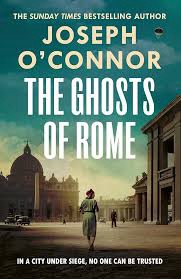
The Ghosts of Rome, by Joseph O’Connor

Summary: more Paddington 2 than Jaws 2

Sequels are a tricky thing. Some, like Margaret Atwood’s The Testaments add something to an earlier classic. More ill-judged ones, like Pat Barker’s The Women of Troy, can dent the lustre of their more accomplished predecessor, seeming to aim to cash in on a successful formula rather than say anything compelling or new.

So it was with some trepidation that I picked up the Ghosts of Rome, Joseph O’Connor’s follow up to his superb novel of European Resistance to Nazism, My Father’s House.

Time has moved on a few months from the first novel, the German occupation has become more brutal, and the pressure on the Choir – the escape line for Allied prisoners of war and Jews established by Monsignor Hugh O’Flaherty – more extreme.

The pattern that O’Connor uses for this book is similar to its prequel: It focuses on one operation, and one individual in the midst of the otherwise present and correct ensemble of the Choir, in this instance Contessa Giovanna Landini – Jo.

O’Connor admits that all of the novel, including the purported transcripts of BBC interviews, is his own invention. But many of the people involved including Jo and her Irish pals, Delia and her daughter Blon, were real. This accentuates the sense of awe regarding what these ordinary people endured and achieved in such extraordinary circumstances. And, even if we know they survived the war this does not diminish the tension.

The Ghosts of Rome is a gripping thriller. But like the best thrillers it is more than that. It explores and asserts the importance of morality and friendship in the face of monstrousness. These remain important ideals in a world in which the genocide of vulnerable people is again high on the agendas of many of the supposed liberal democracies of the West.

Standing Tall: living with motor neuron disease, by Samantha Whittaker

Summary: a poetry of courage

“Silence – like a Quaker meeting.”

And like a Quaker meeting, Samantha Whittaker breaks this silence with her deeply considered words. Standing Tall is her first book, a collection of her poetry. As she explains in the introduction poetry is something that she returned to writing after her diagnosis with motor neurone disease. “At 56 I was struck with this terrible disease… Nobody can understand me now… I used to chat and laugh so much… Standing tall is where you’ll find me/ When I die.”

Because of its subject matter, this is a desperately sad book. But it is also an awe-inspiring one. I have only been in the presence of true courage a couple of times in my life. This book reminded me of those times. Because in this book Whittaker unflinchingly confronts her disease and her life with it: “Reason, slobber, alive, decline/ Words that sum up…”

Standing Tall is an extraordinary book by an extraordinary woman.

A Thread of Violence, by Mark O’Connell

Summary: I would be more forgiving of this book if there had been more about Bridie and Donal in it.

I worked with a lot of Irish nurses in Ethiopia and Angola. They were a tough, sexy bunch, ruthlessly professional and deeply committed to social justice. (The character of Sophia in my novels The Undiscovered Country and Some Service to the State was modeled in no small part on some of them.)

As a professional group, certainly as an Irish professional group, they have probably done more than any others to make the world a better place. 

I imagine Bridie Gargan must have been quite like them. A 27 year old in 1982 she was already making the world a better place working as a nurse. Having just finished a long shift one day she decided to reward herself on her way home with a spot of sunbathing in Dublin’s Phoenix Park. It was there she had the misfortune of encountering Malcolm Macarthur, who proceeded to beat her to death with a hammer. 

After Bridie, Macarthur went on to kill Donal Dunne, a farmer, with his own shotgun. It seems that these killings were part of a half-baked plan that he had to commit an armed robbery to replenish his finances after he had squandered an inheritance. Macarthur was such a wastrel that he simply could not contemplate working for a living. 

Having finished it, I am left with very mixed feelings about A Thread of Violence, Mark O’Connell’s account of a protracted series of meetings that he had with Macarthur following his release on licence for the murders of Bridie and Donal. O’Connell had set himself the task of trying to get to the bottom of what motivated Macarthur to such grotesque violence. 

It is a beautifully written book, and it is important, I believe, to try to understand violence to better prevent it. But in the end O’Connell adds little illumination to these dreadful events and he admits that he never did get to the bottom of the question of motivation. 

So, what justifies this literary treatment of Macarthur, a worthless man who has led a worse than worthless life? I am left feeling not much, particularly as O’Connell writes so little about Bridie and Donal who barely feature in this book other than as victims. O’Connell missed the opportunity, in my view, to show how these much more consequential people deserve more attention than their self-important killer.

I can understand how O’Connell, as a working writer doubtless with a contract to fulfil, must have felt he had to write something in spite of his admitted failure to achieve his aim. But I am sad to say that I do not think this book adds much to human understanding. 

A roundup of Unusual Suspects: Isolation Island, by Louise Minchin; The Trials of Lila Dalton, by L J Shepherd; Long Time Dead, by T M Payne; A Limited Justice, by Catriona King.

Summary: books that it would be criminal to overlook!

I once met a woman who had given her newborn daughter the second name of “Danger” just so when she was older she would be able to say, like the heroine of a 1930s movie, “Danger is my middle name!”,

There is a strong hint of such movie heroines in Lauren, the investigative journalist protagonist of Louise Minchin’s Isolation Island

Minchin uses her experience of journalism and having been a contestant on the storm ravaged set of “I’m a Celebrity, get me out of here!” to craft a fun, Agatha Christie inspired, tale of murder amongst game show contestants. 

Minchin brings a lovely devilment to her tale, fattening up the despicable before despatching them while Lauren desperately tries to unearth the evil genius behind the mayhem.  

Minchin has described her heroine as being braver than herself. That may or may not be true – Minchin is also a triathlete and having done one myself I can attest that those are daunting things. But, perhaps as importantly Lauren is driven by a sense of journalistic ethics and a conviction of the importance of truth, which must be Minchin’s own. 

In a time of in which even genocide is being made undiscussable, it is important to be reminded that some truths, no matter how inconvenient, must be spoken. 

On the opening page of The Trials of Lila Dalton, the titular Lila, a barrister it seems, stands up in court with no knowledge of how she got there, but with a client to defend. LJ Shepherd, the author, a barrister herself, describes her book as an “ontological mystery”. That is, not only does her protagonist have to get to the bottom of the facts of her case – the defence of a man accused of a bombing atrocity – but also work out who the hell she is and what she is doing there. 

Shepherd’s is an entertaining and intriguing story. I am not sure that it really required the reality questioning elements as the issues she deals with – the importance of the right to a defence in a criminal trial no matter how seemingly heinous the accused, and the question of how democratic societies protect themselves from violent assaults by those who do not share their values – are important enough.

These quibbles aside, the quality of Shepherd’s writing is exceptional, particularly when describing the treating of casualties in the aftermath of an explosion: these recalled for me some of the accounts of the survivors of the Rana Plaza collapse in Bangladesh. In this Shepherd does that most difficult of things: she forces the reader to empathise with victims that they may prefer not to think of.

In Long Time Dead, an extra body shows up in a grave and it is identified as a man suspected of murdering a cop and grievously injuring a bystander seven years earlier. The investigation eventually falls to Detective Inspector Sheridan Holler. 

It was Chandler, I think, who conceived of his tales of gumshoes as updated versions of the stories of Knights Errant from Arthurian legend. So, whatever else was unclear in his mysteries, no matter how corrupt the world in which they ventured, one thing you could count on was that his shamus would endeavour to do the right thing, protecting the innocent and unmasking the guilty. 

TM Payne’s peeler protagonist in Long Time Dead is an inheritor of that tradition. While she may find the sort of defence barrister of which LJ Shepherd writes somewhat distasteful, she is still fundamentally decent and committed to the finding the truth. 

There is an echo of Payne’s book in Catriona King’s A Limited Justice. Like it, it is a police procedural – a type of crime novel for which I have a particular affection. 

Both have the bonus of being written by writers who know what they are talking about: Payne is a former cop; King has worked as a police forensic medical examiner. Both eschew the brooding detective for sympathetic professionals – the sort of people who you might actually like to work with. 

A Limited Justice begins with King’s investigator, Marco Craig, opening a probe into a particularly grisly killing on a Belfast garage forecourt. As with many of the Sherlock Holmes stories, as the investigation unfolds the story of the perpetrator and their motivation becomes as important as that of the investigators. Consequently, King is able to use her story to explore not just the crime itself, but contemporary Northern Ireland. As is typical of Northern Ireland the story is replete with black humour. 

Both King and Payne have founded book series based on their protagonists. It is easy to see why: both are appealing companions on the mean streets of the imagination, and King and Payne, like Minchin and Shepherd, are both very gifted writers. 

Some Service to the State

Summary: why partition in Ireland has been such an injustice.

“… sometimes it is absence itself which is the hardest thing to hide.”

I grew up in South Armagh, just a mile or so from the British-imposed border in Ireland. That border is a thing that, in many ways, has cast a long shadow over my life. It was, I sincerely believe, at the root cause of many of the problems for both parts of Ireland during the Twentieth Century, not least the squalid little war known as the Troubles during which I grew up.

With partition, the British sought, successfully, to create two sectarian states in Ireland rather than one plural one. My novel, Some Service to the State, is at heart an exploration of some of the human rights abuses that Irish people had to endure as a result of this.

Hence it is an indictment of the injustice of partition’s continuation. As the impetus takes hold for an end to partition and the establishment of a new Ireland, I hope that this book will resonate with an audience that wants to understand better why the status quo has been such a poisonous thing for ordinary people living on the island of Ireland.

But Some Service to the State is also a gripping detective story, about the repercussions of an enquiry into the fate of a girl who seems to have gone missing in that politically divided island.

Here is what other authors said about it: 
Ronan McGreevy, author of Great Hatred: the assassination of Field Marshal Sir Henry Wilson, has said of Some Service to the State that it is “a superb book with dialogue that would not be out of place on the stage of the Abbey Theatre. … [in Mick McAlinden} McQuade has created a character whose travails highlight the thwarted dreams and the tragedy of partition for so many people in post-revolutionary Ireland.” 

Rosemary Jenkinson a multi-award winning playwright and author of Marching Season, has said that the book shows a “prodigious skill in shining a spotlight on the scandal of the mother-and-baby homes and in brilliantly imbuing the past with … [a] potent blend of heart, soul and wit”

If you would like to get a copy, the book is available in the UK from Bookshop.org and in the US from Barnes and Noble. It is also available on Amazon.

I hope you will read it, and if you do, I would love to hear what you think in the comments below.

Keep safe and many thanks.