An Evil Eye is the fourth book in Jason Goodwin’s series about Yashim, an official in the Ottoman Court of the 19th Century with a particular penchant for investigation. A eunuch, butchered as a teenager by the enemies of his father, his status means he is privileged access to the harem as well as the city and so is frequently entrusted with some of the Court’s more sensitive enquiries.
In this book a body is found in the water tank of an Orthodox monastery outside of Istanbul bringing with it the suspicion that perfidious Christians have murdered a Muslim. Yashim is sent to investigate and hopefully stave off an ugly incident. Of course the body is merely the tip of a much more dangerous and labyrinthine plot that threatens the entire stability of the Ottoman State.
Jason Goodwin is an historian. He has written an earlier history of the Ottoman Empire, and so knows his stuff. This is one of the greatest pleasures of his books – he transports the reader to bustle of 19th Century Istanbul and Yashim is an elegant and erudite guide through its diversity. Yashim is not only a man of action but also a polyglot and cook – I was inspired, with modest success, to attempt three of his culinary efforts over the course of reading this book.
In his investigations Yashim is assisted by his close friend Palewski, the Polish Ambassador to the Ottoman Empire. Of course at the time in which the book is set Poland doesn’t exist, subsumed by the empires of the “Great Powers”. But the Ottoman Empire insists on maintaining the embassy of its old enemy. At the very least it annoys the Russians. Palewski also has one of the best lines I’ve come across in while: “If you go on saying and believing the same things for long enough, the world will eventually come around.” That should be a motto for anyone who has ever strived for a more humane world.
I must confess that for the fourth time reading one of Yashim’s adventures I am still not very clear on what happened. I think this, to an extent, is a result of quite complex plots with a myriad of characters and various strands running from the harems to the Court, to the international embassies and their spies and diplomats, to the back streets and waterfronts of Istanbul. Perhaps I should simply be paying closer attention to the final pages of the book.
In spite of these reservations I will be picking up the next instalment of the adventures of Yashim and Palewski. They are tales of escapism like few others.
Caius Octavius, son of Caius, was born on 23 Sept 63 BCE to a decent but hardly spectacular family of the Roman aristocracy. When he died as Augustus in 14 CE he was the most powerful man in the world, the first Roman Emperor, hailed as “Father of his Country”.
Part of the reason for this spectacular career arose from his relationship with his maternal uncle, one Julius Caesar who, at the time of Octavius birth, had just been elected Rome’s most senior priest, Pontifex Maximus. Julius Caesar adopted Octavius shortly before his own assassination. But in the chaotic aftermath of the Ides of March, this bequest could easily have proven lethal rather than beneficial. Nevertheless, while still not yet 20, Octavius not only decided to embrace Caesar’s legacy, but to take up where his uncle/adoptive father had left off and become the most powerful man in Rome.
Goldsworthy notes a number of difficulties with Augustus, principally how to make sense of the way that the vicious warlord of his youth seemed to give way to the sober statesman of later years; how the organiser of the death squads for the proscriptions (“These many, then, shall die; their names are prick’d”) became, after Actium and the deaths of Antony and Cleopatra, a patron of the arts and restorer of Rome.
Goldsworthy contrasts the magnanimity of Julius Caesar during the Civil Wars with the ruthlessness of Octavius. But of course, while Julius Caesar drew the line at using indiscriminate violence against Roman citizens, he had used ruthless terrorism during the Gallic Wars and this had contributed to the conquest and pacification of Gaul. In his own resort to terrorism perhaps Octavius was thinking about this as well as Sulla’s bloody coup in Rome, during which Julius Caesar himself almost lost his life. Octavius certainly had no intention of following Julius Caesar’s precedent of being murdered by the very enemies that he pardoned.
Goldsworthy tries to resolve the apparent contradictions in the career of Augustus within the structure of a narrative biography. But while the overall book is both elegant and erudite, Augustus still seems somewhat unknowable. This is perhaps intrinsic to Augustus. On the surface he tried to live his life simply as “Princeps”, first among equals with his fellow senators. But this was mere façade. The truth was almost absolute power and this colours all of Augustus’ utterances. Was Virgil flattered by the joking letters that Augustus sent him enquiringly about his work? Or was he frightened and uneasy by the interest shown him by someone who had in the past shed the blood of so many citizens, and still held the power to do so with impunity?
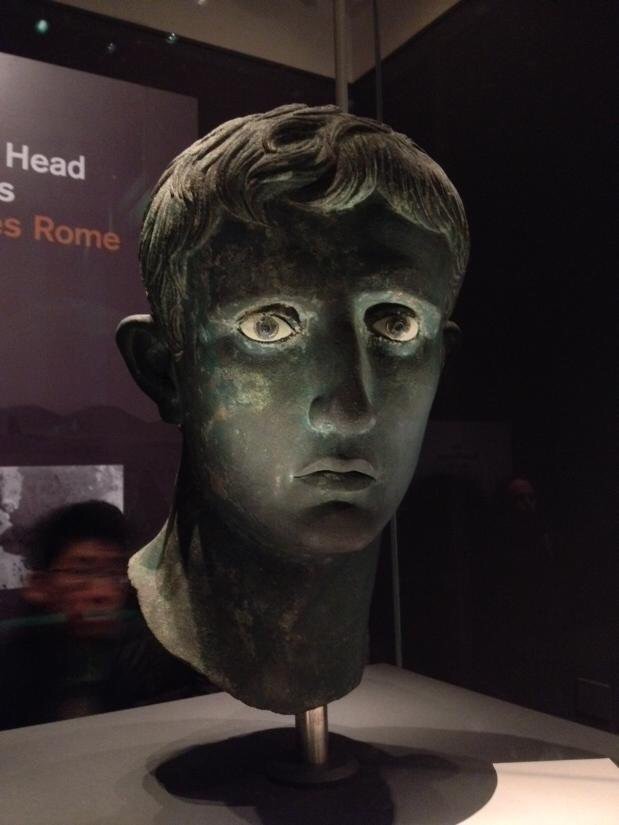
The Head of Augustus, excavated in Sudan, on display in British Museum
The official depictions of Augustus, on coins and in statuary, such as the one on the cover of this book (above), tend to show Augustus as regal and youthful, every inch the ideal of Roman fatherhood and generalship. But there is another image of Augustus, excavated from Sudan where it had been taken after its capture in Egypt by Ethiopian troops. To my mind it is the image of an altogether more haunted figure.
Goldsworthy notes that if there is one theme in the life of Augustus it is that he got better as he got older. While still able to summon moments of murder and ruthlessness right through his life, perhaps some of his later moderation grew from his own horror at what he had once been.
Summary: “The rebels who went out to do battle on Easter Monday morning may have been marching into the unknown, but they shared one expectation: that the British military response would be rapid and hard.”
On Easter Monday, 24th April, 1916, a group of armed Irish rebels occupied the General Post Office (GPO) and other major buildings across the city of Dublin. It was the beginning of the Irish War of Independence that would last with varying degrees of political and military intensity until 1921.
The O’Rahilly
The troops who occupied these strongpoints were members of the Irish Volunteers, a force assembled to defend the Home Rule promised Ireland by the British Government, and the Irish Citizen Army, a force organised by the trade union movement to protect workers from the police. But it was neither an Irish Volunteer nor Citizen Army rebellion so much as an Irish Republican Brotherhood one. The IRB was a highly secretive revolutionary organisation, and with the rebellion they were in fact trying to organise a coup on the leadership of the Volunteers including Eoin MacNeill, the Chief of Staff, and Michael “The” O’Rahilly, Director of Arms.
When MacNeill learned of the IRB plan, to use proposed training exercises on Easter Sunday 1916 to stage a rebellion, he countermanded the order. Consequently instead of tens of thousands rising up all over Ireland, less that two thousand mobilized in Dublin alone.
The remote chances of success were further dented by a considerable quantity of bad luck. The great Irish anti-slavery activist and revolutionary Roger Casement was captured with the huge quantity of German arms he was trying to smuggle into Ireland for the rebellion.
Added to this, from the start there were gaping flaws in the plan. The strong points taken by the rebels were disconnected and hence unable to provide mutual support. They failed to take Dublin Castle, which was virtually undefended because of the Easter holidays. They could have made better use of guerrilla tactics. Where they did, at Mount Street Bridge, a handful of intensely brave Irish soldiers inflicted tragic and devastating losses on the young Sherwood Foresters they fought there.
After six days it was over, crushed by the might of the British Empire that overwhelmed them with troops and heavy guns. The O’Rahilly, despite his opposition to the rebellion, ultimately felt duty bound to participate, and was killed towards the end leading an attack on a British machine gun position to give cover to the withdrawal from the GPO. As The O’Rahilly himself had put it in a phrase later taken up by Yeats, the man who had helped wind the clock came to hear it strike.
Charles Townshend, a distinguished English historian of Ireland, published this exceptionally fine account of the origins, course and consequences of the 1916 Easter rebellion in 2005. It is, therefore, the product of a life of scholarship rather than a rush for centenary sales. It is both an accessible starting point for those who wish to learn more as well as a valuable contribution to the ongoing conversations about and considerations of the Rising.
It has been argued that the 1916 Rebellion could never be classified as a just war, given the hopelessness of the cause and that the use of violence could not have been viewed as a last resort. The Easter Rising also casts something of a shadow between unionist and nationalist communities to this day: unionists regard it as a stab in the back of those who were serving and dying in the British Army in the defence of “small nations”.
By the standards of the First World War this was a trifling affair. In the blood bath of the Somme that would begin a few weeks later thousands of Irishmen, nationalist and unionist alike, were pointlessly butchered alongside English, Scots, and Welsh, in the name of Empire.
But one cannot deny the extraordinary courage and idealism of those who went out to fight: Grace and Malone at Mount Street Bridge; The O’Rahilly in the retreat from the GPO; Ned Daly in the Four Courts. These were people who displayed enormous grace under pressure in the face of overwhelming odds, in the name of an unquestionably just cause, if, perhaps, not in a just war.
Yeats was perhaps never more prescient, both politically and historically, than when he finally published his view of the Rising: “A terrible beauty is born”.
Summary: The Troubles through the prism of Kevin Myers’ favourite subject – himself
Kevin Myers is one of the finest writers of his generation. An exquisite prose stylist, he is the author of some of the most compelling and elegantly written journalism of the past 40 years.
He is also an arsehole of the first order: If the Oxford English Dictionary is considering a pictorial edition they would probably include a picture of Myers to illustrate the term “West Brit”. Since the events covered in this book Myers has transformed himself into a smart-arsed apologist of the establishment, frequently economical with the facts where they may conflict with his opinions. Indeed, if there is an entry for “Smart-Arsed Apologist of the Establishment” in the Oxford Pictionary, Myers photo would probably be there too.
Given all the aforementioned, I deliberately bought this book in a charity shop in the hope that this would deny Myers any financial benefit from my purchase. As Myers is a voluble opponent of international aid this purchase therefore represented something of a double-whammy.
Watching the Door is a memoir of Myers time as a young journalist in Belfast in the early 1970s. It displays a considerably higher degree of self-awareness than I expected. Myers, it seems, has always known he was an arsehole, and a foolhardy one at that.
A former housemate of mine once almost got himself very badly hurt by a frankly stupid disregard for the dangers posed by a Belfast city centre car bomb. This prompted a house meeting with one item only on the agenda: whether we should kick his shite out for being such a stupid fecker. (We didn’t… even though he was.)
Myers does not appear to have had any housemates to slap him around for his reckless behaviour. Even had he not been so reckless the daily grind of reporting one of the most brutal periods of the Troubles would have resulted in profound post-traumatic stress.
Myers now appears repelled by his youthful self, and the portrait he presents of himself as a youth is repellent. The 180 degree transformation that he has fashioned of himself is also repellent. So in that at least he is consistent.
But he is still an exquisite writer and this is an important subject as the horrors of the 1970s begin to be overlaid by romantic hues and preposterous myths: one article I read recently by an American journalist seriously reported the inspiration that Gerry Adams claimed to take from Martin Luther King, the same Adams whose first appearance in these pages relates to his instruction to an IRA minion on how to deal with a local thug: “Shoot him.” On another occasion, when questioned by a journalist about the disappearance and murder by the IRA of Jean McConville, a single mother, on the trumped up charge of informing, Adams glibly asserted “These things happen in wars.” Indeed they do. They are called war crimes.
Sean O’Callaghan, an Irish Police informer in the IRA, also alleges that Adams contemplated at one stage assassinating John Hume, the most passionate of King’s disciples ever to walk the island of Ireland. John Hume only makes a fleeting appearance in this book. The Peace People are mentioned a couple of times. Seamus Mallon not at all. It may be that they rarely encroached upon Myers consciousness in the midst of his alcoholic stupor from the considerable time spent in late night drinking dens with murderous Loyalist and so-called “Republican” paramilitaries. However their exclusion may be simply to bolster a dubious thesis in this book: that no matter how horrific the paramilitary actions became, and to his credit Myers details many atrocities the former paramilitaries would like to forget, they were never condemned or repudiated by their communities. Hume and Mallon became hoarse in their condemnations of the atrocities of all sides, including the British who Myers, to my mind, soft pedals on, and the SDLP consistently outpolled Sinn Fein by a ratio of 2 to 1 during the period that the Provos waged their illegal war.
The repudiation of sectarianism and violence by many ordinary people in the North was also illustrated in two of the most horrific incidents of the Troubles, which Myers choses to skate over in this book: the Miami Showband and the Kingsmills Massacres. To be fair after the litany of bloodshed which he has already recounted he may have felt exhausted at having to confront these atrocities as well. But there are important details.
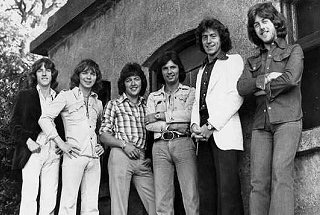
The Miami Showband, in one of their last publicity images
The Miami Showband was non-sectarian and religiously mixed. According to Stephen Travers, the band’s bassist and one of the survivors, his best friend in the band, trumpeter Brian McCoy, a Protestant from a Unionist background in County Tyrone, understood the rest of the band’s concern at having been stopped by the Ulster Defence Regiment (UDR). McCoy whispered to Travers that he could stop worrying when a British officer showed up. That did not protect them unfortunately when the bomb the UDR was trying to plant in the band’s bus went off and killed two of these British armed and directed terrorists. The UDR soldiers, whose dual membership in the paramilitary Ulster Volunteer Force had not been a barrier to their entry into the British Army, then started butchering this group of defenceless musicians who represented the best of society of the whole island of Ireland.
The Protestant victims of the IRA’s Kingsmill massacre also showed a impressive anti-sectarian heroism as they tried to protect their Catholic colleagues from what they initially thought was a similar UDR/UVF attack, before the horrendous realisation that the war criminals in question on this occasion had come to butcher them.
So in spite of the author’s arseholeism, and the exaggerations, evasions and distortions that pepper this account of war and his, sometimes quite bizarre, sexual adventures, this book is an important one. As many of those who directed war crimes in the course of this illegal war attain high office in both parts of Ireland it reminds us just how horrendous and shameful the Troubles actually were.
For this reason I can only hope many more charity bookshops will benefit from the sale of this book in the years to come.
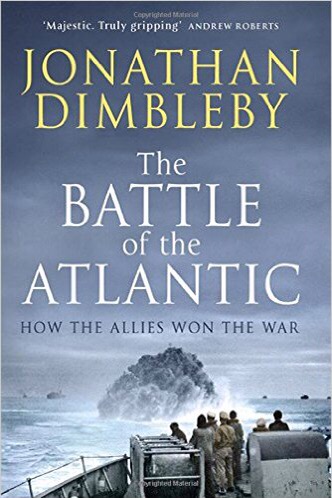
There was no “phony war” at sea. The Battle of the Atlantic started on the first day of the Second World War, 3 Sept 1939, with the sinking of SS Athenia by a German U-boat. It continued until the last day of the war and so was the longest campaign of the Second World War and the most destructive naval conflict in history.
Dimbleby’s account of this campaign is an elegantly written horror story, alternating between accounts of the ghastly fighting at sea, and the operational and strategic planning of the Allies and the Axis that guided the slaughter.
Churchill famously said that the U-boat menace was the one thing that gave him sleepless nights during the war. However it would be fair to say he brought many of the nightmares that afflicted him on himself. Most damningly Churchill prioritised the militarily pointless and morally indefensible bombing of German cities by the psychopathic head of Bomber Command, Arthur Harris, over the vital defence of the convoys across the North Atlantic. Hence Coastal Command was denied the relatively few aircraft that could have turned the tide of the battle months earlier.
Dimbleby asserts that Churchill was possessed of a great strategic vision. But this seems rather at odds with the account presented which suggests a certain strategic fickleness on Churchill’s part. It is true he did have a vast and complex set of problems on his mind. But one does get the impression of a man easily given to temporary military enthusiasms to little useful purpose but to the detriment of some truly vital endeavours. Dimbleby puts this into sharpest focus on some of Churchill’s choices around the Battle of the Atlantic. But one sees this in many other places such as his failure to finish the defeat of the Italians in North Africa before, wholly ineffectually, attempting to arrest the invasion of Greece.
Rather than military strategy Churchill’s genius was of the political variety. His forging of the trans-Atlantic alliance with Roosevelt was perhaps his finest hour. This resulted ultimately in the Allied victory, not least by bringing the true strategic genius of the US General George Marshall to bear on the situation. This inexorably refashioned Allied strategy away from Churchill’s fanciful Mediterranean focus – which arose more from his desire to keep some semblance of unity on the British Empire rather than to pose a lethal threat to the Axis – and towards an altogether more effective intent to mount an invasion of France to swiftly strike at the heart of Nazi Germany.
In spite of these strategic failings a combination of increasing effectiveness of convoy tactics, and improved technology ultimately, and with dramatic suddenness in May 1943, turned the tide of the Battle in the Allies’ favour. Thereafter, with victory in the North Atlantic, victory in the overall war was assured. Convincingly Dimbleby argues that the code-breaking of Bletchley Park was only marginally a factor in this victory, not least because the Germans had also cracked the Royal Navy code and the advantages that Bletchley provided were somewhat cancelled out in the war at sea.
The Battle of the Atlantic was to any imagining horrendous and Dimbleby conveys this well – from the account of Italian prisoners weeping in terror as they drowned imprisoned in the holds of the torpedoed Laconia, to the massacre of the Arctic Convoy PQ 17, condemned to its doom by incompetence in the Admiralty for which, of course, no one was ever held to account: That the lives and heroism of merchant seamen were held cheap by the Establishment is a recurring theme in this book.
The Battle of the Atlantic is a gripping and generous-spirited book, drawing on the accounts of German as well as Allied participants recognising the courage and humanity of all the participants in the Battle, while also recognising the horrendous things that many of these ordinary human beings did to each other.
Patrick Leigh Fermor, legendary travel writer and Special Operations Executive officer, never published during his own lifetime this, his full account of the kidnap of General Kreipe in Crete in 1944. His junior SOE colleague Billy Moss did, with Leigh Fermor’s help. Ill Met by Moonlight was published in 1950 and made into a famous movie with Dirk Bogarde as Leigh Fermor.
However as Roderick Bailey points out in his foreword to this book, Billy Moss did not speak Greek and the Kriepe kidnapping was his first clandestine operation. So his account lacked understanding and appreciation of the Greek partisans with whom he fought.
Leigh Fermor’s account is therefore something of an apologia to pay proper tribute to the people upon whom he depended for his life during his years undercover in Crete. He notes towards the end of his account that, “There has been more than a hint in these pages of [the kindness and generosity of the Cretan people] and of that aspect of Cretan life which suddenly gives the phrase ‘Brotherhood in arms’ such meaning”.
It is this, rather than a desire to convey a “boy’s-own” adventure, which seems at the heart of this account. It is an account that is marked by a remarkable joie de vivre in spite of the harsh circumstances he describes, and the constant threat of death under which he lived. As such it contrasts interestingly with Eric Newby’s similarly themed, but altogether more melancholic, account of his time being sheltered by an impoverished Italian rural population while on the run from the Germans: Love and War in the Appenines.
Leigh-Fermor conceived of the kidnapping of the German commander in Crete as a bloodless operation, to prevent German reprisals against Cretan civilians. Originally he aimed to kidnap the brutal General Muller, but this plan was thwarted with Muller’s transfer and replacement with General Kreipe.
Leigh-Fermor went ahead with the plan anyway as a morale boosting exercise for the Cretan resistance, and to keep them distracted from shedding German blood and hence provoking fierce reprisals.
He almost achieved his bloodless coup, though his Cretan comrades were at one point compelled to leave the poor driver who had been captured with the General in an unmarked grave. And some months after the operation the Germans conducted a series of brutal reprisals anyway, which may, or may not have been linked to the kidnapping.
Given this, and the undertaking of the operation late in the war when Germany’s fate was all but decided the strategic value of the operation is open to question. But the courage and fortitude that it entailed is not, as Leigh Fermor’s account amply demonstrates. Abducting a General gives a fine insight into a little-known corner of the Second World War, prosecuted, in the main, by ordinary people at terrible cost.
Summary: an elegant and distressing exploration of a storehouse for a genocide
A few months ago I visited Elmina Castle, a centre of Dutch slave trade on Ghana’s Atlantic coast. The tour of the castle started in the women slaves’ dungeons, overlooked by a balcony of the castle governor’s apartment, from which he would periodically select women to rape as they were paraded below.
From the stifling heat of the dungeons the tour eventually proceeds up to the wonderfully airy governor’s apartment and the officers’s quarters at the top of the castle, with spectacular views of the sea and the surrounding coast. The thought of such horrors in the midst of such beauty is profoundly unsettling.
The narrative journey that William St Clair follows in his book The Grand Slave Emporium goes in the opposite direction to the path tourists, pilgrims and penitents tread touring such castles. Starting with a consideration of the establishment of Cape Coast Castle, the centre of the British slave trade on the Ghana coast a few miles from Elmina, he proceeds to describe the lives of the various denizens of the slave castles, from the governors, through the officers to the soldiers and the women – wives, “wenches” and the Castle’s sexual slaves – to the human beings – the slaves for export – who provided the entire rationale for the existence of the hundreds of such castles along the African coast.
The picture he describes is one of banal evil as the pretentious functionaries of the Castle, dreaming of lives like that of that idealised slave trader, Robinson Crusoe, dehumanise and process their human livestock through the Door of No Return and onto the waiting slave ships.
The Door of No Return, Elmina Castle, Ghana
Over hundreds of years slavery devastated the African interior as wars and raids encouraged by the European powers kidnapped millions of people, many of them children, to feed the demand from the Americas for human beings who could and would be worked to death to produce cash crops, mostly for European markets.
It is one of the bleakest episodes in human history, echoing the holocausts of the 20th Century in the level of industialized organisation that was brought to bear on such an atrocity.
In spite of this compassionless bureaucracy of enslavement, moments of humanity and heroism do shine through: one person who had been enslaved through Cape Coast Castle, Quobna Ottobah Cogoano, eventually escaped and became a major anti-slavery campaigner at the end of the 18th Century. And David Richardson, an economic historian, estimated that the extra costs that slave ship owners incurred in order to discourage or defeat insurrections on the slave ships saved many hundreds of thousands of other Africans from having been enslaved.
The Grand Slave Emporium is an elegantly written, but profoundly bleak book. Nevertheless it is a necessary one. It shows humanity in its squalid complexity, and reminds us of how easily societies can, wholesale, descend into savagery while believing themselves to be the epitomes of refinement.
Dictator is the final volume in Robert Harris’ fictionalised three-volume biography of Cicero, covering the years up to his death and with it that of the Roman Republic.
Cicero did have a biography written by his secretary Tiro, the inventor of one of the first systems of short-hand which still echoes into contemporary English, for example, e.g. Fortunately for Harris, that biography has been lost to history, so he has constructed his own trilogy as if it were Tiro’s biography of Cicero, with Tiro as narrator.
As with the previous two volumes of the trilogy, Imperium and Lustrum dealing with earlier phases in Cicero’s career, Dictator is a gripping political thriller, covering the period from Cicero’s exile to the downfall of the Republic with the establishment of the second triumvirate of Antony, Lepidus and Octavian.
Contrary to Goldsworthy’s Caesar, or Massie’s fictionalised accounts of the period, with Harris Cicero is presented as a hero, albeit a flawed one, a proponent of rule of law against arbitrary and tyrannical rule in spite of personal threats and the moral cowardice of his contemporaries.
Unlike Goldsworthy who typically tries to explain his subjects in the contexts of their own time, Harris deliberately seeks parallels with the present. Here he presents a warning for a polity that disdains basic principles of rule of law.
But, Harris does not allow the vital political-philosophical points to interrupt the narrative, which is gripping, as Cicero with only logic and argument in the face of shocking violence seeks to maintain constitutional principles in the face of the vanity of warlords.
The result is a fine political thriller, with much to recommend it for the student of the ancient world.
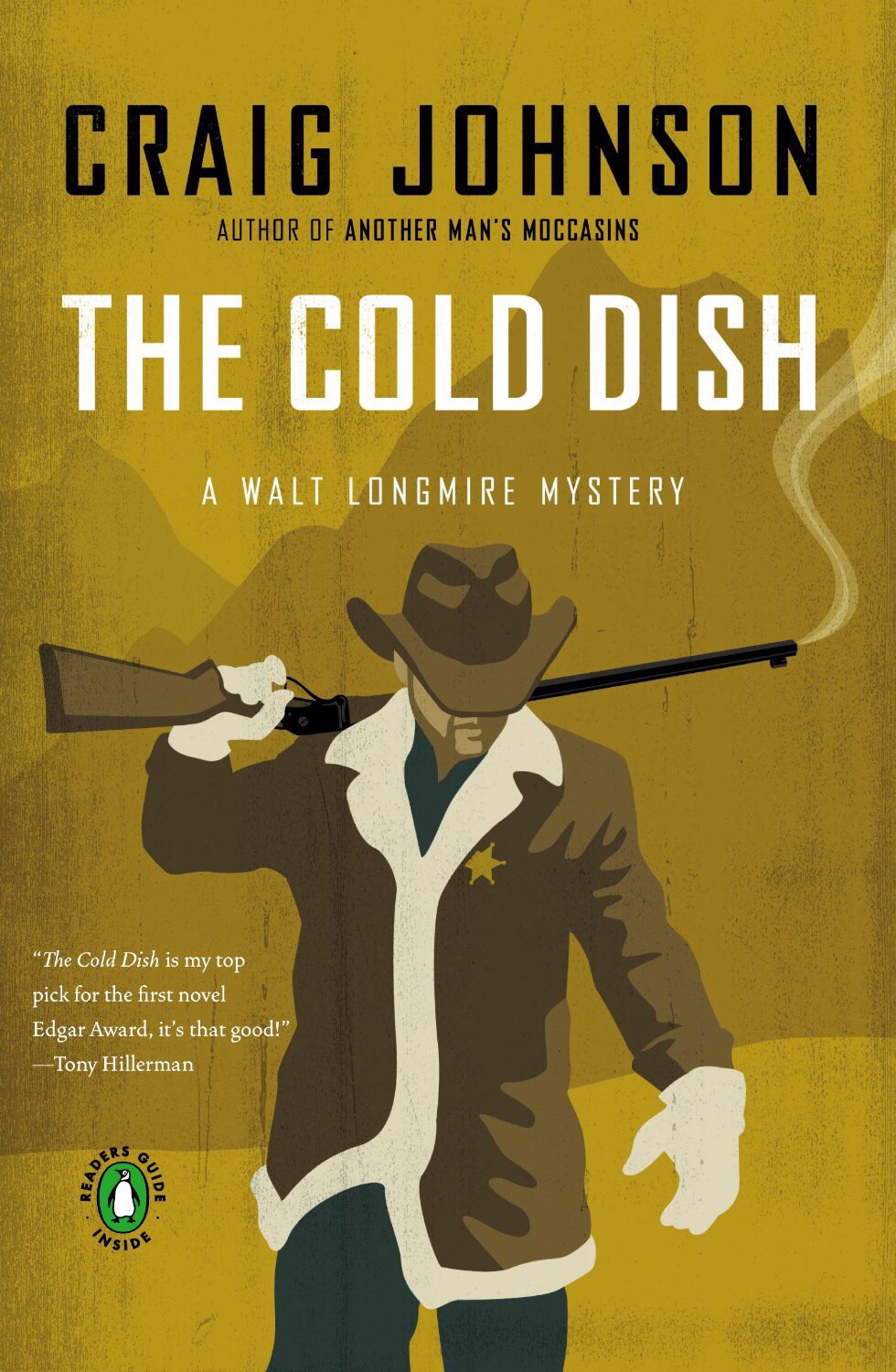
Walt Longmire is a mess. Three years widowed, he lives out of cardboard boxes in the house he half-completed with his wife. And he is marking time until his term finishes in his job, sheriff of Absaroka County in Wyoming, Cheyenne Country.
Fortunately for Walt, his friend Henry Standing Bear decides to take him in hand and help him get his life back together. This happens just as the body of a kid, Cody Pritchard, shows up dead, killed by a gunshot that could, maybe, have been the result of a hunting accident. But when the death is recognised as no hunting accident a further problem arises: the abundance of folk who had a motive to kill the wastrel, a convicted and unrepentant rapist of a young Cheyenne girl, who got away without serving much time because of his youth. Furthermore, as the Cheyenne girl in question is Henry’s niece, and the gunshot in question was one that only maybe half a dozen folk in Absaroka County, including Henry, could manage, Walt has to start considering, reluctantly, just how well he knows his friend.
The Cold Dish is about a lot of things, not just murder and investigation. It is about depression and ageing. It’s about the relationships between the Native American and settler communities in the West. It’s about friendship and spirituality. It’s about the legacies of the conquest of the Cheyenne and their dogged resistance. And its about revenge, the dish best served cold, or not served at all maybe.
Along with Walt and Henry the cast of characters in the book are particularly well drawn and there is great warmth and humour in the midst of the bitter winter vistas in which much of the action takes place. It is a potent combination of narrative, reflection and character that has made the Longmire series such a success. Once visited, it is difficult to imagine not wanting to return to Absaroka County.
Jack Kennedy said the reason that people read biography is to answer the question, “What was he like?” With this fine biography Chris Matthews tries to answer this basic question about JFK himself.
The result is an affectionate, though clear-sighted, biography of Kennedy charting his path from sickly second son of Joseph Kennedy Senior, to President of the United States. It is a short book, only 400 pages or so with equal weight to each chapter of his life, from his childhood to his presidency.
There are many bad things one can say about JFK, from his almost pathological womanising and frequently callous treatment of his wife, Jackie, to his stupid decision to support an invasion of Cuba at the Bay of Pigs, to his escalation of the US involvement in Vietnam and his acquiescence in the coup against, and assassination of, South Vietnamese President Diem.
And yet… even when all this is considered there is a greatness about Kennedy which even the most damning assessments of him cannot deny. From his earliest days he displayed an extraordinary indomitability of spirit: when his life was threatened by ill-health; when his PT boat was sunk by a Japanese ship and he displayed enormous fortitude in saving his crew; in his post war efforts in politics; and finally to his election to the Presidency. As President he showed himself on the right side of history and progress more often than not, introducing an economic stimulus to reduce unemployment, bringing the weight of the Presidency to bear in support of civil rights, and in a sustained focus on a nuclear test ban treaty as a first step in de-escalation of the arms race.
During this crisis, Kennedy faced down the hawks amongst his own advisers, rejecting their advice to immediately attack Cuba in favour of a more cautious naval blockade of the island. It has subsequently emerged that had he followed that advice it would have precipitated a nuclear war. As a result Jack Kennedy, the junior naval officer from the Pacific theatre of the Second World War, proved Clemenceau’s dictum, “War is too important to be left to the generals.”
Jack Kennedy saved the world. Shortly after the forces of reaction had him killed and then conspired to assassinate his character and historical achievements. But still there is this, as Chris Matthews puts it, “In the time of our greatest peril, at the moment of ultimate judgement, an American president kept us from the brink, saved us really, kept the smile from being stricken from the planet. He did that. He, Jack Kennedy.”

 An Evil Eye is the fourth book in Jason Goodwin’s series about Yashim, an official in the Ottoman Court of the 19th Century with a particular penchant for investigation. A eunuch, butchered as a teenager by the enemies of his father, his status means he is privileged access to the harem as well as the city and so is frequently entrusted with some of the Court’s more sensitive enquiries.
 In his investigations Yashim is assisted by his close friend Palewski, the Polish Ambassador to the Ottoman Empire. Of course at the time in which the book is set Poland doesn’t exist, subsumed by the empires of the “Great Powers”. But the Ottoman Empire insists on maintaining the embassy of its old enemy. At the very least it annoys the Russians. Palewski also has one of the best lines I’ve come across in while: “If you go on saying and believing the same things for long enough, the world will eventually come around.” That should be a motto for anyone who has ever strived for a more humane world.
 On Easter Monday, 24th April, 1916, a group of armed Irish rebels occupied the General Post Office (GPO) and other major buildings across the city of Dublin. It was the beginning of the Irish War of Independence that would last with varying degrees of political and military intensity until 1921.
 After six days it was over, crushed by the might of the British Empire that overwhelmed them with troops and heavy guns. The O’Rahilly, despite his opposition to the rebellion, ultimately felt duty bound to participate, and was killed towards the end leading an attack on a British machine gun position to give cover to the withdrawal from the GPO. As The O’Rahilly himself had put it in a phrase later taken up by Yeats, the man who had helped wind the clock came to hear it strike.
 By the standards of the First World War this was a trifling affair. In the blood bath of the Somme that would begin a few weeks later thousands of Irishmen, nationalist and unionist alike, were pointlessly butchered alongside English, Scots, and Welsh, in the name of Empire.
 The Protestant victims of the IRA’s Kingsmill massacre also showed a impressive anti-sectarian heroism as they tried to protect their Catholic colleagues from what they initially thought was a similar UDR/UVF attack, before the horrendous realisation that the war criminals in question on this occasion had come to butcher them.