Conclave, by Robert Harris

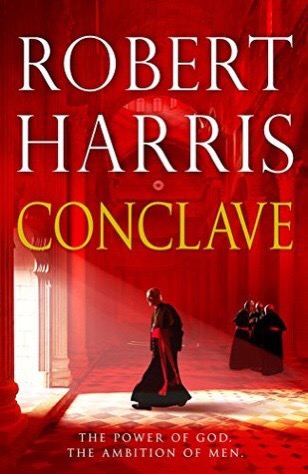
The pope is dead. It falls to Cardinal Lomeli, Dean of the College of Cardinals, to oversee the Conclave to elect the new pope.

The one hundred and eighteen men who gather to elect a new pope are a diverse mix: conservatives and liberals from every corner of the world, some desperate for the prize, some dreading the prospect.

I started reading this book the day after Donald Trump was elected, on a minority of the votes as it transpired, as President of the United States. I was desperate for a story to transport me from the bleak reality.

It can be a bit hit and miss on the cheeriness front with Harris – things turned out okay for Dreyfus in An Officer and a Spy, Cicero not so much. But Harris always puts together a good political thriller, and this is no exception with the growing tension as the voting in the Sistine chapel proceeds.

At the heart of the story is Lomeli, a man of faith and doubt, trying his best to behave honourably in the face of the dark secrets and challenges that emerge. I don’t know what Harris’ own religious views are but he provides a deeply sympathetic and empathetic account of the beliefs and thinking of the high cleric and committed Catholic at the heart of the story.

As a remarkable coincidence after I finished this book early one morning I switched on the television to see a 2011 interview with Robert Harris talking about Graham Greene’s novel, The End of the Affair. In the interview Harris concluded that there has never been anyone who can quite fill the gap left by Greene, a writer of gripping thrillers which wrestled with serious moral concerns and complex philosophical issues. I’m not so sure that since he gave that interview in 2011, Harris himself hasn’t made a creditable claim on Greene’s mantle.

The Modi Effect, by Lance Price

Summary: A Spinner gets spun.

img_1032

Lance Price presents his book to Prime Minister Modi

The first and most important thing that Lance Price wants you to know from his book The Modi Effect, is that he, Lance Price, is a BIG DEAL. He has worked for Tony Blair as his Director of Communications. He has met Margaret Thatcher and Barack Obama. He even once had a 10 minute conversation with Nelson Mandela.

So it is only natural that Narendra Modi should chose him, Lance Price, to write this book on Modi’s successful 2014 election campaign. Price suggests this is an act of particular self confidence on Modi’s part, because someone who is as BIG a DEAL as Lance Price is not to be trifled with. “You can’t spin a spinner“, Price informs us early on, because he is a BIG DEAL, and used to work for Tony Blair.

To which I thought, “Hmmm… lets see.”

The thing is though Price is not really interested in India, per se. Price is interested in elections. So he is only interested in India insofar as it relates to his story of the conduct of this election. And he is interested in Modi because he won an overwhelming electoral victory in the world’s largest democracy.

Hence we get extensive passages on Modi’s personal fashion sense, branding, merchandising, manifesto writing, use of social media and technology, including the tour through rural areas of his hologram so he could make speeches to communities with no electricity or television. The deeper question, of what Modi really believes and represents is addressed in only a fragmentary fashion

Price discusses some of the key controversies relating to Modi, in particular his relationship with the RSS, the ideological parent of the BJP that many progressive Indians accuse of neo-fascism, Hindutva – the ideology of Hindu nationalism, and the 2002 Gujarat riots in which a thousand people, mostly Muslims, were killed on his watch as Chief Minister of the state. But Price insists on casting these issues in the most benign light possible. The RSS, he suggests, may be no more sinister than the UK’s trade union movement. Hindutva as espoused by Modi, shouldn’t really be seen as that antagonistic towards India’s non-Hindus.

As for the Gujarat riots of 2002, the Indian Supreme Court itself found that Modi couldn’t be held culpable. This may be true. Nehru should not be held directly culpable for the atrocities during the partition of India. But then Nehru spoke loudly against the bloodshed, personally faced down Hindu mobs to protect the lives of Indian Muslims, and ultimately managed to bring Nepalese and southern Indian troops into place to stop the killing. The best that Modi, that master of language, could bring himself to say regarding the bloodshed was if “someone else is driving a car and we’re sitting behind, even if a puppy comes under the wheel, will it be painful or not? Of course it is.”

Price notes that following the 2002 riots Gujarat has been peaceful and economically prosperous under Modi’s rule. Perhaps that shows his enlightenment? Perhaps it shows an effectively terrorised minority? Rather than deign to talk to Gujarati Muslims, Price is content that the carnage of the Gujarat riots “pains” Modi “greatly“.

But the fact that Modi has never been forceful in his denunciation of the 2002 or other alleged Hindu atrocities indicates, at best, a profound cynicism on Modi’s part, that he is not prepared to alienate even his most fratricidal potential supporters. The conduct of the 2014 election in Uttar Pradesh, in which Modi’s BJP stirred up caste and sectarian prejudices to win the election is further evidence that his BJP is less benign than Modi would like to portray. In two of the more interesting chapters towards the end of the book Price finally seems to recognise Modi’s silence on these issues cannot be excused as a mere political calculation, but rather they indicate a profound moral failure, that as elected leader of India Modi is making no effort to confront some of the darkest and most atavistic aspects of Indian society that have disfigured the world’s largest democracy since independence.

Overall The Modi Effect has some interesting information, but it would have benefited from a greater interest by Price in Indian politics instead of just Indian elections. And it would have benefited even more if Price had perhaps been a little more interested in the lives and experiences of the millions of Indians who are not so nearly as BIG a DEAL as he is.

The Pigeon Tunnel, by John Le Carre

Summary: just what he wants you to know

The Pigeon Tunnel is a memoir presented in the form of short stories and vignettes from the Irish author’s life. Some are extremely funny. Some, such as his brief appreciation of his friendship with the late ITN newsreader Reggie Bosinquat, or his disclosure of how he came upon the character of Issa in A Most Wanted Man, are very moving. Some shine an unexpected light on aspects of world affairs in forlorn and forgotten places over the past 40 years. All are exquisitely written.

I cannot recall enjoying many books as much in recent years. And yet I am not sure I know David Cornwell, John le Carre’s alter ego, any better having just finished this book. Le Carre tells us much about the things he has done and seen, including, towards the end, a beautifully written chapter on his relationships with his parents, in particular his con-man father, Reggie.

Irish writer John le Carre, aka David Cornwell

But there is always a sense that le Carre is only prepared to disclose so much and is wholly in control of those portions of his biography that he is prepared to be known. He is substantially silent, of course, on much of his work as an MI6 officer. But he is also very silent on his love and family life: siblings and offspring are referred to with much affection but little information; the ending of his first marriage is referred to only obliquely, as is his finding love with his second wife, Jane.

In truth Le Carre’s subject in The Pigeon Tunnel, is not David Cornwell, but the books that Cornwell wrote under this nom de plume – their points of origin, the research undertaken to bring them to publication, and, occasionally the adventures involved in transposing them to film, including getting to know Richard Burton during the filming of The Spy who came in from the Cold.

It’s a lovely and frequently fascinating excursion with one of the finest writers of English. Treat yourself and read it!

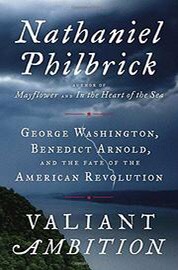
Valiant Ambition – George Washington, Benedict Arnold and the fate of the American Revolution, by Nathaniel Philbrick

Valiant Ambition is a sequel to Philbrick’s Bunker Hill. That prior book dealt with the origins of the American War of Independence in Boston, and covered key events including the Boston Massacre, the Tea Party, the initial clash of arms at Lexington and Concord, Bunker Hill, where the American’s didn’t shoot until they could see “the whites of their eyes”, and Washington assuming command on the death of General Warren and finally driving the British from the city.

This book takes up the story with Washington’s incompetent defence of New York, his retreat into New Jersey and crossing of the Delaware in a desperate attempt to maintain some cohesion to his army, before his extraordinarily courageous counter attack, re-crossing the Delaware in mid-winter.

img_1012

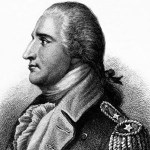
Benedict Arnold

In parallel with Washington misadventures Philbrick describes the altogether more effective military exploits of Benedict Arnold, whose extraordinary courage and aggressive instincts time and time again thwarted British stratagems to snuff out the rebellion.

Arnold’s name has become a byword for perfidy in the United States. But Philbrick reminds us just how vital his role was in securing American independence. Philbrick notes how it was American victory in the Saratoga campaign which convinced France to enter the war on the side of the United States, and that it was Arnold’s actions at those battles that, more than anyone else, secured the victory.

But Arnold was a particularly thin skinned soul, and his shoddy treatment by the Continental Congress stoked his alienation eventually leading him to explore the possibility not only of defecting to the British, but inflicting a devastating blow to American independence by surrendering the fortress at West Point.

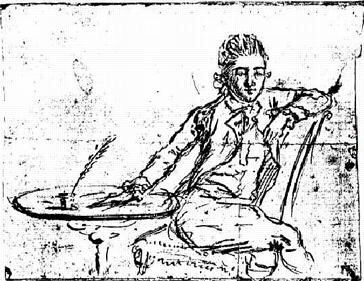
Self portrait of John Andre

Towards this end he established a line of communication with Major John Andre, a young British officer who had risen to the role of adjudant to Sir Henry Clinton, the British commander in New York. By Philbrick’s account Andre is not the honourable officer of legend, brought low also by Arnold’s treachery. Rather Philbrick notes that he was a hugely charming and erudite officer but a thoroughly ambitious one with a ruthless streak, previously demonstrated by is involvement in actions that verged on being war crimes.

Philbrick argues that it was Arnold’s treason that was decisive in uniting the nation behind the cause of independence: one could get only so far with the inspiration of the heroic Washington, he argues. What the young nation really needed was a villain and Arnold, previously the most effective battlefield general in the American army, filled that role to perfection.

It is an intriguing tale. Doubtless Philbrick is already working on a follow-up.

Career of Evil, by Robert Galbraith (JK Rowling)

img_0957A package is delivered by courier to Robin, the assistant of private detective Cormonon Strike. It contains not the wedding-related paraphernalia that Robin had been expecting, but a human leg.

When the police arrive they ask Strike whether he can think of anyone who would want to send him a human leg. No, answers Strike, I can think of three.

And so begins the third of the adventures of Strike and Robin, the protagonists of JK Rowling’s superb “Robert Galbraith” authored detective series. Strike and Robin remain compelling characters with their evolving friendship and work relationships as intriguing as the crimes they are investigating. But this particular investigation gets rather too close to home for comfort, stirring up elements of their personal histories that still haunt them.

It is at times a frightening and grizzly affair. In a series of chapters that intersperse the main narrative Rowling attempts the distasteful task of getting into the mind of a misogynistic serial killer. It is a brave and unsettling thing to do, and also, necessarily, deeply unpleasant. I was at times tempted to skip these chapters because of that. But they are important inclusions as Rowling seems determined that this book should not be simply a hugely entertaining procedural, but also one that does not allow the reader to lose sight of what disgusting things violence and misogyny are. In this there is a strong echo of Stieg Larsson’s Millennium trilogy, though with a much less overt political agenda to Larsson.

Overall a great addition to a series that I hope will run and run.

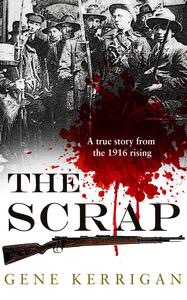
The Scrap, by Gene Kerrigan

Summary: a volunteers’-eye perspective on the 1916 battle


The Scrap is an account of the 1916 Rebellion. Like many other fine accounts, such as Charles Townshend’s, it draws heavily on the archives of the Irish Bureau of Military History, which years after the Irish War of Independence gathered the oral testimony of the survivors. But where other accounts seek to tell the story of the overall battle, Kerrigan’s focus is on a relatively small group of participants, principally the members of F Company of the Irish Volunteers.

This perspective reminded me of Cornelius Ryan’s frontline account of D-Day, The Longest Day. The result is a hugely rich work, which offers, at least to me, a whole array of new detail and insights on the fighting. For example I never knew that Oscar Traynor, a future commander of the Dublin Brigade of the IRA, had been professional goalkeeper for Belfast Celtic. Or that Arthur Shields, the actor who was a regular member of John Ford’s company perhaps most famously playing the Church of Ireland vicar in The Quiet Man, was a veteran of the 1916 Rising. Or that the rebels had made radio broadcasts from O’Connell “Sacksville” Street to announce the Irish Republic to the world.

John Wayne, John Ford, and Arthur Shields on the set of The Quiet Man

In the midst of this there is further important detail on aspects of the fighting including initial clashes in the north of the city around Fairview, at the City Hall, and a worm’s eye view of the desperate fighting around Henry Street in the final hours of the Rebellion. The book also throws interesting light on the actions and decisions of the leaders during the Rising, particular Pearse, Connolly and McDermott.

Kerrigan does not shy away from the horrors of the battle either. In one disturbing passage a medic examines the head of an injured child in the darkness, accidentally running his fingers across her mouth and feeling her teeth. When a light is brought he finds that he has actually run his hand across a gaping wound in the dying child’s head.

Gene Kerrigan is a legendary journalist and makes no attempt to dress this book up as academic history: there are no footnotes, for example. He is also an exceptionally gifted writer and this is a remarkable and arresting contribution to the literature on the1916 Rebellion, giving a strong sense not just of what happened, but what it was like to be there.

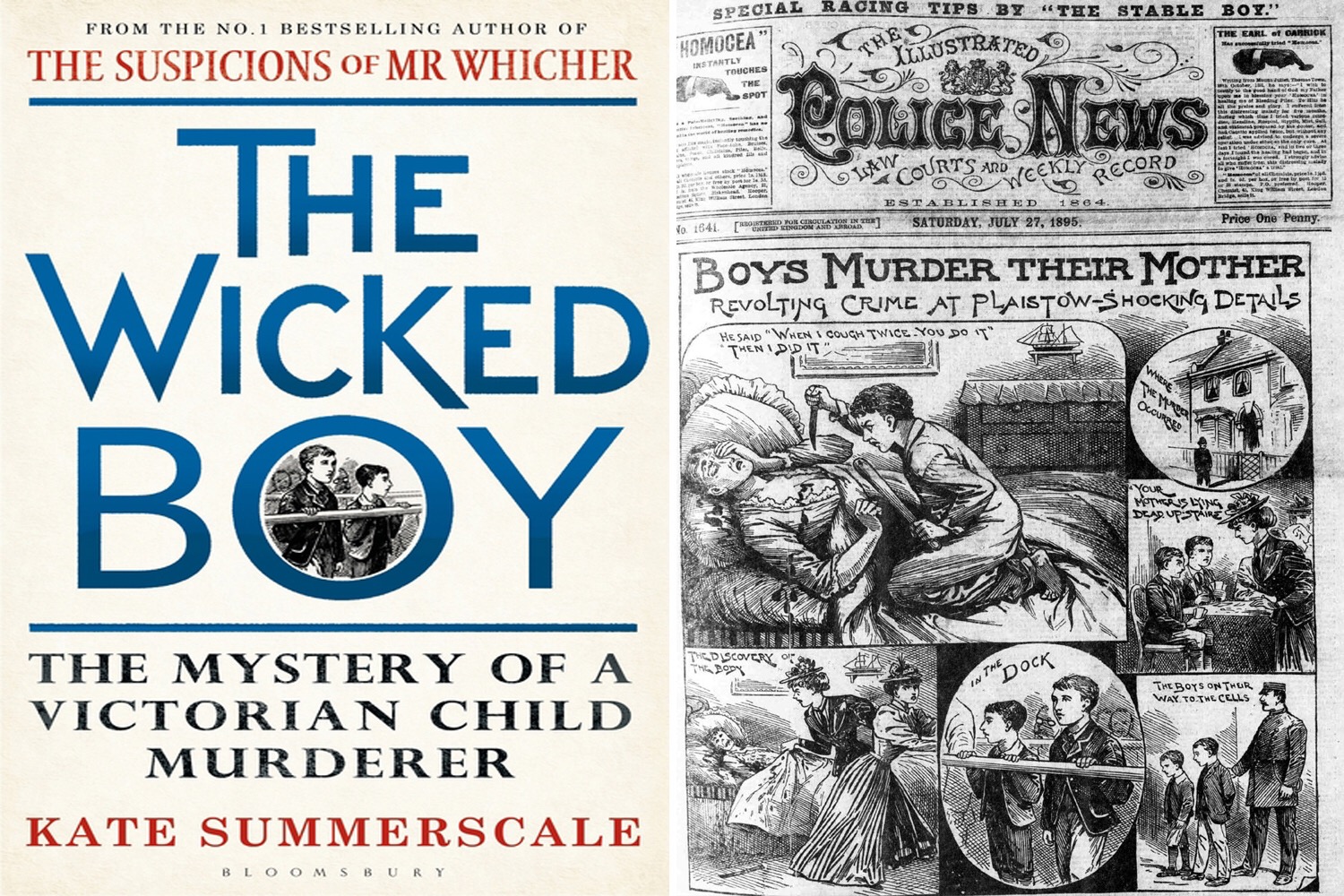
The Wicked Boy: The Mystery of a Victorian Child Murderer, by Kate Summerscale

Sometime during the weekend of 6/7 June 1895 Robert Coombes killed his mother with a hunting knife he had purchased a few days earlier. His mother’s body was not discovered for another 10 days. When it was finally found it was still in the bed where she had died and in an advanced state of decomposition. During that time Robert and his younger brother Nattie had stayed in the same house and amused themselves by, among other things, excursions to the cricket in the Oval.

The case was a sensation of the day and provided an opportunity for all sorts to give vent to the moral decline of society and the delinquency of youth.

There was no doubt about Robert’s guilt, but the jury baulked at sending a child to the gallows, so found him instead guilty but insane. He was sent to Broadmoor for the criminally insane and spent 14 years there, in, perhaps surprisingly, a progressive and rehabilitative environment. Robert was finally released into a Salvation Army community where he worked as a tailor, a skill he had learned in Broadmoor.

Eventually he emigrated to Australia and with the outbreak of the First World War, he joined the Australian Army and served with distinction throughout the war, in particular as a stretcher-bearer in the bloody fighting of Gallipoli.

Kate Summerscale’s book is a remarkable thing: it is part biography of Robert, part social and military history. At its heart though it is a story of redemption, of how a disturbed boy became a quietly extraordinary man. It is a compelling and moving story, elegantly written by a writer with a genuine feeling for her story and her subject.

Muhammed Ali

When We Were Kings, by Leon Gast
The Ghosts of Manila: The Fateful Blood Feud Between Muhammad Ali and Joe Frazier, by Mark Kram
The Tao of Muhammed Ali, by Davis Miller 

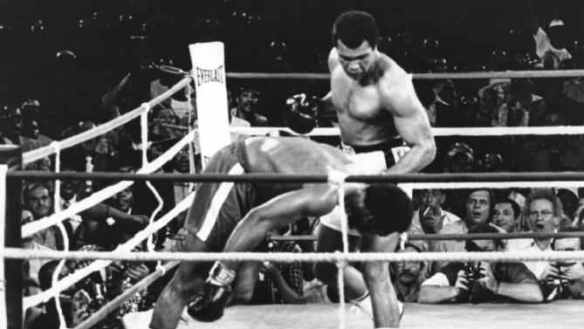
img_0912My first proper memory of Muhammed Ali was waking up to the news of his victory over George Foreman in Kinshasa in 1974. I watched the BBC Sports film of the fight the next evening. It was  awe-inspiring.
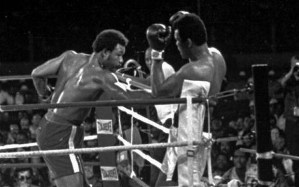
This fight is the principle subject of Leon Gast’s electrifying documentary When We Were Kings. The bloody, thieving, murderous dictator of Zaire, Mobuto, had decided that the world heavyweight title fight would help put Zaire on the world stage. Gast’s movie is an account of the extraordinary circus that resulted. It intercuts documentary and news footage from the time with illuminating interviews with, among others,  George Plimpton and Norman Mailer, on the bizarre circumstances surrounding the fight, and on the phenomenal fight itself.

When We Were Kings is a great introduction to Ali, both as a cultural and political figure and as a boxer. His victory is beautifully explained as one not just of his technical fighting skills, but of his strategic thinking skills.

image

Rope-a-dope

Years later George Foreman described the devastation of having been beaten by someone so “braggadocio”. This is but a hint of the darkness that is frequently ignored in discussions of Ali. This comes much more to the fore in the Ghosts of Manila, an account of the rivalry between Ali and the great Joe Frazier. Frazier had been a supporter of Ali in the wilderness years when Ali had been stripped of his licence to box because of his courageous refusal to fight in Vietnam: “I ain’t got not quarrel with the Viet Cong. No Vietnamese ever called me nigger!” he said by way of explanation.

However this was no protection to Frazier from Ali’s often cruel and lacerating invective. Frazier came to detest Ali and their brutal fight in Manila in 1975 has become a thing of legend.

image

Manila

Both fighters inflicted incredible damage on each other in dreadful heat, displaying incredible levels of endurance and courage just to keep up with each other. However by Kram’s account Frazier had effectively won the fight by rendering Ali unable to take the ring for the 15th and final round. All Frazier needed to do was to stand up. Then his manager, without consulting Frazier, threw in the towel, appalled at the damage that Frazier himself had already sustained in the fight. Frazier never forgave his manager and this extraordinary stroke of luck for Ali became a fundamental element in his legend.

But brutal fights such as Manila and the necessity to fight on almost to middle age that resulted from the loss of his license in his peak years, took their toll on Ali’s body and resulted in the Parkinson’s Disease that afflicted his final years. Davis Miller had met Ali at the peak of his career but became friends with him in these years. The Tao of Mohammed Ali is about a number of things including this friendship, writing, boxing, and perhaps most poignantly about Miller’s relationship with his own father. It is a fine and moving book that describes beautifully what Ali meant to ordinary fans, millions of who are today bereft at the news of his death.

The world is a duller, smaller place with Ali gone. But in many ways it is a better one in part because of what he did and what he stood up for. We will never see his like again.

image

Ali delivers the coup de grace on Foreman (Plimpton and Mailer look on – bottom right)


Early Autumn, by Robert B Parker

Spenser is hired to find a kid who has become a bit of a ping-pong ball in a bitter divorce. What starts as a routine case is complicated by Spenser’s realisation that neither parent actually cares about their son. Always a bit of a softy, Spenser decides to take the kid under his wing to teach him to build, box, cook and the rudiments of feminism.

Early Autumn is a similarly themed book to Sixkill, the last Spenser novel written by Robert B Parker. It is about mentoring, perhaps even fatherhood, and how boys learn to become men. This leads to much of Spenser’s trade-mark philosophising and wry observations on life.

This being Spenser, of course, his chivalrous act upsets some nasty Boston hoodlums and so Spenser and his buddy Hawk are compelled to show these gangsters the errors of their ways.

In other words this is another fine chapter in the chronicles of Spenser – an efficient and thoughtful thriller without a word wasted.

Burial Rites, by Hannah Kent

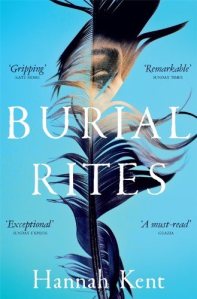
imageAgnes Magnusdottir has been condemned to death for her involvement in the murder of two men, one of them her lover. As she awaits confirmation of her sentence she recounts the events leading up to these deaths to a young priest, appointed as her spiritual advisor, and the members of the family she has been billeted with.

Burial Rites is a sort of a Nordic “Crime and Punishment”. It is beautifully written and desperately sad, a story of both the physical violence that destroys lives, and the violence of poverty that destroys hope as well.

It is a very rich book – a portrait of a poor rural community on the edge of the world in northern Iceland at the beginning of the 19th Century; a whodunnit; a book about the redemptive power of decency.

At the heart of the story is Agnes – a fiercely intelligent woman cursed by the bad luck of her birth – finally finding a place in a family and a community as a sword of Damocles, in this case an executioner’s axe, hangs over her.

It is a fine work, extraordinary also that it is Hannah Kent’s first novel.