Times that try men’s souls: David McCullough’s 1776

Washington Crossing the Delaware by Emanuel Gottlieb Leutze

Summary: a gripping account of the beginning of the American war of independence

This is an exceptionally gripping work of narrative history. Written as a companion to McCullough’s John Adams this book focuses on Washington from his appointment as commander of the Continental Army to his crossing of the Delaware at Christmas 1776 to mount a surprise attack on the British forces that had routed him from New York. What makes that story so remarkable is its consideration of the leadership of Washington, most particularly how he turned around his fortunes, and those of the American Revolution, from their nadir following his poor generalship in New York which led many of his closest lieutenants to lose confidence in him.

McCullough conveys in his narrative the extraordinary steeliness of Washington when faced with this crisis and which was core to his historical greatness. President Obama in his inaugural address cited Washington’s crossing of the Delaware in mid-winter as an example of the sort of courage in the face of adversity that was necessary to deal with America’s current travails, and this story can be inspirational to non-Americans (such as myself) or anyone faced with personal or professional reversals.

This is a compelling work, beautifully written, deeply exciting and a great introduction to this period of American history.

What is past is prologue: Warsaw 1920 – Lenin’s Failed Conquest of Europe, by Adam Zamoyski

Summary: a brief but clear and gripping account of one of the pivotal battles of European history

This is a fine, concise account of the war between the Soviet Union and Poland in 1920 and particularly the climatic battle of Warsaw. The book focuses primarily on Józef Pilsudski, the Polish head of state who commanded Polish forces in the war and was architect of the victory, conceiving of a manoeuvre, highly reminiscent of Hannibal’s tactics at Cannae, that led to the Soviet rout. However the author also recognizes the pivotal role played by General Wladyslaw Sikorski, Poland’s Second World War leader until his assassination by the Soviets (probably by the British traitor Guy Burgess using the agency of MI6), in the defeat of the Red Army on the Vistula.

Zamoyski argues that Stalin, who was part of the Soviet Army devastated by the Poles in 1920, developed a pathological hatred of the Poles as a result of this that culminated in his massacre of Polish prisoners of war in Katyn. Interestingly this is the motive that Putin also ascribed to Stalin when he finally publicly acknowledged Soviet responsibility for the Katyn atrocity. Hence the book reads, ultimately, as a prologue to an even greater tragedy, when many of the actors in this drama were cruelly murdered and Poland itself dismembered by the Nazi-Soviet alliance.

In spite of that this is a gripping work on a pivotal and ill remembered aspect of history.

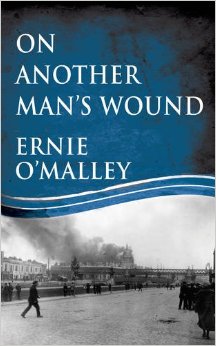
War and its consequences: Ernie O’Malley’s On Another Man’s Wound

on-another-mans-woundSummary: a masterpiece with resonances and relevance beyond its geographic and historical contexts.

“On another man’s wound” is generally regarded as the only personal account by an Irish War of Independence commander that has true literary merit. It is a beautifully written and gripping narrative of O’Malley’s experiences from 1916 to 1921. The book is packed with incident from initial observations on the 1916 rebellion to guerrilla action in the South, to his capture in Kilkenny, subsequent torture, and his participation in the only successful escape from Kilmainham gaol in Dublin. Along the way there are interesting pen portraits of many of the leading figures of the time including Erskine Childers, Liam Lynch, and, not least, Michael Collins.

At its heart the book is a remarkably honest account of the brutalising effects of war: Towards the end O’Malley describes unflinchingly his decision to murder three captured British soldiers just before the Truce. The effect is both chilling and moving: O’Malley’s literary acheivement is to show how his personal experiences are representative of all soldiers in war, which can transform idealistic youth into diminished and bloody men in a pattern that is repeated through history and across the world to this day.

As such the book retains a relevance beyond it geographic and historical contexts: It speaks a truth that should be remembered by all contemplating sending young people to kill and die on behalf of some cherished cause, particularly if the closest the decision-makers have been to war is an Oxford PPE course or a London law chambers.

A German Odyssey: Field Gray by Philip Kerr (A Bernie Gunther novel)

I had not come across Bernie Gunther before this book, the seventh in a series but one that stands up very well on its own.

The jacket note describes the book as relating to Gunther being press ganged into working for the French intelligence service to identify a war criminal. But this is merely an element in a plot that sprawls across 23 years, taking in the rise of the Nazis, the occupation of France, the invasion of Ukraine, the battle of Konigsberg and the fate of German prisoners in Russian hands after the war. Heydrich and Graham Greene have walk on parts in the novel along with a variety of other real people.

To say the novel is a thriller may be true, but it is not like any other thriller I have read. It is also part war story and a meditation on German history in general and its war and war crimes on the Eastern front in particular. This historical aspect of the story is compelling enough in itself, but a dramatic arc is also established across the book through the relationship relationship between Gunther and another real individual co-opted into the narrative Erich Mielke, a veteran German communist.

In the Russian camps a character alludes to the Odyssey, and this more than Raymond Chandler is the template upon which this story plays out. Gunther here is a wise cracking Odyesseus, brilliantly cunning but, after the war, cursed to wander the world remembering his Penelope as he searches for his home.

Father of US government, grandfather of emancipation: Ron Chernow’s Alexander Hamilton

Alexander HamiltonA truly outstanding, elegantly written, warts and all, biography of a facinating individual. It throws light not only on Hamilton’s life and death at the hands of Aaron Burr, the US Vice President, but also on the Revolutionary war, the drafting of the US constitution, the establishment of US government and finance, and the beginnings of the fault lines that divide US politics to this day: On the one hand the Federalists with their strongly nationalist view of the US and the importance of federal government; on the other hand the Republicans with their promotion of “states rights” and nonsensical fantasies about small government and citizen farmers. Along the way we learn of the first sex scandal in US political history and the strange mores and tragic consequences of the late 18th century duelling culture.

The divisions at this period in US history were described in short-hand by the attitudes to the French Revolution. However it is interesting that while Hamilton and the Federalists were generally Anglophile and deeply distressed by the bloodshed and chaos of the French Revolution, they seem to have been little troubled by the exercise of British power, which between 1796 and 1798 massacred more people in Ireland than died in the entire three years of the French Terror – there is not a single mention of this sanguinary episode of European history in the book.

Towards the end of the book Chernow notes how many of the Republican “slave holding populists were celebrated by posterity as tribunes of the common people. Meanwhile, the self-made Hamilton, a fervent abolitionist and a staunch believer in meritocracy, was villanized in American history textbooks as an apologist of privilege and wealth”.

Countering this tendency in histography Chernow casts Jefferson as villian of the piece, even more so than the murderous Burr, for professing himself an abolitionist but, unlike Washington, never freeing his own slaves and advocating both an economy that was only sustainable through the enslavement of hundreds of thousands of human beings, and a polity that facilitated and rewarded slavery.

In contrast it is clear from Chernow’s work that, in addition to establishing US credit and effective government, a central part of Hamilton’s political project was building in the US an economic system that could not only be sustained without slavery but could also contribute its eradication. While the elimination of slavery ultimately took a civil war Hamilton’s work did provide the North the economic capacity to destroy the slave holding south 60 years after his death. For this, I would argue, that if Lincoln was the “father” of emancipation Hamilton could perhaps be regarded as its “grandfather”.

Chernow makes the argument that, with Washington, Hamilton, for all his faults, was the greatest of the Founding Fathers of the United States. Chernow describes him as the “father of US government”. On the basis of the evidence he presents it is a difficult argument to refute, and, in this time of Tea Party lunacy, his life and achievements are worth celebrating again.

Remembering properly the central event of European history: TImothy Synder’s Bloodlands

Timothy Synder strives with this book to repudiate the anonymity of the mass murders of the twentieth century, reminding the readers that each death represenented an individual human being with all the flaws and hopes of any reader.

Central to his achievement is his taking of a holistic approach to the atrocities, considering not just the policies of Hitler and Stalin separately but in interaction, and considering the Jewish, Polish, Ukranian and Belarusian tragedies in their totality rather than in isolation. This approach is perhaps best exemplified by his consideration of the Warsaw uprisings: here the distinctively Jewish character of the 1943 Ghetto uprising is recognised but not to the exclusion of its Polish character, as demonstrated by the alliance between the Ghetto fighters and the Home Army. Likewise the Jewish contribution to the 1944 Warsaw uprising is discussed: For example after the Home Army liberated the Warsaw concentration camp many of the Jewish slave labourers joined the Home Army, “fighting in their striped camp uniforms and wooden shoes, with ‘complete indifference to life or death'”. (p. 302)

This approach also draws out some uncomfortable ambiguities: Tuvia Bielski, for example, is one of the incontrovertable heroes of the book. His exploits, depicted in the film “Defiance”, saved hundreds of Jewish lives in what is now Belarus. In order to do this he established an alliance with Soviet partisans, which ultimately meant he, a former Polish soldier, was directly involved in the suppression of the Home Army by the invading Soviets in 1944(something not depicted in “Defiance”).

In consciously repudiating more simplistic narratives Snyder make a profoundly important point: horrendous as the history of this time and this place is, it is a central episode of human history. Presuming that this was the work of monsters threatens that we may blunder into perpetrating such atrocities again.

This is a hugely important book: an awesomely impressive research undertaking resulting in an exemplary work of history, beautifully written, horrific and deeply moving by turns. It should be read be everyone with an interest in humanity itself.

Anatomy of a Moment, by Javier Cercas

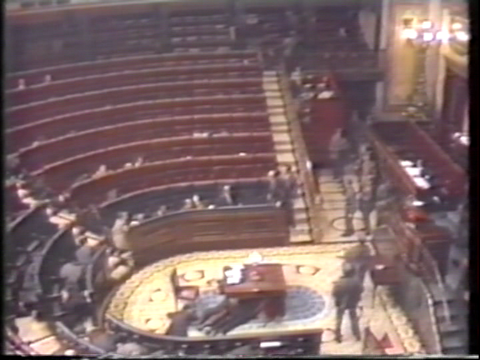
ub_tejero_coup_etatSummary: The lad battle of the Spanish Civil War?

Following his unconvincing meditation on American atrocities in the Vietnam war in “The speed of light” Javier Cercas returns to his own country’s history for his latest work. “The anatomy of a moment” revisits the theme of the Spanish Civil War and its consequences that Cercas so brilliantly explored in “Soldiers of Salamis”. However in his new book he eschews fiction, even the “post-modern” variety that he practices, which blurs the distinction between the real and the imaginary. Instead he employs a part philosophical, part journalistic meditation on the 1981 attempted coup to overthrow Spanish democracy.

“The anatomy of a moment” focuses on the three parliamentarians who refused to duck when the Civil Guard who invaded the Cortes opened fire. They were Gutteriez Mellado, a former Francoist general now deputy Prime Minister, Santiago Carillo, head of the Spanish Communist party, and Adolfo Suarez, the outgoing Prime Minister. Suarez is above all the hero of the book – in Cercas account a Francoist functionary and “provincial non-entity” who grew into the architect of democracy and a giant of Spanish history. The author returns again and again to the image of Suarez sitting alone on the prime minister’s bench as the bullets fly around him, one of only three people prepared to risk their necks while those with more impecible democratic credentials cower behind their desks, as most of the rest of us would naturally and rationally have done in similar circumstances.

Parts of the book are difficult – the author talks to the reader as if they are already au fait with the history and politics of Spain. This leads, I thought, to a richer experience than books which spoonfeed the reader the historical background: in the end you feel you have earned the understanding you have achieved.

In places the book has the characteristics of a non-fiction thriller as the details of both the coup, led by senior elements in the army, and the countercoup, led by the King, are plotted. The book is also very moving, particularly regarding the travails of Suarez in later life, and a deeply affecting coda when the author reflects upon the life and politics of his own father.

The book is also deeply political, rejecting a current view prevalent in Spain that the rupture between Francoism and democracy was false and that Suarez ensured that those who had power under the dictatorship retained it under the constitutional monarchy. Cercas argues instead that the rupture was real and that Suarez was a “hero of the retreat” from dictatorship. That the author is prepared to set out such forthright opinions on this and other aspects of the coup add to the pleasure of the book: it is widely researched, deeply opinionated history, provocative, but not gratuitously controversialist. It demands the reader thinks while keeping them entertained.

A great book.

Empire of the Summer Moon – Quanah Parker and the Rise and Fall of the Comanches by S.C. Gwynne

PortraiSummary: Brilliant, but not the whole story

This book is a fascinating look at the rise and fall of the Commanche nation. Its intensely exciting and sympathetic to Native Americans in general and the Commanche in particular. However it is also intensely violent, taking a clear sighted, almost forensic, look at the practices of Commanche war-making, particularly their routine use of rape and torture.

(Speaking as a Celt myself) the author draws a not unreasonable comparison of Comanche warfare to Celtic warfare of a bygone era to undermine any racist presumptions about the origins of warriors cruelty. He also notes the intensely political purpose behind Comanche terrorism on settlers and buffalo hunters, and that Texan warfare was itself brutal and racist. However while he spends time describing Comanche violence in some detail, he frequently skates across comparable white violence – explicitly avoiding a deep discussion of the Sand Creek massacre for example.

The author appears to like and admire Quanah, particularly the Quanah of later years who struggled to lead his people in peace after years of violence. Quanah described himself as having been a “bad man” but in later life he appears to have become a warm and generous one with little animosity to whites. However the author’s real hero in this book seems to be the enigmatic Col MacKenzie, Quanah’s nemesis, rather than Quanah himself. One should be grateful to the author for bringing this fascinating man and his role in the violence of the era to greater public attention: for all his crankiness he stands in a much more positive light that the strange, and more infamous, figure of Custer.

For those interested in Hollywood history the author notes how the story of Cynthia Ann Parker, Quanah’s mother, was the inspiration for arguably John Ford’s second greatest Western (after The Man Who Shot Liberty Valance), The Searchers. However he doesn’t mention that MacKenzie seems to have been Ford’s model for Lt Col Kirby Yorke in Rio Grande, another one of John Wayne’s classic roles: the climax of that film – the Colonel leading his troopers into Mexico to attack the Apache on Sheridan’s orders – is something that the author mentions MacKenzie actually did when not fighting the Comanche.

It is a book that can comfortably sit alongside Dee Brown’s classic “Bury my heart at Wounded Knee” and which complements it, providing greater detail to some aspects of that book and a deeper understanding of the politics and attitudes of white America to Native Americans in the course of their conquest.

The setting of the sun on the British Empire: Alex Von Tunzelmann’s Indian Summer

imageSummary: a lucid and witty addition to the literature on the British Empire, its greed, incompetence and atrocities… though Edwina and Dickie were decent enough old sticks

The sub-title of this book, “The secret history of the end of an empire” is probably a bit misleading. It seems to derive from the author’s very sympathetic exploration of the not very secret menage à trois that developed between Edwina Mountbatten, Nehru, and Edwina’s husband Louis, the last Viceroy. Rather than a secret history this is a fine narrative history of the coming of Indian and Pakistani independence and the bloody aftermath. Nehru and Edwina Mountbatten are the author’s particular heroes, though she also seems to have a healthy respect for Jinnah and Gandhi, and a soft spot for Lord Louis “Dickie” Mountbatten who, for all his limitations, comes across as a very likeable and fundamentally decent chap.

There is much else to admire in the book, not least the author’s portrayal of the true awfulness of the carnage that erupted with partition and her assessment of controversies, such as the origins of the Kashmir conflict, I found fair-minded and careful. Personally I was left with a much more negative opinion of Gandhi as a result of reading this book: He was unquestionably a brave and principled man of considerable moral courage, but his calling a halt to the campaign for the British to quit India in the 1920s seemed to have meant the loss of an opportunity for Indian independence unsullied by partition, and the holocaust that entailed. Others may prefer to emphasize the failures of twentieth century British policy towards India, up to and including the management of their departure. However given Gandhi’s retrogressive position on caste it is probably time for a more sober reassessment of the man’s life and achievements.

As a bonus the author also has a lovely gift for humour and the narrative is peppered with some excellent jokes that emerge naturally from her account, rather than being shoe-horned into it. The result is an elegantly written and erudrite popular history of run up to Indian independence and the bloody chaos of the sub-continent’s partitioning.

Citizen philosophers and a dimwit go to war for Old Ireland: my review of Insurrection by Liam O’Flaherty

imageLiam O’Flaherty’s 1950 novel is an account of a small group of rebels progress through Easter Week 1916, starting with the storming of the General Post Office, through an action clearly based on the intense fighting around Mount Street Bridge, to the final hours around the GPO leading up to the surrender.

As in his books Skerrit and The Informer, O’Flaherty’s principle protagonist is a pretty dim one, in this case a Connemara man Bartley Madden, who is transformed, though not intellectually, by his experiences during the novel. How much you enjoy having a Stage Irishman at the centre of the novel you are reading is probably a matter of personal taste, but I could have done without it. Such a device seems to have been chosen by O’Flaherty in order to explore his political and philosophical ideas, and it is these more than the fighting that are central to his concerns in this novel.

And, unfortunately this makes for a rather unbelievable and clumsy novel. Pages are taken up with philosophical and cod-philosophical discourse. Perhaps this is how soldiers, most particularly citizen-soldiers, spend their time in battle. But even if it rings true I found many of their conversations uninteresting and the view of O’Flaherty, who had been a combatant in both the first world war and the struggles around Irish independence, bleak.

Those who know a little about the 1916 rising will recognise that O’Flaherty is generally faithful to the course of events and the geography of Dublin. However if one is searching for a gripping introduction to the 1916 rebellion, Charles Townsend’s historical account is both more informative and, for me, much more exciting.