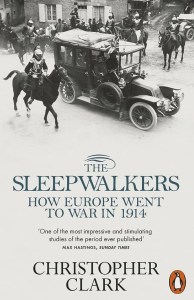
In search of the Dark Ages, by Michael Wood

Summary: a fine introduction to pre-Norman English history

Over the past 40 years Michael Wood has become known for his highly engaging television documentaries. Some of the books that this has prompted, such as The Story of India, are essentially travel books. Others, such as In Search of Shakespeare, are much more substantial affairs.

Fortunately, In Search of the Dark Ages falls into the latter category. It is a fine history of England from the departure of the Roman Legions to the Norman conquest. Along the way Wood throws out a range of interesting observations and asides, including a judgement that, based on what he wrote in his Confessions, St Patrick was probably from Carlisle.

In the latest edition of this book, Wood has added material on hitherto neglected figures and issues, including Aethelflaed (Millie Brady’s character in the Last Kingdom), who Wood judges to be comparable to her father Alfred in the making of a country called England, and Theodore of Tarsus and Hadrian the African who together established a school teaching the classics in Canterbury during the 7th Century. Just as is the case today, women and immigrants have contributed more to English society than many would like to acknowledge.

Overall then, a fine and entertaining work of English history before William the Bastard showed up in 1066 and helped make stealing other people’s countries the defining trait of the country he stole himself.

Empireland, by Sathnam Sanghera

Summary: a gripping and elegantly written survey of the bloody British empire and its echoes in the present day

Between 1845 and 1854 the population of Ireland was halved through starvation – over a million people died – and forced emigration. The English like to refer to this horrendous period as the “Irish Potato Famine”. This suggests the blame for the cataclysm lies with Irish people’s bizarre and somewhat comical taste for spuds, rather than upon callous government policy that thought the death of hundreds of thousands of Irish people a price worth paying for British profits in the agricultural free market.

Paradoxically Sathnam Sanghera sticks with this nomenclature in his exceptional book Empireland. This book both elucidates many of the other atrocities upon which the British Empire was built, and explores the imprint that sustained bloody exercise in pillage still leaves upon contemporary British society. The term “potato famine” is part of that imprint.

There is an echo in this book of Tom Holland’s Dominion, which explores how Christian thought – such as the ideas of human rights and secularism – has so fundamentally shaped European civilisation that the origins are now generally unknown and almost unnoticed.

The British empire brought nothing so positive as human rights to the UK let alone the rest of the world. Rather it became, for much of the world a byword for bloodshed and impoverishment. But the British – in marked contrast to those societies that were on the receiving end of their colonial project – are startlingly ignorant of what Empire entailed or of its repercussions through time. Few British people now have heard of the murderous British suppression of the Sepoy rebellion of 1857, let alone of the sacking of Tibet in 1903 – even though some of the extremely valuable loot once showed up the BBC’s Flog It while Sanghera was writing this book.

And yet the consequences of all that bloodshed is with us at every turn. The British Museum is stuffed with art treasures, such as the Benin bronzes, stolen in the name of Empire. London’s position as a major financial centre is a consequence of the preferential trade terms and punitive tax regimes that the Empire imposed on subject peoples. British xenophobia towards migrants is a contemporary manifestation of the racism of Empire. The presumption of the British ruling class that the rules – whether relating to human rights, trade or public health lockdowns – that apply to others should not apply to them are also echoes of the political economy of the Empire.

Indeed, Brexit may be regarded as the inevitable consequence of the racist logic that underpinned the British Empire: having no more colonies to pillage, the British Establishment instead decided to loot the UK.

Sanghera’s book is a superb and important introduction to this inglorious period of British history and its reverberations into the present. It is elegantly written, accessible, and vital for anyone who wants to understand better why Britain finds itself in its current morass.

I just which he would quit it with his talk of “potato famines”.

The Restless Republic, by Anna Keay

Summary: a fine and elegantly written, though overwhelmingly Anglo-centric, account of Cromwell’s dictatorship

In the 2001 film, Rat Race, one family participating in the race stumble upon a “Barbie Museum”. It turns out this does not house a collection of the beloved children’s toy, but rather is a homage to the Nazi war criminal, Klaus Barbie. As one of the deranged guides tell them, “People don’t remember just what a wonderful ballroom dancer he was.”

I thought of that movie while reading Anna Keay’s rather affectionate portrait of Oliver Cromwell in the Restless Republic. He may have overseen the massacres of thousands of people, soldiers and civilians alike, children, women and men, in his racist campaigning in Ireland – something that is mentioned rather than described in any detail in this book. But “Oliver” loved music and could be moved to tears at the accomplishments of his beloved children.

The planned wholesale theft of Irish land by the Cromwellian government and the planned complete ethnic cleansing of Catholics from eastern Ireland required remarkable technical organisation and unprecedented accomplishments in land surveying. This Keay does describe in admiring detail. But eventually, before it could reach its genocidal climax, this “ugly episode in Irish history” was brought to an end. Obviously, as Irish history, it is not something that the English need feel too much responsibility for.

Keay choses to tell the story of the short-lived English republic through the eyes of a range of characters, almost exclusively English, but including both Royalist and Parliamentarian perspectives. It is an imaginative approach and engagingly done, with a strong narrative drive. For example, towards the end, her account of Monck and Fairfax’s machinations to bring about the restoration of the monarchy is quite gripping.

Overall, the Restless Republic is an illuminating and elegantly written work of history. But, appropriate to the theocratic monstrosity of which Keay writes, and to the spirit of Brexit Britain too, I suppose, it is written with negligible empathy for the aspirations and experiences of those non-English people who bore, and continue to bear, the brunt of the English Parliament’s ignorance and crass prejudices.

Rome, by Robert Hughes

Summary: a shoddy swan song

You pick up a book by as renowned an art historian as Robert Hughes you think you can be confident in his erudition. With Rome, you will be disappointed.

I would not class myself as an expert on ancient Rome, but I have read a few books by proper authorities. Which seems to be more than can be said for Hughes. Perhaps he did once. But if he did, he did not bother checking any details and instead consigned his misrememberings to the page with gay abandon.

Rome was Hughes last published book. It put me in mind of John Keegan’s The American Civil War, and Christopher Hibbert’s The Borgias: shoddy final books by authors who had quite properly earned distinguished reputations for earlier work.

I read a review of this book by Mary Beard who suggested skipping the first five chapters – the ones that deal with her area of specialism, ancient Rome – so riddled with errors are they. But even if he is less slapdash with the facts in later chapters, presumably the ones that were closer to his professional specialism, I still found it is difficult to trust an author who doesn’t know the difference between architecture and engineering, and despite being a product of Australian Catholic schools, doesn’t seem to understand some of the most basic tenets of Christianity either.

Caesar, by JFC Fuller

Summary: a concise biography, particularly insightful on the military aspects of Caesar’s career.

JFC Fuller was a military theorist, highly influential, in particular, on the Wehrmacht’s use of armoured warfare. However, as a man with pronounced fascist leanings he was excluded from allied military command during the Second World War.

So, instead he wrote.

Among his oeuvre then is this biography of Caesar. Perhaps Fuller was drawn to the subject because of his far-Right leanings: Mussolini also loved Caesar and thought himself his bloated successor.

Given Fuller’s professional interests there is a strong focus on the military aspects of Caesar’s career. But additional entertainment is to be had from Fuller’s waspish sense of humour: how terrible it would be, Fuller muses, if some newly discovered piece of papyrus were to suggest that one of history’s most erotic scenes – the delivery of Cleopatra to Caesar’s bedchamber in a laundry basket – was a myth? Or, discussing Caesar’s prospects in his unrealised plans to invade Parthia, Fuller reckons that Caesar would likely have been routed by the arrows of the Parthians, just as Crassus had been earlier, and Antony would be later: So the Ides of March was probably the luckiest thing that could have happened to Caesar: at least his military reputation survived.

There is an interesting duality to Caesar’s military career: throughout his life, from the Cataline conspiracy to the civil wars, Caesar showed a marked reluctance to shed Roman blood. By contrast Caesar’s conduct of the Gallic Wars, and his later campaigns in Spain, were practically genocidal in their ferocity, and they provided the slaves whose trafficking ensured Caesar’s fortune. For Caesar, it seems, like the British and French imperialists of later centuries, war was merely the logical extension of racism.

A sub theme in this book is Caesar’s relationship with Decimus Brutus, cousin of the more famous, Marcus. It was Decimus Brutus, who convinced Caesar to attend the Senate on the Ides of March. He has been a close lieutenant to Caesar during the Gallic and Civil Wars, and Caesar adopted him alongside Octavian in his will. And yet as every reader of Shakespeare will know Decimus also put a knife into Caesar on the Ides. So, it seems likely, as Robert Harris suggested in his Cicero novels, that Caesar’s last, plaintive cry, “You too, my son?” related to Decimus rather than Marcus.

Overall, not as good as Adrian Goldsworthy’s account of Caesar’s life, but not without merit.

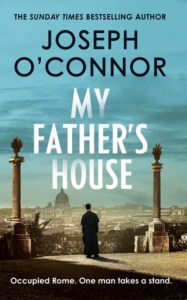
My Father’s House, by Joseph O’Connor

Summary: an outstanding historical thriller of Europeans united against the Nazis

Philippe Sands once wrote a very fine book on the origins of the international law on crimes against humanity and genocide, East-West Street. This does not in my mind absolve him of writing The Ratline: a pointless, rambling wastrel of a book, undertaken, it seems at the behest of the son of a Nazi, who believed his father was, nevertheless, a good man.

He wasn’t.

The Ratline in question in the book’s title was a bit of a Godot character. It never really shows up. The Nazi in question could not stump up the cash to pay the venal and corrupt Vatican officials who were offering Nazis a way of escape from the allies’ dragnet to South America and Southern Africa.

Despite his high profile role in the Vatican Hugh O’Flaherty doesn’t show up in Sands’ Ratline either. Not that this committed anti-Nazi Irishman would have had anything to do with it. But he is an altogether more interesting character, with a much more interesting story to tell of a single night than Sands found to tell in the years he covers before, during and after the war in The Ratline.

O’Flaherty was the head of one of the key Italian resistance networks of the Second World War, run vastly more effectively and altruistically out of the Vatican than the later Ratline. With his pan-European group of Irish, Italian, Dutch and British friends he kept thousands of Jews and escaped prisoners safe as the Gestapo grip on the city tightened.

My Father’s House is a wonderful historical thriller that, by focussing on a single mission by the group introduces us to its various personalities. These take turns narrating the events of the mission. This is an elegant and compelling way to explain to the readers their previous lives before the horrors of the Nazi occupation forced heroism upon them. One scene, in which the British ambassador to Rome, a member of O’Flaherty’s group, encounters O’Flaherty and his deputy, British officer Sam Derry, in the Vatican gardens is particularly chilling. Derry is rehearsing the false names and addresses he will give up under torture if captured.

It is a wholly gripping and deeply moving story of love and friendship in the face of adversity, and asserts a position for O’Flaherty’s alongside Casement as one of the great Irish humanitarians of the Twentieth Century.

Hitler, by Ian Kershaw

Summary: an exceptional work of historical biography

With the instincts of a high-stakes gambler, and a remarkable gift for public speaking – but with absolutely no other discernible gifts or redeeming qualities – Hitler managed in the chaotic aftermath of the First World War to parlay his modest skills into the dictatorship of Germany, and then from that office to unleash the most cataclysmic conflict that Europe has yet seen.

Kershaw’s account of this career was widely praised when first published and rightly so. It remains a gripping, elegantly written portrait of the pathetic monster and a succinct account of much of the suffering he caused.

For me the piece de resistance of this remarkable book is, appropriately enough, the account of Operation Valkyrie, Staffenberg’s doomed attempt to overthrow the monster and grasp some flicker of redemption for Germany. The chapter is as gripping as the best thriller and a reminder that, in the midst of the horror, heroism was still possible.

Like so many of his minions, Hitler was a study in the banality of evil. But, as we have already seen in the 21st Century, sad, narcissistic little men with delusions of grandeur can still wreak terrible devastation.

Consequently this book deserves continued study, so that humanity never completely forgets that.

Confidence Man: The Making of Donald Trump and the Breaking of America, by Maggie Haberman

Summary: portrait of a fascist as a fat man

The character of Biff Tannen in Back to the Future is based on Donald Trump: bullying, lazy, greedy, misogynistic. Confidence Man traces the original Biff’s career from the corrupt world of New York real estate to the American presidency.

It is a depressing story, but, in hindsight, seems almost inevitable now. Because, enabled by his overweening sense of entitlement and his daddy’s money, Trump has one talent that Biff lacked. As the title of Haberman’s absorbing book suggests, Trump has the instincts of a grifter. Like Giovanni Ribisi’s character in the short lived, but highly entertaining, series, Sneaky Pete, it is Trump’s instinct every time he is caught in one lie to double down with another, to meet every attack with a counter attack, and, where possible, to get his retaliation in first. 

According to Haberman Trump was once told, “You’re really very shallow.” “Yes” he agreed, “that is my strength.”

Everything is a transaction to Trump in a zero sum game. For him to win there must be a loser. Love, selflessness, compassion, empathy are meaningless to him. Haberman reports Former White House chief of staff, retired Marine General John Kelly, describing Trump as “the most flawed person” he had ever known. 

Yet enough Americans confuse Trump’s brand of sociopathic narcissism with strength to vote to award this revolting human being with the Presidency.

Not that Trump ever understood the role he had won in a constitutional system. Again and again in this book he is described as unable to comprehend why he is not permitted to do the unlawful. How he yearns for the unconstrained power of a Putin or a Hitler. Nevertheless even corralled by the law and the constitution, Trump and his acolytes still managed to do more damage to the concept of “government of the people, by the people and for the people”, than the entire Confederate army.

Haberman’s fine book is not just an explanation of Trump but also a warning: given the chance again this bloated fascist will reek further chaos.

Apeirogon, by Colum McCann

Summary: a desperately sad but hopeful perspective on Israeli Apartheid and the illegal occupation of Palestine

Rami Ethanan, a graphic designer, and Bassam Aramin, a scholar, are friends. They have a lot in common. Both are smokers. Both are former combatants. Both understand the deep, moral corrosiveness of the Israeli occupation of the Palestinian territories. Both understand that peace requires people to talk to each other and try to understand each other’s point of view. Both are the fathers of murdered children: Rami’s daughter, Smadar, was murdered by Palestinian suicide bombers; Bassam’s daughter, Abir, was murdered by Israeli soldiers.

Apeirogon is the story of how, in particular, these two men have sought to advocate for peace by building mutual understanding. But it ranges even more widely, into the lives of their families, including their murdered daughters, and into the cultural and political history of Israel and Palestine.

(From the Guardian)

I finished this book just before Israel launched its latest series of child-killing attacks on Gaza. As usual, in such situations, American politicians are to be found on social media congratulating themselves for the US military support to Israel that allows its leadership to launch such attacks on Gaza with impunity. Such politicians find the slaughter of children with rockets, and American journalists with bullets, much more palatable than the murder of children by suicide bombers. But that is the logic of the US’s military alliance with what the Israeli human rights organisation, B’Tselem, has called an apartheid state.

The asymmetric nature of the warfare between Israelis and Palestinians is very much on display with the latest Israeli attack on Gaza. In prison, for throwing a dud grenade at an Israeli patrol, Bassam realised that responding to Israeli violence with violence, even if only stones, plays into the hands of those who want to sustain the occupation: it allows them to portray Israeli violence and theft as defensive, and the Palestinians as less than human. As a result of this realisation Bassam became committed to the ideal of non-violence.

Rami, recognising the common humanity of Palestinian and Israeli families who had suffered similar losses to his own, came to his own realisation that the status quo offered no real security for Israelis either. His wife, Nurit, a distinguished academic and peace activist, had understood this much earlier: with enormous courage she explicitly and publicly blamed the racist and militaristic policies of Israeli Prime Minister Benjamin Netanyahu for the death of her daughter.

Apeirogon reminds us that as well as the meat-headed terrorists in the high echelons of government and the military, Israel and Palestine also have thousands of people like Rami and Bassam: people committed to non-violence, human rights and dialogue as a path towards justice.

For success such activists need international support. Yet the US and Europe fail utterly to do this, privileging Israel with arms and trade rather than compelling the dialogue that is essential for any meaningful peace to be forged.

Apeirogon is an extraordinarily important book. It is a tribute to the thousands of (asymmetrically) marginalised Palestinians and Israelis who have sought to build peace and fraternity through dialogue and understanding rather than acquiesce in violence. How many more children will be slaughtered before their path is recognised as the only truly viable one?

Photo by Sarah Lee for the Guardian

Great Hatred: the assassination of Field Marshal Sir Henry Wilson MP, by Ronan McGreevy

Summary: a fresh and gripping new perspective on the Irish war of independence in London

Great Hatred is a superb addition to the literature of the Irish revolution. Similar to Anita Anand’s, The Patient Assassin, McGreevy explores the lives of the killers and the killed. So Great Hatred provides a triple biography of Reggie Dunne, Joe O’Sullivan and their victim, Henry Wilson. The result is a book that is hugely illuminating on the conduct of the War of Independence in London and the experiences of the London Irish community during the First World War and in the fight for Irish freedom.

As Director of Intelligence of the IRA, Michael Collins had a central role in London operations, so he is also a major figure in this book. One thing that did niggle with me was the author’s apparent acceptance, along with many other fine historians, of Emmet Dalton’s criticism of Collins’ actions at Beal na mBlath, and the idea that the only rational option was to try to run the ambush rather than stop and fight into it. This seems to me to ignore the realities of IRA ambush practices which Collins would have been more familiar with than Dalton.

Like so many other books, this one also does not mention that the last Dail representative for South Armagh in Northern Ireland was Collins. This is emblematic of the depth of Collins’ emotional commitment to the North, and in exploring this McGreevy seems to have found the key to the enduring mystery of who gave the order for Wilson’s killing.

Great Hatred is a fresh, elegantly written and wholly gripping work. It is one of the best books on the Irish Revolution in many years.