In his magisterial biography of Collins Tim Pat Coogan tells the story about how one day in late 1918 or early 1919, Collins’ cousin Nancy O’Brien, then an employee of the Post Office, was summoned to the office of Sir James MacMahon. MacMahon had himself been taken from the Post Office and made Under-Secretary of State for Ireland, thus becoming the most senior Catholic civil servant in the Castle. Coogan records how MacMahon told Nancy that, “in view of the worsening situation it was imperative that the Castle’s most secret coded messages be in safe hands and that he was putting her in charge of handling these messages for him! Collins first reaction on hearing of his cousin’s new job was to exclaim, ‘In the name of Jasus how did these people ever get an empire?”[1] (p.82)
It is an amusing anecdote about an apparent British blunder putting some of the most secret British military communications into the hands of one of Collins’s most trusted agents. However the presumption of this as a blunder may be misconceived. Because, if you are a patriotic Irish person in the service of the BritishState, how else do you change sides in time of war?
T Ryle Dwyer describes how Ned Broy achieved just such a change of sides at the beginning of the War of Independence, when such a manoeuvre, even an honestly intended one – and there were many which were not – could result in you getting shot.
Broy, a confidential typist in the Detective Division at Great Brunswick Street was assigned “to type up the lists of Sinn Fein members who the crown police intended to round up… He gave a copy of the list to his cousin, Patrick Tracy… Tracy passed on the complete list to Harry O’Hanrahan… who’s brother, Michael, was one of the leaders executed for the Easter Rebellion”.[2]
Here it is clear that Broy made the switch which led to him becoming one of Collins most valued agents, by making an oblique approach to the Irish authorities with high quality intelligence through mutually trusted channels. It appears a strong possibility to me that MacMahon was doing the same thing.
The few references to MacMahon in the Bureau of Military History Archives show him to have been a man with extensive contacts in, and strong sympathies with, the nationalist community. A statement by Monsignor Curran to the Bureau[3] on Sean T O’Kelly’s efforts to obtain a passport to attend the Paris Peace Conference notes that it was almost certainly MacMahon who advised the aspirant Irish delegate that the British military were delaying the issuance of his passport. Another account by Kevin Barry’s sister describes that MacMahon contacted their mother on the eve of execution advising her to appeal directly to King George V for mercy – something she refused to do because she felt it would have lost the sympathy of the republican movement[4].
These accounts are suggestive of a man who had significant contacts in the nationalist community, and was highly knowledgeable of who was who in that community. Hence it seems unlikely that he would blunder thoughtlessly into handing British military secrets over to a person who, particularly in the relatively small community of the Post Office and in the aftermath of 1916 must have been well known to be a second cousin and close friend of Michael Collins.
Nancy O’Brien told her son that in the conversation MacMahon told her that he had made enquiries about her to find out if she could be trusted[5]. On the face of it, viewing the matter as a blunder one might presume that he had made enquiries of her in the civil service and heard only good things about her. Or he may, one Sunday morning after Mass in Blackrock, have buttonholed a person he knew well from their membership of the same confraternity of St Vincent DePaul, a certain Eamon deValera[6], and asked him about people in the civil service that Sinn Fein trusted, who might help him to prove where his true allegiance lay?
George Chester Duggan, Assistant to the Under-Secretary for Ireland while MacMahon was Under-Secretary noted that during the War of Independence period, “James MacMahon … had become almost a figurehead at this juncture for being a Roman Catholic and a friend of some members of the Hierarchy[;] he was regarded by [Assistant Under Secretary Sir John] Taylor as suspect, a person to be disregarded where questions of policy arose and policy affected not only the criminal law but matters of finance.”[7]
But distrust by others is not positive evidence of disloyalty, and primary evidence in support of the theory of MacMahon as an active agent is considerably thinner than that of him as a sympathetic nationalist in senior Castle employ. Probably the strongest supportive evidence is a statement given by Colonel Dan Bryan to the Irish Bureau of Military History[8]. Col Bryan noted that
“In 1921 I was acting and frequently Assistant I[ntelligence] O[fficer] of the 4th Battalion, Dublin Brigade. James Dwyer of Rathmines, who became a Deputy [in Dail Eireann] some time about this period, was then the most prominent and active person in Sinn Féin and other civil activities, not merely in Rathmines, but in large areas of County Dublin.
At the same time he was a member of the Volunteers and was I.O.[Intelligence Officer] of “G” Company, 4th Battalion… In addition, however, he had special sources of intelligence in wider fields, such as the political, and in connection with those he dealt directly with Director of Intelligence – Michael Collins.
I was usually aware of his special activities in this respect but did not bother about the details. Some time, I should say in the late Spring or early Summer of 1921, he showed me at least one copy of a report which he was sending to the Director of Intelligence [Collins] on a discussion he had had with Sir James McMahon, the then Under-Secretary for Ireland. Strangely enough, the only item in this report that I can now recollect was one on Sir Henry Robinson, the then British Chief of Local Government in Ireland, which was to the effect that McMahon regretted – having to admit that Robinson, whom he previously regarded as a decent man, had now gone completely over to the side of the extreme military clique or crowd in the Castle. I assume, but do not recollect, that the report generally dealt with information given by McMahon on the political condition of the British Government in Ireland and related subjects.
I have a very definite, but not an absolute recollection that Dwyer had at least two interviews with McMahon. I do not know how the contact between Dwyer and McMahon was made but Dwyer and all his family had been in Blackrock College where McMahon had been educated. This may have provided some contact.”
The only other suggestion of MacMahon as an agent that I could find in the Bureau of Military History records was a mention by Michael McDunphy, himself from 1947 a Director of the Bureau[9]. McDunphy describes meeting Collins for the first time in May 1921 to convey a message to him from a certain Brother Joachim, a lay brother of the Dominican Order. Joachim had “learned from the Hon. James MacMahon … that the British Government were about to make final overtures for peace, with the accompanying threat that if they were not succ[essful] they would proceed ruthlessly to destroy the I.R.A. and the country with them.
“I brought Brother Joachim’s news to Michael Collins… [He] listened to my message, and I gathered that the news did not come to him as a surprise. His comment on James MacMahon was pithy-” that white-livered coward”!”
This account along with Dan Bryan’s and Nancy O’Bryan’s recollection begins to suggest a pattern of contacts between MacMahon and Collins through mutually trusted contacts. The substance of the contacts seems to have been in the main political intelligence, though Nancy O’Brien’s account suggests he also facilitated the passing of military material. There certainly appears to have been at least enough contact between MacMahon and Collins for Collins to have formed a distinct opinion of MacMahon, but whether that opinion was a result of MacMahon having failed to meet Collins expectations, or to provide cover to MacMahon because of his importance is a matter for conjecture.
The presence of someone like MacMahon as a senior agent in the Castle makes more sense of how Lloyd George’s representative Andy Cope was able to conduct his apparent mission to establish a “back channel” between the Irish and British Governments both with success and without getting shot.
Tim Pat Coogan notes that Cope is once recorded, pre-Truce in 1921, as boasting that he met Michael Collins “every night“. While undoubtedly an exaggeration, there may well have been some truth it. Charles J. MacAuley, a former 1916 volunteer and a civilian doctor who provided support to IRA activities during the War of Independence, in his statement to the BMH describes at one point, “Shortly before the Truce, at James MacNeill’s [brother of Eoin MacNeill, Dail Minister of Industries] request, a secret meeting was held in my house, 22 Lower Fitzwilliam Street. To the best of my knowledge, in addition to James MacNeill, [Andy] Cope and James MacMahon were there. They were closeted together for some time. I could only guess at the subject for discussion, which I took to be some form of secret peace negotiations.”[10]
Coogan notes the importance of MacMahon’s contacts in the nationalist community to Cope’s mission. However it seems at least a strong possibility to me that that by the time Cope and MacMahon met that MacMahon had more than good contacts. Rather at this stage, given his knowledge of British machinations and having proven himself trustworthy to Collins, he was able to vouch for Cope efforts to set up clandestine talks in a way that would not have been earned by mere sympathy to Irish national aspirations.
Coogan also notes that there was significant talk in Sinn Fein pre-Truce that Cope had met and become friends with Collins. Collins denied this, probably for political reasons, because this sort of talk was used post-Treaty by its opponents as evidence that Collins was in the thrall of the British. But intelligence concerns may also have been a factor: in denying he met with Cope before the Truce he may have been deliberately trying to obscure also his relationship with the person who would have been the probable facilitator: Sir James MacMahon.
It should be noted that Col Bryan, himself a Director of Intelligence for the National Army during the Second World War, considered and discounted the possibility that MacMahon was an agent: “Turning over in my mind … I have come to the conclusion that it might be assumed that the Dwyer-McMahon contact was an intelligence one and that McMahon was prepared to give information which could be used… against the British. Looking back on the matter since I do not think this was so. McMahon presumably had no reasons for knowing and believing that Dwyer was involved in the military side of the movement… Dwyer presumably was known to McMahon as a sensible, shrewd man, who was very prominent in the Sinn Féin organisation and in the political activities of the period. I assume… that McMahon was merely anxious to discuss the general situation with a man who was both a member of Dail Eireann and a driving force in the Sinn Féin and related organisations.” However there is no evidence that Bryan knew of the other channels between Collins and McMahon which may have caused him to alter his opinion.
Dwyer himself, a pro-treaty TD who was shot dead in his home by armed men in 1922 never left an account of the nature of the relationship with MacMahon. So unless at some stage Sir James MacMahon’s own memoirs come to light the level of his involvement in Collins’ intelligence operation will remain a matter for speculation. However at the very least it appears to me a considerably more complex relationship than first meets the eye.
[1] Page 82, Michael Collins by Tim Pat Coogan
[2] Page 10, The Squad and the intelligence operations of Michael Collins, by T Ryle Dwyer
[3] Bureau of Military History, DOCUMENT NO. W.S. 687 (section 1) Witness: Right Rev. Monsignor M. Curran, P.P.
[4] Bureau of Military History, DOCUMENT NO. W.S. 731, Witness: Mrs. Katherine Barry-Maloney
[5] See the documentary “The Shadow of Beal na mBlath”, by Colm Connolly
[6] See Tim Pat Coogan’s Michael Collins
[7] Bureau of Military History, DOCUMENT NO. W.S. 1,099, Witness: George Chester Duggan
[8] Bureau of Military History, DOCUMENT NO. W.S. 947, Witness: Colonel Dan Bryan,
[9] Bureau of Military History, DOCUMENT NO. W.S. 498, Witness: Michael McDunphy,
[10] Bureau of Military History, DOCUMENT NO. W.S. 735, Witness: Charles J. MacAuley,

 I remember sitting in the back of Newry Town Hall in November 1980 when Seamus Heaney came to give a poetry reading. It was a revelation to my teenage self who had not once been out of the island of Ireland at that point.
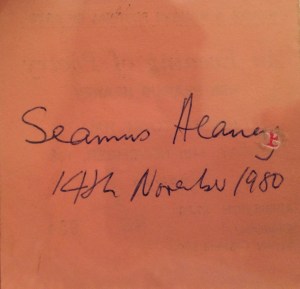 The world has been enriched by his life’s work. But that must be little consolation to his wife and family now. I am sure the country’s hearts go out to them in their grieving.

 I first read this book shortly after it was published in the 1990s. Rereading it in 2012 I was struck by the breathtaking scale of the achievement in the writing: drawing on the accounts of members of Collins’ Intelligence operation Coogan provides a detailed and compelling account of the intelligence war. In addition he provides a gripping account of the peace initiatives that led to the Truce and a facinating description of the negotiations that led to the Treaty. Probably the piece de resistance of a book that is overflowing with extraordinary detail is his account of Collins’ Northern policy: here Coogan wields a wealth of evidence to present a powerful argument that when other so called Republicans were preoccupied with silly disputes over the presence of the Oath of Allegience to the Crown in the Treaty, Collins was, for good and ill, marshalling all his political, diplomatic and military skills in a desperate effort to achieve a united Ireland.