Summary: The UK government’s shenanigans around Palestine Action undermines fundamental principles of rule of law
In 2010, Tom Bingham — former Master of the Rolls, Lord Chief Justice, and Law Lord — demonstrated in his book The Rule of Law that the concept is fundamental to any tolerably functioning democracy. He set out eight principles, including that: • legal rights and liabilities must be determined by law, not the arbitrary discretion of, for example, ministers; • the law must provide effective protection for fundamental human rights; and • the rule of law requires states to comply with their obligations under international law as seriously as domestic ones.
The British government appears to violate all three of these particular principles in its decision to ban Palestine Action and criminalise anti-genocide demonstrators.
To begin at the beginning: there is no agreed definition of terrorism in international law and little academic consensus. The terrorism scholar Alex Schmid once suggested that terrorism might be considered “peacetime equivalents of war crimes.” That deliberately omits atrocities such as Hiroshima, Dresden or Gaza, but it is easy to see why governments responsible for mass civilian killings might resist such a definition that makes them seem at least terrorism adjacent.
In the absence of international agreement, terrorism becomes whatever individual governments decide it is. In the UK, the government has defined it broadly as violence against people and damage to property in pursuit of a political cause. Yet even by that standard, its application is arbitrary. The killing of close to 100,000 civilians by a UK ally is treated as legally too complex for ministers to judge, but the throwing of paint on a weapons system is not. To brand the latter vandalism as “terrorism” is to reduce the definition to a tool of political convenience — a textbook example of arbitrary discretion, and thus a breach of the rule of law.
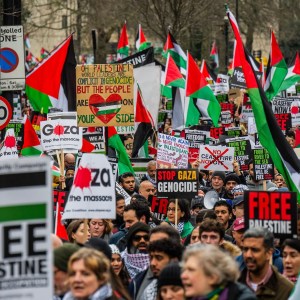
This arbitrariness also undermines basic human rights protections, most clearly in the assault on the right to peaceful protest. On 6 September 2025, Steve Masters, a British military veteran, was arrested while sitting in his wheelchair in Parliament Square holding a poster. He was one of 890 people detained that day. Their “crime” was not violence, but conscience: holding placards in solidarity with Palestine Action. Farcically, many will be charged with terrorism offences.
Protesters hold up a mirror to the British government, and the government recoils from its reflection. Yet it is only the protesters who offer any hope that the UK might one day be able to face itself with any self-respect, once the atrocities with which it has been complicit have passed.
Summary: First in a series of guest blogs on the war in Sudan, by “Elphaba”
I have been writing family bulletins for myself and anyone ready to read them since the start of the war in Sudan in April 2023. Kind readers have followed events that have driven my family from their homes at gun point from areas around Umderman to Gedarif and Singa. Then again from Singa as they went under siege there.
Before the war, meeting of the Blue and White Niles at Khartoum: many of the buildings in this photo have now been burnt down
In an attempt to spread the burden of too many mouths to feed under one roof and much heart searching they scattered further. Some made the treacherous route to the north only later to face long electricity blackouts in April and May in the hottest time of the year. Others fled Singa on foot eastwards to Gedarif. From there one or two made it to Saudi Arabia where they have safety but at the cost of visa renewals and a deep sense of loss.
Now since the start of this year with relative peace in the Eastern areas of Sudan. For our family, at last, the kids are mostly back at school, the offices working and the economy working on some level. The banks work intermittently and cash is in very short supply. Some can use online banking with an app but for all everyday trading for basic goods, it is only cash. Adding to this, at some point in the year someone thought it a good idea to introduce a new currency and a new layer of potential confusion and corruption. In most of the East only the new currency works, while in the West only the old. In Khartoum and Wad Medani both get used.
With no immediate drama, I worry that we run the risk of joining the world in forgetting that the war and instability is far from over and accepting a new normal that is anything but. Now with the rains falling heavily there is very little seed to plant to benefit because infrastructure is decimated and only very few have any spare funds. And there is drama. For our friends in El Obeid and our once-home Dilling, siege, counter siege and fear have outlasted anything seen in the East and Darfur continues to be another story again. We last heard from close family friends there about a year ago.
As in Israel/Palestine there are huge profits and plans for still greater ones being made by those who would seize power and (ab)use weakness. In Port Sudan there are huge agricultural schemes under discussion not to mention rebuilding contracts and deals with the Gulf. It is mind-numbingly depressing in its logic of winner – eventually- takes all at whatever cost.
Meanwhile, for our family there is the on-going need to claw back dignity and rebuild with the resources we have. The young men – nephews and sons – working for low wages as labourers, drivers and other sorts of fixers send back what they can. They are themselves stranded in nearby countries away from their families and they know that whatever they send it is never enough. We are aware we have more than many and less than others.
I challenge anyone to fault the determination. My elderly sisters-in-law (elderly = 10 years older than me and in their 70s) have returned to their suburb in Umderman. There is no power. They returned to homes totally stripped bare “not even a teaspoon”. The first job for Nxxx was to buy a front gate as that too had been taken. Bottled gas costs 5 times what it did a year ago and anyway the cooker is gone. The widespread gossip that her neighbour’s son – now gone – whom Nxxx had known since childhood orchestrated the theft of her property and many others. And yet after a few days Nxxx at least is back in her house. As Rxxx explained to me from Saudi Arabia, her homesickness palpable: “of course all the family have been amazing. We are lucky. So much luckier than many. But you ache for what is yours, where you are you and where you’re not thought of a ‘a displaced’”
The violence has gone from these neighbourhoods for now and the young men returning have great plans to fix the power. Knowing the place well, I have no idea how they are getting by. I know it will be a profoundly communal endeavour. My 24year old nephew, his own life plans long since on hold returned from Port Sudan to help his father. He says they live on ful and ta’amia because that is made at a local shop where they have fuel. I imagine them all together much of the day to support, chat about possibilities, find workarounds to issues, talk prices and a future. I hope this will help them recover for now from the trauma of recent months/years.
The profound divide emerging in Sudan and the discrimination and racism that underlies the political stories is a worrying strategic trend that most Sudanese don’t have the luxury of considering. Maybe in that there are some universal trends.
This led me to check again what Lammy had said when announcing the suspension of some arms licences to Israel in September 2024. Then he said, “There are a number of export licences that we have assessed are not for military use in the current conflict and therefore do not require suspension. They include items that are not being used by the Israel Defence Forces in the current conflict, such as trainer aircraft or other naval equipment. They also include export licences for civilian use, covering a range of products such as food-testing chemicals, telecoms, and data equipment.”
Sophistry – the use of clever sounding arguments to deceive – is, of course, stock in trade of politicians. There is the stench of such sophistry in Lammy’s pronouncements on Israel, which remains a valued ally of the UK in spite of the extraordinary genocide that it has wrought on Gaza in plain view of the world.
In September 2024 Lammy asserted that, “There is no equivalence between Hamas terrorists… and Israel’s democratic Government”. To which one can only conclude that Lammy, desperate for high office, has, in the words of Orwell, submitted to the Party’s final most essential command: that he reject the evidence of his own eyes and ears.
On 2 August, the Guardian reported that Lammy “calls shooting civilians waiting for aid ‘grotesque’, ‘sick’; demands ‘accountability’ from the Israeli side. He says things are ‘desperate for people on the ground, desperate for the hostages in Gaza’, that the world is ‘desperate for a ceasefire, for the suffering to come to an end’”.
It is possible that Lammy and the rest of the British government may finally be becoming squeamish at the level of killing in Gaza. But that does not absolve them of past complicity. Netanyahu and the rest of those that they have allied with have not changed. As a lawyer Lammy “ought to have known” that his allies were just going to do exactly what they said they were going to do at the start of the butchery.
Given the weakness of international institutions that the British and other Western Governments have contributed to through their complicity in Israel’s war crimes, Lammy and his colleagues in policy may yet avoid a criminal reckoning. But they will always have to answer to their consciences on whether the perks of high office were actually worth the price of their souls.
Summary: the sudden death of Mike McDonagh on 21 June 2025, brought an end to a life that was larger than most.
Mike was a legend in humanitarian response having worked across the globe as a country director for the Irish non-governmental organization Concern for more than 20 years. This included time in Laos, Cambodia, Somalia, Angola, Rwanda, Sierra Leone, Liberia, North Korea, Honduras, Albania and Zimbabwe.
Invariably you heard the stories of Mike before you met him. When I arrived in Angola in the middle of the 1990s people were still talking about Mike’s recent time in the country when he set up Concern’s response to the brutal civil war there.
Even for a humanitarian response to a war this was a testing operation. At one point Dublin headquarters began nagging Mike because his financial reports were late. He let them know that he was somewhat inconvenienced at the time – the office in Luanda had just been blown up and they had lost everything.
One long-term Angola development specialist, Dr Mary Daly, remembers how Mike broke the blockade on the besieged city of Malanje in the Angolan central highlands during this phase of the war. Against all advice, Mike brought in planes with supplies and had them fly into Malange. This forced other agencies to join in the effort.
There was always something of the buccaneer to Mike. He never doubted for a moment that he was the most charming rogue anyone had ever met. For most people he was probably correct. He was also a living example of the truth that you do not have to be a saint to be a hero.
Mark Evans, a water engineer, who survived the artillery bombardment of the city of Kuito during that time, remembers being surprised by the tenderness that Mike showed him when he was eventually evacuated from that massacre. As a witness to multiple war zones and the worst of humanity, Mike understood the toll that mitigation of such violence took on those who sought to respond. Marcus Oxley, a long-time Concern colleague of Mike’s described him as “a very relational person, with a genuine compassion and respect for people in need and a belief in “life with dignity” as the core of humanitarianism.”
I got to know Mike on his second stint in Angola, another bloody phase of that brutal civil war. It takes a certain amount of courage to endure that sort of environment once. It takes quite another quality of courage to return to it. But it was a quality of courage that Mike had in abundance, underpinned with an unshakeable good humour and a generosity of spirit for anyone who was genuinely trying to make the world a better place.
After Concern Mike joined the UN’s Office for the Coordination of Humanitarian Affairs (OCHA) in 2004, working in Darfur where he drew international attention to the attacks on humanitarian workers there, and the impact these had on aid for the civilian population.
As in Angola Mike developed a reputation. Jonathan Lingham, formerly of the UK’s Department for International Development, described him as “an absolute professional. His knowledge, advice, and wisdom was eagerly seized upon by new arrivals in Khartoum, especially by younger members of the NGO community, many of whom looked up to him as a sort of father figure. It was a difficult place to work. Mike was always available, kind, giving.”
It was in Sudan that Mike met Sarah, with whom, after years of bachelorhood, he started a family. No one was surprised when he turned out to be such a devoted husband, and doting father to Saoirse and Molly.
After Sudan, he worked with OCHA in Ethiopia, Iraq and Libya.
On news of his death the OCHA Chief of Staff in a message to all OCHA personnel said, “Mike was a force of nature, a humanitarian with grit, and was not one to ever let ‘the perfect be the enemy of the good’. He was famed for his no-nonsense approach, his one-word email replies, and for finding “creative” ways to get things done. He was a legend with many of us re-telling any one of his numerous escapades to inventively overcome challenges to get assistance to people in need.”
If anyone had ever said to Mike that he was a representative of what EM Forster called the “aristocracy of the sensitive, the considerate and the plucky… [who] are to be found in all nations and classes and throughout the ages” and who represent human decency in the face of the worst inhumanities, he would probably have said “Ach, away with ye!”
But he was. As Paul Heslop, the veteran demining engineer put it, “Even those of us who knew Mike sometimes have difficulty grasping what a giant he was in the humanitarian sector.”
In recent years, Mike was furiously vocal about Israel’s genocide in Gaza and Western leaders’ complicity with Netanyahu’s atrocities. How could he have been otherwise? Mike had seen so much violence he knew war crimes when he saw them. His very life was an indictment of those who assert that Israel has every right to defend apartheid and supply them with the diplomatic cover and weapons to do that and worse.
The world is a sadder, poorer, less just place without Mike. But he died holding Sarah’s hand. That is as great a way to go as Mike could ever have hoped for on any of those battlefields where he spent his life trying to staunch the bleeding of the innocent.
Summary: calls for humanitarian aid are being used by pusillanimous politicians to distract from their failures to directly address the causes of humanitarian crisis in Gaza, most specifically Israel’s genocidal assault.
For over five years in the late 1990s I worked, mostly for Oxfam GB, organizing assistance, including water supply and sanitation, for the civilian victims of the civil war in Angola.
So, humanitarian response is a subject area I know a little about. As students of management and leadership will be aware, a problem with a bit of expertise is that you can presume that everyone understands the fundamentals as well as you do. This is called taken-for-grantedness in the literature.
I have been taking-for-granted that David Lammy and Keir Starmer – human rights lawyers after all, as they like to tell us, and therefore smarter than everyone else, as they like to imply – would understand the fundamentals of humanitarianism. After all, they have been pontificating on it since the start of Israel’s murderous assault on Gaza in 2023.
But maybe they don’t. Maybe it is possible that they are not the craven accomplices to war crimes that their ongoing military and diplomatic support of Israel suggests. Perhaps they are just pig ignorant of the vitally important stuff that successful humanitarian response requires.
So, here are a couple of the most basic lessons of humanitarianism for their edification.
The technical term for this position in relation to humanitarian response is “Oxford Union debating horseshite”. It is part of an approach to politics that values a plausible sounding point to win an immediate argument over the concrete measures necessary to resolve the actual causes of the crisis that the argument is about. Food assistance, vital as it is, does not protect from the other forms of collective punishment, such as the cutting of power and water that Keir Starmer advocated Israel doing, let alone the mass burning alive of children that Israel has routinised in Gaza since the outset of its violence.
2. If a belligerent nation is using famine as a weapon of war, then they are not going to permit humanitarian assistance unless put under robust pressure to do so. Robust pressure, not expressions of sadness or concern: Boycotts. Divestments. Sanctions. Criminal accounting.
The British government used to like to depict itself as a world leader against slavery. But there has been a deafening silence from that government, and indeed much of the anti-slavery community, on this matter.
6. If you have soldiers in place to machine gun aid recipients, then the purpose of an aid distribution is not humanitarian. It is war crimes.
7. If you are materially supporting a political regime that has publicly stated its war aims are ethnic cleansing, then no amount of humanitarian assistance will mitigate that. You too are practicing genocide, even if you are also offering the doomed their meagre last meals.
Maybe these ideas are new to Starmer, Lammy and the rest of their government. But they are not hard. Indeed, tens of thousands of ordinary British people demonstrate that they grasp these most fundamental points already as, month in, month out, they gather in protests across the country to indict their own government for its abject moral collapse.
Summary: a not very funny rumination on a very funny tv show
Who wants to read about what the tv series Hacks has to say about leadership? Probably no one. But it has lessons on that subject area as important as those that Buffy and Angel teach on philosophy and morality. So here are a few thoughts.
If you haven’t seen Hacks yet, you are lucky. There are four seasons awaiting your delectation. However, like much writing about humour the following is not all that. Still, this is free to read. So tough.
Hacks is about the borderline unhealthy relationship between a legendary comedian, Deborah Vance (played by the legendary Jean Smart) and her new writer, Ava Daniels (the very funny and genuinely admirable Hannah Einbinder).
While the setting may be the glamourous world of showbusiness, fundamentally it is a workplace comedy. In the workplace that Deborah and Ava find themselves in by season 4 they represent archetypes of bad leadership: Deborah is imperious and ridiculously demanding, with no sense of workers’ rights and frequently forgetting that she has a duty to teach not just perform. Ava is well-meaning but so young she does not know what she does not know. In particular she has not quite grasped that her brilliance as a writer does not necessarily provide her with the knowledge and experience to be a professional leader.
If you are in any way like me, this will immediately remind you of Lavina Greacen’s book, Chink, her biography of the Irish Second World War general Eric Dorman-Smith.
Just me?
Well, a central theme of that book was that leadership is a collective task, requiring at least two people to have any chance of working.
This is something that the writers of Hacks also instinctively seem to understand. Neither Ava nor Deborah are necessarily people you would like to know in real life. But together they make each other better as people and as leaders. Of course, they have difficulty admitting this to each other – too much ego getting in the way. And they have even more difficulty realizing that there are others central to what success they have achieved, not least Jimmy, their self-effacing and under-appreciated manager (perhaps the real hero of the show?)
Maybe if they had read a few of Louise Penny’s Inspector Gamache novels they would know that they need to use more the four sentences that achieve wisdom: “I was wrong,” “I’m sorry,” “I don’t know,” and “I need help”.
But they haven’t. Indeed, not enough people have. That is one of the reasons why there is so little wisdom and empathy among those responsible for leading in today’s world. It is also one of the reasons that moral leadership increasingly falls to the protests of artists like Hannah Einbinder and Kneecap, while so many more respectable pillars of society are silent as gravestones.
All that aside, Hacks is one of the best portrayals of workplace politics since The Wire. And it’s bleeding funny. Try it.
There are diverse perspectives on leadership. Mine is leadership as a responsibility to choose – particularly in choices that affects the lives of others, in organisations or in wider society.
That has been most the defining feature of my experience of leadership, and something you never really appreciate until you are in that role. Key aspects of leadership involve decisions on resource allocation. Such choices are always fraught because there are always winners and losers, upset and distress, and lingering resentments.
Of course it can always be worse – I spend a good number of years leading humanitarian operations in, among other places, Angola during the civil war there. This led to some choices that were even more filled with anguish than the difficult but routine budget allocations that all leaders have to deal with. I write in my book, Ethical Leadership, about having to prioritize the lives of one group of people over another and how you have to learn to live with that after. That thought experiment with the runaway tram can get very real in some leadership roles.
So given that these are leadership realities, ethical leadership is self-evidently important: by ethical leadership I mean the attempt to make the most life affirming choice possible, irrespective of the difficulty of the situation. A life affirming choice is one that optimizes the protection of the environment on one hand and the protection of human rights on the other.
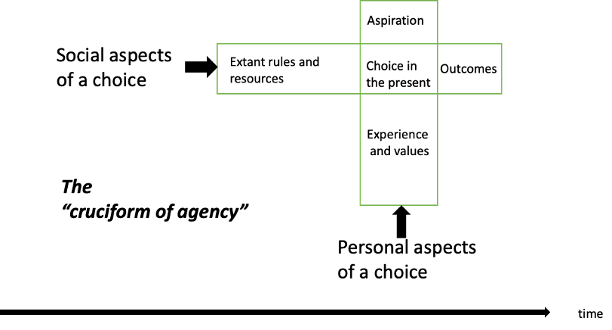
Now, when we are making choices it is important for leaders to remember that those choices are made in, what I call in my book “a cruciform of agency”.
That is, there are aspects of the choice – whether that choice relates to a love affair, or work, or war – that are in the social world: those are the rules and resources associated with the choice: the laws, polices, practice, finances or people who will be affected.
Then there are the personal aspects of the choice: the ones relating to the choice maker’s aspirations and experiences, and most fundamentally to their moral values.
The dialogue between these personal and social aspects of choice can be conceived of interacting orthogonally, hence the idea of a cruciform of agency emerges.
Now there is a 2002 paper by Craig and Greenbaum on a mining operation in South Africa. In that paper they recount how when they raised concerns with the mine management about issues such as health and safety, or labour terms and conditions, or the environmental damage that the operation caused, the managers they interviewed would express sympathy, but assert there was nothing they could do. The company they worked for caused the problems. Their responsibility was simply to get on with the job. They seemed to believe that they had no moral responsibility for the damage caused by the company despite the fact that it was they themselves who constituted the company.
This denial of personal responsibility of policy makers and business executives for the consequences of their choices is a central constraint on obtaining progress on many of the world’s contemporary problems including slavery, something that affects an estimated 50 million people in the world today.
I have rarely met anyone who has been in favour of slavery in principle. However, many in reality are in favour of slavery in practice. And if you doubt that, to take just one example, look at the hostile environments for migrants that many political leaders, from left to right in rich countries, take such pride in. This, despite the well documented fact that such hostile environments lead to the trafficking into forced labour and sexual exploitation of hundreds of thousands of vulnerable people.
If the personal aspects of leadership, particularly the moral responsibility of the leader for the consequences of their choices is abandoned then ethical leadership becomes impossible, and indeed much worse may emerge. But this is not uncommon.
You all know the history: The Nazi’s used the idea of “just following orders” to try to evade personal moral responsibility for their atrocities.
Henry Kissinger infamously used the notion of “realpolitik” to justify his murderous foreign policy that devastated the lives of millions in Bangladesh, Cambodia and Vietnam.
Today, Joe Biden, Olaf Scholz, Keir Starmer and David Lammy use the formulation “Israel has the right to defend itself” to justify their craven complicity in war crimes and genocide.
While the words used in each of these examples are different, their purpose is the same. They are explicit attempts to disguise moral bankruptcy and evade basic leadership responsibilities for the catastrophic human consequences of their choices. For this they deserve utter condemnation in “history and eternity” as Abraham Lincoln once put it.
The evasion of personal responsibility in a choice is the anathema of ethical leadership, and it brings with it a loss of authority: what follower worth their salt is ever going to respect a moral coward.
And there is always something more moral that leaders can do, even in the most extreme of circumstances. At the very least they can protest.
The current British prime minister likes to boast that his is not a party of protest. Which of course is true. Because protest is leadership. Protest is a way in which a society can open dialogue with itself and change the ways it thinks about itself.
Protest is sometimes the only way more formal dialogue with power can be obtained. Protest is how women’s rights and gay rights, minority rights and, indeed, all human rights have been advanced in the world. Protest matters nationally and internationally as the struggles to end apartheid in South Africa and bring some measure of justice to the north of Ireland have shown.
It also matters internationally because the failure of the West to protest Israel’s atrocities in Gaza, Lebanon and now Syria, compared to our volubility on Ukraine exposes an ugly, frankly racist, double standard at the centre of Western policy.
Much of the progress towards human dignity, including limiting contemporary forms of slavery, has been through advancing international rule of law. This avenue for progress has now been struck a grievous blow, because the profound undermining of the principle of the universality of human rights that Western policy towards Gaza has asserted. This has undermined in a fundamental way the ideal of an impartial system of international rule of law.
Many European leaders are expressing concern at the threat that Donald Trump poses to international order. But the damage done to that system of rule of international law by Biden, Starmer and Scholz is already catastrophic.
At the heart of ethical leadership is the ideal once set out by the Irish patriot and anti-slavery campaigner Roger Casement who said, “We all on earth have a commission and a right to defend the weak against the strong and to protest brutality in every shape and form.”
That is a commission which we must all take up. Because, more than any other time in my life, the challenge for all of us to lead ethically is at its most urgent. We are all leading in the grey zone now. Indeed, it is almost night.
[1] In his essay collection, The Drowned and the Saved, Primo Levi wrote of the “grey zone” a morally ambiguous space where the ideas of right and wrong are no longer absolute and “good” decisions are impossible.
Summary: Netanyhu’s war is racism and should be condemned as such
Perhaps I have missed it, but I have not seen many anti-slavery organisations condemning the mounting slaughter of civilians in Gaza, and now Lebanon, over the past year.
I wonder about anti-slavery organizations more than other specialist NGOs or human rights issues because, for the past 20 years this has been my principal area of professional practice and so is a sector with which I have some familiarity.
Perhaps some anti-slavery organization feel that something like Gaza is not part of their mandate and so would be inappropriate for them to raise their voices. Perhaps others are afraid of upsetting donors by raising question about another specialist area – human rights in war – and losing funding for other important work. Maybe others are afraid of annoying the governments of the US, UK and Germany, or certain parts of the EU Commission, who may be complicit with the policies of Netanyahu’s cabal and so losing precious access and the occasional invitation to convivial cocktail parties.
The thing is this: if we survey the realities of slavery through history right up to the present day we see very clearly that it is rooted in racism and the dehumanisation of others. Hence, anti-slavery organisations must be anti-racist if they are at all serious about tackling the causes and consequences of enslavement. If they fail in that fundamental then they are not truly anti-slavery. They are merely performative distractions.
Each of these examples, and there are many more, is a naked expression of racism against a whole people. Racism is at the root of every atrocity that is committed by Netanyahu and his cronies.
The continued acquiescence of US, UK and Germany in this, up to and including the provision of money, material and intelligence to sustain the Israeli offensives, in spite of overwhelming concerns regarding both their morality and legality, has dealt a grievous blow to international rule of law. It has also done something that would have seemed unbelievable a mere 18 months ago. It has established a credible case that there is no moral difference between the foreign policies of Biden’s America, and Putin’s Russia. Both appear ready to shred law and the most basic principles of human rights when it is convenient for them.
It is upon meaningful rule of law and a common adherence to the fundamental principles of human rights that the cause of anti-racism, and anti-slavery, have been advanced. Now, however, if campaigners challenge transgressing governments that their policies are in breach of human rights many will laugh and point to Gaza and Ukraine and say that the US and the UK, Germany, Israel, and Russia have demonstrated that the only right is might.
So, every anti-racist organisation on this planet, and that includes all anti-slavery organisations that are worthy of the name, and every organisation that derives its mandate from the Universal Declaration of Human Rights, must add their voices to the international condemnation of the Netanyahu government’s racist wars. If they do not then they will seem as hypocritical as the western governments who facilitate these wars in spite of the mounting evidence that the bloodshed that Israel perpetrates is foul murder.
As the Irish anti-slavery campaigner Roger Casement put it, “we all on earth have a commission and a right to defend the weak against the strong and to protest brutality in every shape and form.”
That commission was never more urgent than it is today as we daily bear witness to Netanyhu’s unfolding policy of genocide.
The smug, self-satisfaction that this statement implies might be better sustained if the party were conducting itself with unimpeachable professionalism now that it is in government. But its first 100 days in office have been notably rocky. A survey of this period by the Guardian was headlined, “We all hope it’s teething troubles – but worry it’s something worse.”
Well, I suspect it is something worse.
This thought will likely have occurred to many students of organisations. It will be a particular worry to those concerned, as I have been, with what is required to lead ethically: that is, the struggle to make organisational decisions that optimise life-affirming choices by seeking to protect human rights and advance environmental restoration.
For me, there seems to be three inter-related structural problems with Starmer’s Labour party that are the root of the Labour government’s shaky start and shady future. The first of these is that Starmer’s Labour party is strikingly authoritarian.
Everyone who has ever effectively led people in organisations will be aware that sometimes a directive approach is needed. For example, if it is necessary to evacuate a building due to an emergency, it is not appropriate to ask everyone how they feel about that first. It is necessary to point folk to the fire exits and tell them to get out.
However, Starmer seems to privilege such an approach over more collaborative ones even when there is no compelling need. Indeed, his leadership seems to have a problem with any independence of thought and voice.
Starmer and his acolytes present this as “discipline” and “strong leadership”. It is a peculiar notion of strong leadership when a leader is afraid to countenance a bit of criticism or consider different perspectives on issues.
From the longer-term view of organisational health this approach is even more problematic. Because if organisations exclude dissent, they reduce their capacity to think critically, to test ideas and winnow out the stupid or counter-productive ones.
All leadership teams, no matter how smart, will come up with poor ideas from time to time. But truly smart leaders understand that they need processes in place to guard against such things. The restriction of dissension in Labour undermines the necessary processes.
This leads to a second structural problem which will increasingly emerge for Labour as this government proceeds. The purging of intellectual and philosophical diversity, and the fear of being seen as disloyal that is bred by leadership authoritarianism, will reduce Labour’s capacity to generate new ideas as time and events evolve. This will make it more difficult for the government, and the party as a whole, to right recent wrongs and to respond to the new challenges that will inevitably emerge.
Both these problems, of authoritarianism and lack of intellectual diversity, are dwarfed by the most fundamental of Labour’s current structural problems: that is its moral bankruptcy.
Not to put too fine a point on it, these votes look more like a process for the breaking of the human spirit of backbench members of parliament rather than any cool consideration of regrettable financial necessity.
In bringing these matters to a vote when they did, the Labour leadership sought to purge any residual dissent by demanding that, in the name of loyalty, backbenchers should betray their constituents and their consciences on the issue of the poverty of English people, until now a residual Labour moral value.
Having done this, the thoroughly compromised backbenchers have been truly initiated into the moral bankruptcy that is at the core of the British Labour party. So, all will have diminished credibility if they are ever tempted to mount a future principled challenge to the leadership’s proposals, no matter how stupid or morally repellent those proposals might be.
Starmer’s Labour may be better than the Tories that they replaced. But there seems to me to be a rot at their heart, the stench of which may soon become overwhelming.
Summary: those who have lost their moral compass will never understand that protest is leadership
Rule of international double standards
Today, it appears that many Western political leaders apply multiple caveats to the principle of the universality of human rights. The result is that rather than rule of international law we seem increasingly to have rule of international double standards.
The moral black hole at the heart of Western policy towards Israel
British, American and German policy on Gaza appears to be underpinned by a view that Palestinian lives are not equal to Israeli lives and so unworthy of comparable protection. Hence those three governments seem to have decided that it is better to arm and provide diplomatic cover for the far-Right Netanyahu government rather than to uphold the most basic principles of human rights and international humanitarian law.
In the face of the considerable evidence of genocide these governments are deaf to the international protests of conscience, and to the demands of Palestinian and Israeli voices for peace. Instead, they work to maintain the murderous Israeli Defence Forces supply lines at all costs.
I have heard some try to justify this human rights double standard in relation to Israel by responding to protests with patronising reference to the need for realism, for a “realpolitik” approach to the conflict. This is, perhaps, a notion they may imagine that the protesters do not have the sophistication to properly understand. However, many will know that “realpolitik” is a term that has considerable previous, notably in the hands of Henry Kissinger, as a euphemism for moral vacuity and acquiescence in crimes against humanity.
Given this many will remain unconvinced that “realpolitik” really is a sufficient justification for the mounting horrors in Gaza and the West Bank. So, why are the US, the UK and Germany so steadfast in their support of a far-Right Israeli government pursuing such a horrendous campaign of violence?
It is worth remembering that Germany was genocidal in Namibia well before the Nazis ever came to power. While relatively democratic, Britain and the United States were also genocidal in the 19th and 20th centuries in relation to, amongst others, Native Americans, Ireland and South Asia. It was democratically elected governments in the US that launched the invasion of Vietnam and the destruction of Cambodia. It was democratically elected governments in the US and UK that unlawfully invaded Iraq. Today it is democratically elected governments in the US, UK and Germany that have facilitated the far-Right in Israel in their indiscriminate slaughter of Gazan civilians.
So, if we take even a medium-term historical view on these countries, it seems that there is a strain of thinking in those nations’ political cultures stretching from Left to Right that still view war crimes and genocide not as appalling and even unforgivable aberrations, but as legitimate policy options when it is convenient for them or those, however unsavoury, that they deem allies.
But it is the protests of which they are so contemptuous that so often change cultures and countries in the ways in which corrupt politicians can only dream. This is because protest is moral leadership that seeks to make the world a better place by demanding that it become so.
It is because of protesters that women have the vote, that apartheid has been ended in South Africa, that civil rights have been advanced in the US and the North of Ireland. When many governments have sought to merely manage the status quo – the “realpolitik” – protesters have asserted that this is not good enough and demanded better.
Today protesters understand, as the Irish patriot and human rights activist Roger Casement once put it, that “… we all on earth have a commission and a right to defend the weak against the strong, and to protest against brutality in any shape or form”.
So, at the end of the day, as Israel’s allies become ever more deeply mired in the murder of children, it is the protesters they disdain who will perhaps contribute most substantially to an end to apartheid in Israel/Palestine and thereby save the souls of their own countries.