Gerry McQuade

In memorium – February 2024

When we were discussing the funeral arrangements the other night, our Brian said to me, “You need to say something … something from Seamus Heaney.”

So, I suppose for my Da there can only be one Heaney poem, and that is “Whatever you say, say nothing.”

It’s not just that, as our Geraldine and Eilis will tell you, his mantra through life was “tell them nothing”, a habit developed, no doubt, growing up in mid-Armagh during some of the vilest years of this statelet, “besieged within the siege,” as Heaney put it. 

And, it’s not just because that poem is about the Troubles which overshadowed so many of our lives and shaped his politics. 

It is more that, I think, my father’s philosophy was to let your deeds, your life, speak for itself. 

We’ve gotten all sorts of very kind messages over the past couple of days from people my Da taught, telling us how much he affected their lives, how he gave them the confidence to become the people they are today. 

That was his politics: it was practical non-violence. In the face of state and paramilitary atrocities his response was not to meet like with like, but to teach kids to work hard, to do their sums and become in themselves the new Ireland for which we all hope and strive. 

Our father could barely speak English towards the end there. As the poem says, that voice of sanity really had grown hoarse. But it doesn’t matter now. Because we still have his life. 

His deeds live on in the kids he taught and in others who teach children to read even in these bleakest of days. 

And, no matter how little he would ever say about himself, or could say towards the end, those are things that truly do speak for themselves. 

Some stocktaking – 3

Summary: well, what have I been up to

About 12 months into lockdown, during the plague, I thought it would be a good idea to think about what if anything I had achieved during that period of enforced isolation. A year or so later I repeated the exercise and found it quite therapeutic. About 18 months later, I thought it was about time to have another reflect. So, what have I achieved?

  1. My father died in February 2024. I managed to deliver his eulogy – mostly – without crying.
  2. Having read Susan Sontag’s On Photography (A LOT!!!) I think I worked out how to, occasionally, take a decent photograph. 
  3. I had received an honorary OBE in 2017 for services to the eradication of slavery. I sent it back in protest at the British government’s and Opposition’s clear repudiation of the ideals of the Universal Declaration of Human Rights, most notably for migrants and Palestinians. 
  4. Probably the British government paid no attention, I mean they have a state to plunder and a genocide to facilitate: those things don’t happen by themselves. But, at time of writing, no deportation flights to Rwanda have taken off. 
  5. Best books I read? Well, My Father’s House, by Joseph O’Connor is just outstanding. Evelyn Waugh’s Sword of Honour Trilogy is wonderful: it’s a classic for a reason. James Kestrel’s Five December’s is an empathetic and original take on the detective in war-time sub-genre. My pal Lara Pawson’s book, Spent Light, is an extraordinary and intimate examination of everything from toasters to love to war and atrocity, to the joys of a good broom.
  6. And then there is Ellen McWilliams’ Resting Places, an exquisite exploration of the author’s people and her place, the Bandon valley, where the blood of Protestant neighbours, murdered in 1922, still cries from the ground. A remarkably courageous work on how the political and personal interplay. 
  7. Roger Casement once said, “… we all on earth have a commission and a right to defend the weak against the strong, and to protest against brutality in any shape or form”. So I wrote on Gaza, in a vain attempt to prick the racist mindset of the war criminals.
  8. Published my second detective in war-time novel, Some Service to the State. It is about the repercussions arising from an enquiry into the fate of a missing girl in a newly partitioned Ireland.
  9. My pal, Fergus, said it was over-didactic. I said you mean political. He said, I mean over-didactic. 
  10. “Didactic” means “intended to teach, particularly in having moral instruction as an ulterior motive” Example, “a didactic novel that set out to expose social injustice”. Except he didn’t seem to mean it that positively. “Didactic” also means “in the manner of a teacher….” Or, sometimes, “patronising”. 
  11. Well, I didn’t mean to be patronising. But my father was a teacher. So, if being didactic means I’m a bit like him then that is okay. 

Letter to British Prime Minister Rishi Sunak

Summary: on returning a honorary OBE

16 April 2024

Dear Prime Minister

In 2017 I was awarded an honorary OBE in recognition of my services to the eradication of slavery. I am now returning this as it is something which I can no longer, in good conscience, keep.

On 15 April 2024, your government refused to provide protections for the victims of modern slavery from your unconscionable “Rwanda scheme”. Over the past months you, as Prime Minister, have acquiesced in attacks on the European Convention on Human Rights by members of your parliamentary party. These, along with the UK’s bipartisan position on Gaza, have put into sharp focus how British policy now distinguishes between people whose lives it values, and those whose lives it disdains. 

These represent a fundamental repudiation by the UK of the principles of the Universal Declaration of Human Rights. They are a rejection also of an enduring British human rights tradition stretching back to Thomas Clarkson, William Wilberforce, and Mary Wollstonecraft, and a longer tradition of rule of law that stretches back to Magna Carta. 

As such they send to the whole world a message that the UK rejects the core bases of human rights and rule of law upon which progress in human dignity, including anti-slavery action has been based for hundreds of years. This can only impede the anti-slavery struggle and embolden other governments who seek to systematically abuse the rights of their subjects and citizens, including  by the facilitation of their enslavement. 

I hope that you will yet find it in your heart to alter course and embrace and defend these British traditions of human rights and rule of law rather than sacrifice them to some ill-judged populist crusade.

Yours faithfully

Dr Aidan McQuade 

My top ten reads for 2023

Summary: in case anyone is looking for reading or gift ideas

In chronological order of reading:

  1. Hitler, by Ian Kershaw: an exceptional work of historical biography and the definitive work on the pathetic monster who brought cataclysm to Europe.
  2. My Father’s House, by Joseph O’Connor: an outstanding historical thriller of Hugh O’Flaherty – “the Irish Schindler” – and Europeans united against the Nazis
  3. The Restless Republic, by Anna Keays: an elegantly written, though overwhelmingly Anglo-centric and bizarrely affectionate account of “Oliver’s” genocidal dictatorship
  4. Sword of Honour, by Evelyn Waugh (Men at Arms; Officers and Gentlemen; Unconditional Surrender): Waugh’s war, told with his trademark combination of high comedy and profound melancholy: classics for a reason.
  5. Empireland, by Sathnam Sanghera: a gripping and elegantly written survey of the bloody British empire and its echoes in the present day
  6. The Secret Hours, by Mick Herron: An superb prequel to the Slough House series: 1990s Spook Straße, Berlin, Moscow Rules very much apply
  7. Five Decembers, by James Kestrel:  a surprising and compelling crime story, with a strong echo of Vonnegut’s Slaughterhouse Five, to the backdrop of WW2 in the Pacific.
  8. The Sleepwalkers: how Europe went to war in 1914, by Christopher Clark: an extraordinarily adept and compelling elucidation of the complexities of European politics and alliances that led to the outbreak of World War 1. Basically, it was everyone’s fault… but mostly Serbia.
  9. A History of Water, by Edward Wilson-Lee:  a fascinating exploration of an aspect of Portuguese history and attitudes at the outset of Europe’s colonial plunder of the global South
  10. Killing Thatcher: the IRA, the manhunt, and the long war on the Crown, by Rory Carroll: insight on the Troubles through the prism of a gripping account of one bloody incident

Finding the Telling Detail: Understanding a Photograph, by John Berger; On Photography, and Regarding the Pain of Others, by Susan Sontag.

Summary: on trying to learn how to take a photograph

In 2004, the Finnish-American photographer, Arno Minkkinen, presented to the world his Helsinki Bus Station Theory of Photography. In summary, he argued that just as all the buses from the Helsinki bus terminal stop at the same first three stops before going to wildly different places, that the work of any photographer, over the first three years of their career, is going to be derivative of the work of somebody else. This is irrespective of what genre the photographer chooses to specialise in, from nudes to landscape to war photography: somebody will have been there before. Originality only emerges after persistence and practice over years. Or, as Minkkinen put it, if you “stay on the fucking bus,” rather than give up as soon as you recognise who your work is aping.

That is all well and good if you know which bus you want to get on in the first place. That is why people read Susan Sontag and John Berger: to work out what sort of photographer they want to be.

For me, John Berger provided an initial inspiration with his observation that some photographers work with “emancipatory” intent. After half of my professional career in humanitarian response and development, and the other half in human rights and anti-slavery work, this idea struck a chord with me, but still left me short of ideas of how to proceed.

Sontag’s photography books, paradoxically lacking any photographs, are not short of ideas. She writes of the philosophy of photography and photographers. Both of her books are enormously rich and challenging affairs. In particular, I found that On Photography required more than one reading to come anywhere close to fully appreciating the depth of her thought on the subject. Regarding the Pain of Others, perhaps because I have some experience of living and working in war zones, perhaps because I had read On Photography first, I found much more accessible.

Photography, Sontag observes, like sex, cooking and dancing, is a democratic art form that anyone can participate in. But just because anyone can press a button does not mean that anyone can take a good photograph. So, Sontag explores why some photographers not only take good photographs but take photos that are sometimes deemed worthy of putting in a museum.

And, there appear to be as many answers to this question as there are such photographers. Nadar reckoned the best portraits he took were of people he knew. Avedon reckoned his best portraits were of people he did not know. Cartier-Bresson reckoned you should think before and after taking a photograph, but definitely not during.

That successful photographers work to such diverse, sometimes mutually exclusive, ideas is one of the paradoxes of good photography. Perhaps I found an explanation from Berger’s own reflections on Sontag, “The camera saves a set of appearances from the otherwise supersession of further appearances…before the invention of the camera nothing could do this, except in the mind’s eye, the faculty of memory.”

So, perhaps what makes a photographer good is when they learn to capture with the camera that which they would wish to remember, or perhaps wish others to remember.

That gave me an idea.

One of my first experiences working in Africa was a visit to a poor neighbourhood in Addis Ababa, Kebele 37. Amidst the open sewers and crumbling mud houses densely packed together amidst a warren of streets I saw that someone had planted a geranium outside their door, in a salvaged cooking oil tin from a food distribution. There was something about that telling detail which seemed to me to encapsulate the indomitability of humanity, even in the midst of such dire poverty.

As a student of photography, that is the sort of image – the telling detail – that I want to capture, to emancipatory purpose when I can.

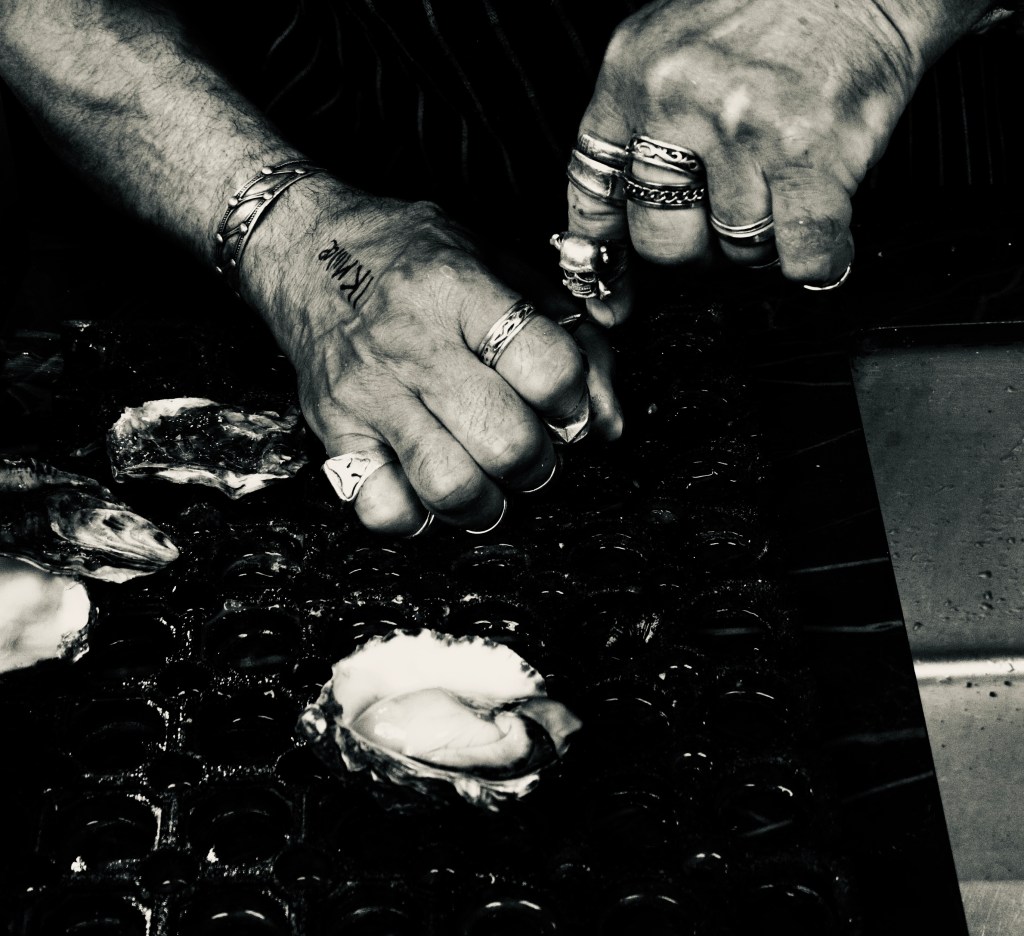
The Oyster Shucker

With that thought in mind I went for a walk in Borough Market and took the first photo that I think begins to express the sort of photographer I want to be.

Of course, after looking at it a while I thought, “That’s rather derivative of Salgado.” But that’s okay. I think that is the bus I want to be on. Let’s see where it takes me now.

How shall we fail thee, comrades? Part 2

Summary: Basic innumeracy is at the heart of Labour’s intolerance of independent thought in its ranks

The UK’s electoral system is a gerrymander. The population of England is broadly centre-left when one amalgamates the 2019 votes of Labour, the Lib-Dems and the Greens. In spite of this the Conservatives have a massive majority in parliament. This sort of systemic anti-democracy sparked a civil rights movement in the North of Ireland in 1968. However the English continue with their bovine acceptance that this is the best electoral system in the world, because it’s English, just as many still believe that the British response to Covid was “world-beating” irrespective of how many corpses pile up.

Currently so egregious has been Tory government over the past decade, Labour looks set to go into the next gerrymandered UK general election with a poll lead sufficient to overcome the bias in the electoral system. Their confidence is heightened by a dubious belief that their message is cutting through to Scottish voters, that they should know their place in the UK rather than having the audacity to seek their rightful place as an independent nation in the European Union.

The prospect of victory makes the Labour leadership sanguine about the need for electoral reform or electoral alliances. It also seems to be a factor in the party’s increasing intolerance of independent thought, of the voices that suggest that the party’s policy on Brexit is as believable as unicorns, and the party’s attitude to electoral reform and electoral alliances smack of hubris.

This seems to be what is behind the the heave to expel Neal Lawson – and others – from the Labour party for having the temerity to support the ideal of electoral alliances and, by implication, recognising the futility of voting Labour in a constituency when there is negligible prospect of a Labour victory in a first-past-the-post election.

UK Labour has never properly backed the introduction of proportional representation in Westminster elections. Even when the PR-lite “alternative vote” system was offered to the UK electorate a decade ago, many Labour leaders grumbled that it was “too complicated.” It is difficult to conclude that basic innumeracy is not a major factor in this.

Every other country in Europe has PR. Scotland and Northern Ireland have it for elections for their devolved government structures. Mayoral elections in England have previously used the alternate voting system. Why do so many in the UK’s political elite think such a system is too complicated for the English electorate?

Truth is, you do need a basic understanding of fractions and decimal numbers to be able to fully understand most systems of proportional representation. You know: the stuff you were taught in primary school, shortly after “one plus one equals two.”

But more fundamentally, the two major British political parties continue to support FPTP because it suits them. It guarantees the Tories the lion’s share and Labour, who know their place, get the occasional sniff of the leavings.

Given the utter incompetency and cynicism of the current Tory government, Labour can perhaps be reasonably confident of winning the next UK general election. But, given that Labour has swallowed whole the poisoned pill of Boris Johnson’s Brexit, the Tories can also be confident this may well be a one-term Labour government as Labour’s promise to “Make Brexit Work” is shown up for the ludicrous fantasy that the Tories already know it to be.

Artificial Intelligence and Ethical Leadership

The warning on 30 May 2023 by industry experts that Artificial Intelligence (AI) might lead to human extinction was a sobering moment. Given this, I wondered again what are the ethical leadership challenges – relating to the protection of human rights and restoration of the environment – this new technology poses?

I started by asking a “Large Language Model” (LLM) AI system ChatGPT:

“1. Ensuring data privacy: …; 2. Promoting responsible use of AI: Leaders should ensure that AI systems are being used in a responsible way, free from bias and discrimination. 3. Developing AI systems ethically: Leaders should ensure that AI systems are developed with ethical considerations in mind, including avoiding the use of algorithms that have the potential to cause harm. 4. Addressing job displacement: ….; 5. Ensuring accountability: Leaders should ensure that AI systems are held accountable for their actions, and that any mistakes made by AI systems are addressed. 6. Encouraging responsible innovation: Leaders should encourage the responsible use of AI and the development of ethical AI systems.”

It’s okay in so far as it goes, and a bit more candid about risks associated with AI than, for example, Microsoft’s happy-clappy advertising for “Co-pilot”, the AI that it is embedding into its Office suite. This focuses on the undeniable promise of productivity that AI brings, for some
professionals at least.

But the ethical choice-making that ChatGPT asserts is so important in AI is dependent on
morality, and it is not at all clear what is the moral basis upon which AI algorithms are being
constructed.

In the April 2023 edition of the Economist, the paper noted that some AI systems “produced
strange results. Bing Chat suggested to a journalist that he should leave his wife. ChatGPT
has been accused of defamation by a law professor. LLMs produce answers that have the
patina of truth, but often contain factual errors or outright fabrications.
” I found that when I
asked ChatGPT about myself: some biographical details were correct, such as that I have
written two books, but it could not find anything close to their correct names and so just
made stuff up. I think that may be the sort of thing that Microsoft, euphemistically, calls
“usefully wrong.”

But these are trivial enough errors: they are not going to cause an existential crisis for
humanity. But, as leading experts have already warned, AI itself might yet. In April 2023 the Economist reported that, “The degree of existential risk posed by AI has been hotly debated. Experts are divided. In a survey of AI researchers carried out in 2022, 48% thought there was at least a 10% chance that AI’s impact would be “extremely bad (eg, human extinction)”. But 25% said the risk was 0%; the median researcher put the risk at 5%. … researchers worry that future AIs may have goals that do not align with those of their human creators.”

A 5% risk is not a trivial one. This sort of risk was a matter that Isaac Asimov famously pondered when he developed his laws of robotics in the 1940s. Having formulated three laws, including his first, that, “A robot may not injure a human being or, through inaction, allow a human being to come to harm.” Asimov realised, as any viewer of the movie, I Robot, will remember, that something was missing. So, he formulated his “Zeroth Law”: “A robot may not harm humanity, or, by inaction, allow humanity to come to harm.”

There is an argument that you cannot, and some would say should not, build morality into
machines.
For example, Asimov’s first law would incapacitate some of the lethal hardware
so beloved of armchair militarists. But it seems incontestable, indeed inconceivable, that
any AI should be permitted without some robust moral systems to constrain its most dangerous excesses.

There may be better moral systems to guide AI than Asimov’s laws. But if AI is trying to
break up marriages on a whim or defaming a law professor, or anyone else for that matter,
it appears that it does not yet have any moral guidance at all.

So, here’s the rub. If programmed from the outset with some key moral principles, computers will not forget to remember them, as they write increasingly advanced programs for future AI generations. However, it seems that many of the human beings initiating these AI processes have sometimes eschewed moral principles in the rush to technological advance.

This should not, perhaps, be surprising. In recent years we have seen a number of controversies in relation to the use of information technology: In the UK, for example, a group of wealthy ideologues convinced a plurality of British voters, in part through the manipulation of information systems, to vote for Brexit unconcerned with the damage it would do to the economy, to Irish peace, and to the fragile bonds that hold their own country together. Similar information manipulation was at play in the election of Donald Trump in 2016. Yet more seriously still, the manipulation of information systems was also a major factor in instigating the genocide against the Rohingya people in Myanmar that same year.

When confronted with the issues arising from these events, some of the leading industry
figures involved have proven themselves moral vacuums. And these are the people who will
be leading much of the industrial development of AI. Will they be as concerned as Asimov
was about any potential threats to humanity arising from their work?

In spite of the information industry’s warning about the risk of human extinction, I would not want to bet my life on this. The leaders of so many other industries are already overseeing an environmental collapse with no discernible concern for a future that will threaten the lives and livelihoods of their children and grandchildren. The 30 May 2023 warning of the perils of AI aside, tech leaders have so far proven themselves no more concerned with the consequences of the moral choices that they are making for their businesses. For some, the scientific innovation associated with it will be just too fascinating to eschew. Others will not be concerned with the future if they can make lots of money now.

The Economist reports that the EU is considering robust regulation on the development of
AI, and the Biden administration has started a consultation on the same thing. These are
positive moves, but no one should rest easy yet. Unsurprisingly, for a government (and
opposition) that lacks the moral courage to tell the truth about the realities of Brexit, the UK
has until now been proposing a “light touch” approach to AI regulation. This is in the hope of attracting some unregulated tech businesses to compensate somewhat for the industries that their Brexit has already devastated.

In the face of such a pusillanimous abrogation of responsibilities, ethical leaders in business
and the citizenry alike need to respond: to make different professional choices that ensure
that the preservation of life and the restoration of the environment are at the heart of their
organisational strategies, and, through protest and political engagement, to demand that
politicians do the right thing not the easy one.

Protest is, and always has been leadership. But, given the crises facing humanity currently, it
has never been so urgent. And, given the rapidity of AI’s development, the moment at which
it can be constrained by law, regulation and morality may be receding as quickly as the opportunity to stave off ecological collapse.


“A (hu)man must have a code”: ethical leadership and saving the world.

The recent People Management article, “Codes of ethics: does every company need one?” raised a number of interesting questions.

The article revealed that only 54% of FTSE 250 have published codes of ethics, according to research by the Institute of Business Ethics. Of these only 57% are considered as “good”.

As Ms McConville, my English teacher at school in Newry, used to regularly ask in her efforts to coax more lucid writing from even her most inarticulate pupils, “What does ‘good’ even mean?”

Milton Friedman would have said that “good” meant making a profit for shareholders within the law. This is a moral perspective that is still widely prevalent in government and business. I have met more than one business executive who has been admiring of such guidance as an amoral underpinning to their strategic approaches. But such amorality is also wholly inadequate for dealing with the existential challenges facing humanity in the 21st Century. Each of those challenges – from climate change to contemporary slavery – is already a product of thousands of business and political leaders thinking that such things are somebody else’s problem.

The People Management article quotes Ian Peters, director of the Institute of Business Ethics, with another perspective on “good”. He says, “A code of ethics should be the cornerstone for any organisation, ensuring it’s doing the right thing for the right reasons.”

This organisational focus on ethics is one that I am strongly in agreement with, though this also begs the question, “What is ‘right’?” It is further striking that others quoted in the article instead emphasise only personal conduct in the workplace and whistle-blowing duties and protections.

These are, of course, important issues. No one should have to endure fear and bullying in any workplace. But in my view ethics is a yet more fundamental thing. It is, at heart, a strategic question and, consequently a leadership one.

In my book, Ethical Leadership: moral decision making under pressure, I define ethical leadership as the effort “to optimize life-affirming choices that seek to protect human rights and advance ecological restoration irrespective of how inhospitable the political, social or professional environment.”

Sometimes this requires dissent or “whistle-blowing”: protest is often, after all, just another name for leadership.

But ethical leadership is also about strategic choice making. For example, a business executive who, decides to source from a textile, electronics or fisheries supply chain in Asia or Africa that they know to be highly destructive of the environment and rife with exploitative labour practices, will often be behaving completely legally. They may also be acting in the spirit of a code of conduct that emphasises legal compliance. But there is, nevertheless, the sulphurous whiff of the banality of evil in such choices.

A recent leading article in the Economist reported that researchers estimate a 5% risk that the current development of Artificial Intelligence systems may result in something “extremely bad (eg, human extinction).” So, I for one am concerned that the executives leading the development of this technology are thinking about ethical standards beyond mere compliance with law, particularly given that so much of the necessary law to constrain dangerous AI development does not yet exist.

Perhaps they are actively thinking about these risks. But as some of them at least also seem untroubled with the manipulation of information systems that was a major factor in instigating the genocide against the Rohingya people in Myanmar in 2016, I would not want to bet my life on it.

But, like the rest of us, I may be forced to. The current precariousness of continued human existence on this planet is a result of so many political and business leaders not looking beyond the short-term questions of immediate profit rather than the long-term question of sustainability or, for that matter, human survival.

For humanity to have a chance requires now that business executives and politicians focus on promoting choices that protect human rights and restore the environment, not just those that comply with the law and obtain short-term financial gains.

So, all businesses, indeed all leaders, need ethical codes of conduct that will compel them to make life-affirming choices the core of their business and economic strategies.

My books of the year for 2022

Summary: For what it is worth, particularly if you are looking for gift or reading ideas, these are my top 10 reads for 2022, with links to longer reviews, in chronological reading order:

The Devil that Danced on the Water, by Aminitta Forna: Forna’s remarkable memoir of Sierra Leone and her father, a former finance minister for Sierra Leone, judicially assassinated by the country’s corrupt government.

Shadow Cast by Mountains, by Patrick Howse: a powerful collection of poetry by an Irish journalist who has seen the horrific face of war up close.

The Sunken Road, by Ciaran McMenamin: a very fine novel of war, alternating between the Western Front in France, and the Battle of Beleeks and Pettigo in 1922.

Country, by Michael Hughes: a brilliantly original retelling of the Iliad, transposed to the mountains of South Armagh during the Troubles.

Do Not Disturb: the story of a political murder and an African regime gone bad, by Michael Wrong: Wrong’s furious expose of the violence and corruption at the heart of the UK government’s favourite dictatorship, modern Rwanda.

Great Hatred; the assassination of Field Marshal Sir Henry Wilson MP, by Ronan McGreevy: not only a gripping account of the assassination, but a insightful history of the Irish diaspora in London and the London IRA’s involvement in the struggle for Irish Freedom.

Fake Law, by the Secret Barrister: a justly angry account of how the very concept of rule of law is under assault in the contemporary UK by its corrupt and venal government.

Apeirogon, by Colum McCann – a desperately sad perspective on the illegal occupation of Palestine viewed through the eyes of two bereaved friends, one Palestinian, the other Israeli.

Act of Oblivion, by Robert Harris – a fine historical thriller set in the aftermath of the English Civil war, that shows how the maxim of an eye for an eye tends to leave everyone blind.

Small Things Like These, by Claire Keegan – an intense, exquisite meditation on the heroism of an ordinary man in the Ireland of 1985.

Some stocktaking, part 2

Summary: not dead yet

Last year, about 12 months into the lockdown, I thought it would be a good idea to make a note of what I had done to see what it amounted to. Thought it would be a good idea to do the same again as 2022 turns to autumn. So:

1. Finished reading Don Quixote.

2. Wrote another bundle of expert reports on trafficking cases. One (at least) helped force a reverse in the UK’s unjust decision to deport a survivor of slavery.

3. Conducted virtual evaluations of three projects in Myanmar and left in awe of the extraordinary courage of local civil society’s efforts to mitigate the consequences of the military’s brutal onslaught on the country’s ordinary people.

4. Edited a special edition on the Journal of Modern Slavery on slavery in humanitarian crises, with an introductory essay entitled, Older than Troy

5. Read Chimamanda Ngozi Adichie mighty novel of the war in Biafra, Half of a Yellow Sun. Think it might actually be better than War and Peace.

6. Finished writing and published my book, Ethical Leadership: moral decision making under pressure

7. Wrote an article for Open Democracy identifying the UK’s plan to deport migrants to Rwanda as a crime against humanity.

8. In aid of Children in Crossfire, I did my first 10k in years, around Kew Gardens, very badly.

9. Delivered a couple of public lectures in the great city of Belfast, including one at the legendary First Church in Rosemary Street.

10. Managed to go for a swim in Margate. Don’t think I will try that again until the British government decides that dumping raw sewage into the sea is not really much of a Brexit benefit.

11. Read Apeirogon, by Colum McCann, a desperately sad but inspiring perspective on the struggle against apartheid in Israel.

12. Completed a first draft of my second novel, Some Service to the State, about the repercussions from an enquiry into the fate of a missing girl in a newly partitioned Ireland. Started looking for a publisher.