Old habits, new protests: on the politics of Israel’s allies

Summary: those who have lost their moral compass will never understand that protest is leadership

Rule of international double standards

Today, it appears that many Western political leaders apply multiple caveats to the principle of the universality of human rights. The result is that rather than rule of international law we seem increasingly to have rule of international double standards. 

This is particularly plain in relation to British, American and German policy towards Gaza. In comparison with their supportive policy towards Ukraine and their outrage at Putin’s war crimes there, in relation to Gaza there is a lack of condemnation for ceaseless attacks upon civilians. On the contrary, the British, Americans and Germans remain publicly and materially supportive of Israeli policy.

The moral black hole at the heart of Western policy towards Israel

British, American and German policy on Gaza appears to be underpinned by a view that Palestinian lives are not equal to Israeli lives and so unworthy of comparable protection. Hence those three governments seem to have decided that it is better to arm and provide diplomatic cover for the far-Right Netanyahu government rather than to uphold the most basic principles of human rights and international humanitarian law.

In the face of the considerable evidence of genocide these governments are deaf to the international protests of conscience, and to the demands of Palestinian and Israeli voices for peace. Instead, they work to maintain the murderous Israeli Defence Forces supply lines at all costs. 

I have heard some try to justify this human rights double standard in relation to Israel by responding to protests with patronising reference to the need for realism, for a “realpolitik” approach to the conflict. This is, perhaps, a notion they may imagine that the protesters do not have the sophistication to properly understand. However, many will know that “realpolitik” is a term that has considerable previous, notably in the hands of Henry Kissinger, as a euphemism for moral vacuity and acquiescence in crimes against humanity. 

Given this many will remain unconvinced that “realpolitik” really is a sufficient justification for the mounting horrors in Gaza and the West Bank. So, why are the US, the UK and Germany so steadfast in their support of a far-Right Israeli government pursuing such a horrendous campaign of violence?

It is worth remembering that Germany was genocidal in Namibia well before the Nazis ever came to power. While relatively democratic, Britain and the United States were also genocidal in the 19th and 20th centuries in relation to, amongst others, Native Americans, Ireland and South Asia. It was democratically elected governments in the US that launched the invasion of Vietnam and the destruction of Cambodia. It was democratically elected governments in the US and UK that unlawfully invaded Iraq. Today it is democratically elected governments in the US, UK and Germany that have facilitated the far-Right in Israel in their indiscriminate slaughter of Gazan civilians. 
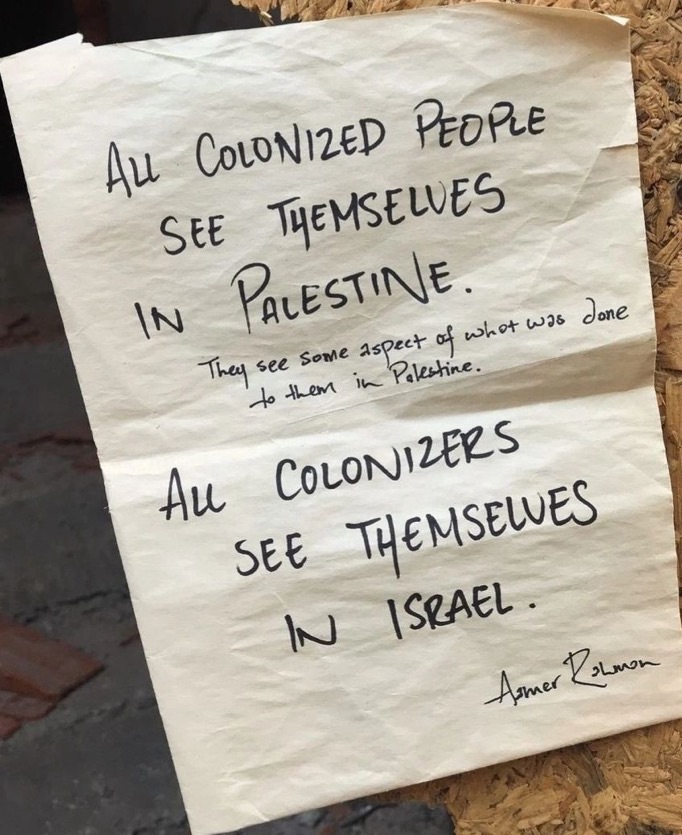
So, if we take even a medium-term historical view on these countries, it seems that there is a strain of thinking in those nations’ political cultures stretching from Left to Right that still view war crimes and genocide not as appalling and even unforgivable aberrations, but as legitimate policy options when it is convenient for them or those, however unsavoury, that they deem allies. 

Protest as leadership

It is in this context that the leaderships of the US, the UK and Germany display such an extraordinary arrogance toward those protesting their disgust at their policies. In the UK, along with their gleeful grasping at graft, their contempt towards protesters is a measure of government ministers’ extraordinary sense of entitlement.

But it is the protests of which they are so contemptuous that so often change cultures and countries in the ways in which corrupt politicians can only dream. This is because protest is moral leadership that seeks to make the world a better place by demanding that it become so. 

It is because of protesters that women have the vote, that apartheid has been ended in South Africa, that civil rights have been advanced in the US and the North of Ireland. When many governments have sought to merely manage the status quo – the “realpolitik” – protesters have asserted that this is not good enough and demanded better.

Today protesters understand, as the Irish patriot and human rights activist Roger Casement once put it, that “… we all on earth have a commission and a right to defend the weak against the strong, and to protest against brutality in any shape or form”.

So, at the end of the day, as Israel’s allies become ever more deeply mired in the murder of children, it is the protesters they disdain who will perhaps contribute most substantially to an end to apartheid in Israel/Palestine and thereby save the souls of their own countries.
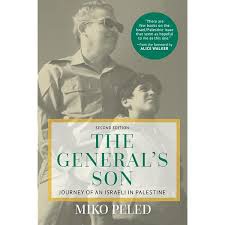
The General’s Son, by Miko Peled; and The Ethnic Cleansing of Palestine, by Ilan Pappe

Summary: on the original sins of Zionism

 In 1967 General Mattityahu Peled, who, as head of logistics of the Israeli Defense Forces, was one of the architects of the Israeli victory in the Six Day War, investigated an atrocity.

Peled had heard from a Palestinian prisoner how IDF soldiers in Gaza had massacred over 30 unarmed civilians, including a 13 year old boy and an 86 year old man. After they were shot the IDF drove a bulldozer back and forth over the bodies until they were unrecognizable. 

Peled, an Arabic speaker, went personally to Gaza to find out what happened and met the families of the victims. Afterwards he wrote a report to the Israeli government warning them about the moral degradation that the illegal occupation of Palestinian territories would bring and how atrocity would become a commonplace if it was allowed to continue. 

Peled’s son, Miko, reckons now that this was probably the decisive moment in his father’s life that transformed him from soldier to committed peace activist, something he remained for the rest of his life, a mantle taken up, in spite of incredible suffering, by both Miko and his sister, Nurit. 

But perhaps Matti Peled should not have wasted his breathe with his warning to the Israeli government. Because as Israeli historian Ilan Pappe explains in depressing detail in his book, The Ethnic Cleansing of Palestine, atrocities of the sort Matti Peled uncovered in Gaza – atrocities of the sort that Israel continues to perpetrate year in, year out, including in its genocidal post October 7th operations in Gaza – were part of the DNA of Zionism from when Israel was but a glimmer in David Ben Gurion’s eye. 

Prior to the founding of the state of Israel Ben Gurion and the cadre of Zionists that he gathered around him to be his closest political and military advisors, drew up detailed plans for the expulsions of the indigenous people of Palestine so they could realise their sectarian dreams of a Jewish state. They recognized from the outset that mass murder and terrorism would be intrinsic to this project. 

With the UN vote to partition Palestine they put their plans into bloody action. Deir Yassin was the pattern, not an aberration. 

On visiting the aftermath of one ethnic cleansing operation by the Haganah, the forerunner of the IDF, Golda Meir was reminded of the Eastern European pogroms that had terrorized her own family from their home. But, aside from this momentary lapse, she otherwise remained comfortable with her role as a war criminal.  But Pappe wonders how a mere three years after the Holocaust its survivors could inflict such barbarity on fellow human beings.

Pappe’s forensic analysis of the war crimes of Israel and the fundamental racism of Zionism has, of course, drawn criticism from other Israelis – the sort who benefit from apartheid in Israel and the West Bank and who celebrate the genocide in Gaza.

But, like Miko Peled, Pappe is on the right side of history. As the world increasingly sees Israel for the rogue terrorist state that it is, Peled and Pappe explain why it is as it is, and plot a path towards the inevitable end to apartheid there.

Both Pappe and Peled represent the enduring voice of conscience in the midst of atrocity. They are advocates of a common humanity in the face of prejudice and sectarianism. In the end it is this humanity that will always triumph over apartheid.

Paris ’44, by Patrick Bishop

Summary: a gripping narrative of the liberation of Paris

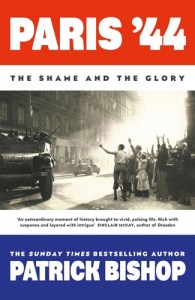
Paris ’44 covers similar ground to the bestselling book, Is Paris Burning? by Larry Collins and Dominique Lapierre, focusing on the liberation of Paris from the Germans in 1944.

Bishop finds some novel perspectives on the story through recounting the experiences of JD Salinger and Ernest Hemmingway in the fighting in France. Bishop is also much less generous to the German commander of the Paris garrison, von Choltitz, than were Collins and Lapierre:  That von Cholititz did not set Paris ablaze had little to do with his moral qualms and much more to do with the logistical difficulties of such an act of terrorism. Bishop is also rightly caustic about how the grossly collaborationist French police switched sides when they discerned how the tide of the war was turning.

The Paris uprising in 1944 was possibly the luckiest such insurrection in occupied Europe. Elsewhere resisters were encouraged with considerable cynicism by the Allied high command to give battle to the Germans to draw off forces from the main allied armies. But Paris was one of the few places where the allied armies moved to support the uprisings before the Germans had time to massacre them. The relief of Paris by a Free French armored division was something of which the Home Army in Warsaw, or the Maquis on the French Vercors massif could only dream.

It is a compelling story no matter how it is served up, and Bishop does this with quite some style. 

The Voyage Home, by Pat Barker

Summary: a fine novel of Cassandra that suffers in comparison with Barker’s initial foray into the stories of Troy

The Voyage Home continues Pat Barker’s feminist retelling of the tales of Troy, following the return of Agamemnon to Mycenae with the enslaved Cassandra in tow. This guarantees that the reunion with his wife Clytemnestra is going to be awkward. Just how awkward Agamemnon, even if he was a cleverer man, could not imagine.

But Cassandra, gifted with prophesy, but cursed that no one ever believes her, knows. In the bloodshed that she foresees she also discerns some measure of justice for the genocide that the Greeks have inflicted on her homeland. 

For this story, Barker replaces Briseis, the narrator of her previous Trojan books, with Ritsa, Cassandra’s maid: slave to a slave, or, as she describes her lowest of the low status, a “catch-fart.” 

The Voyage Home dealing with the beginning of the Oresteia, is, I think, a considerably better book than its predecessor, The Women of Troy. But neither of these books say much additional thematically to the stunning originator of this series, The Silence of the Girls.

Still, it is elegantly written, and Barker’s continuing focus on how war affects civilians and the sexual violence endured by women is important. In addition, Cassandra is always a compelling figure, and Ritsa is a fine creation. 

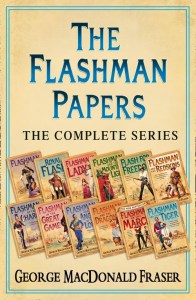
The Flashman Papers, by George McDonald Fraser (Flashman; Royal Flash; Flash for Freedom!; Flashman at the Charge; Flashman in the Great Game; Flashman’s Lady; Flashman and the Redskins; Flashman and the Dragon; Flashman and the Mountain of Light; Flashman and the Angel of the Lord; Flashman and the Tiger; Flashman on the March)

Summary: A thoughtful rumination on Empire masquerading as a scurrilous romp… or is it the other way round?

I read my first Flashman book in the 1990s when I was working in Afghanistan. That book, George McDonald Fraser’s first dealing with the character, described his experiences in the retreat from Kabul. In the market of the town in which I was living, Jalalabad, it was still possible to buy buttons cut from the uniforms of the British dead of that retreat.

The Flashman books are rigorously researched historical novels, and so a great introduction to aspects of British imperial history which are little remembered in Britain, but which still reverberate in the global South. 

They are also exceptionally filthy and extremely funny, though much of the humour, drawing on the racist attitudes of Victorian England – and indeed of McDonald Fraser’s own day – can sometimes be hard to stomach. It is as if the boorish bores of Foster’s Passage to India are given centre stage to opine on the imperial order and revel in the privilege of being top dog in it, albeit with much more interesting lives to narrate.  

By the end of his life, Flashman has attained the rank of Brigadier General, been awarded the Victoria Cross and a knighthood, and is regarded as one of the heroes of Victorian Britian. He has met some of the greatest luminaries of his age, including Lincoln and Bismarck, and been witness to some of the epoch-making events of his days, including the Charge of the Light Brigade, the burning of the Summer Palace in Beijing, and the Battle of Little Bighorn. 

Throughout all of this Flashman remains what he was when expelled from Rugby in Tom Brown’s Schooldays: an utter and selfish coward. And so, his reputation as a Victorian hero is built upon a reality of luck, murder, rape, deceit and pillage. In other words, Flashman is probably the most honest exemplar of British Empire in all of literature. 

Indeed, it is honesty – at least as a memoirist – that is one of Flashman’s few redeeming qualities, though he is also proud of his gifts with languages, women and horses. It is an impressive achievement that McDonald Fraser never softens the character across the decades of the books. 

However, readers continue to be seduced by Flashman. He is undeniably charming when he wants to be. His humour can be enough to make the reader forget on occasion that these are the memoirs of a monster, someone prepared to sacrifice the lives and liberty of everyone who has ever trusted or helped him, with the possible exception of his canny and perpetually under-estimated wife, Elspeth, if it can advantage him. 

Because of the painstaking historical research, Flashman can be highly opinionated on the events and individuals involved. Flashy is never reticent about what he thinks of the good sense or otherwise of the unfolding events and those involved in them. Some of the opinions are uncontentious: he is in justifiable awe of Lincoln, for example. But some of his conclusions are much more questionable: for example, he is mightily impressed by the venial betrayer of the Navajo, Kit Carson. But then as an inveterate Judas himself, Flashman may have sensed a kindred spirit in Carson.

McDonald Fraser states in an introduction to these books that all he was interested in was writing adventure stories. But, he writes, readers insist on finding in them works of satire, moral tales, indictments of Empire, handbooks for leadership. He was once even dumbfounded to find the books compared to Proust in a German review. 

I’ve not read Proust, but tend to agree with the critics who have found all those things that McDonald Fraser said he never put there. I have also read some Tolstoy and, for my tuppence worth, would suggest that taken together these books are literature worthy of serious comparison with the great Russian writer’s ruminations on the Napoleonic wars: a sort of 18-certificate Carry On British Colonialisim, if you will. 

They are a remarkable achievement, and gloriously entertaining. Try them.

Resting places: On Wounds, War and the Irish Revolution, by Ellen McWilliams

Summary: trying to see “higher than the ditches that break up the canvas of the land”. 

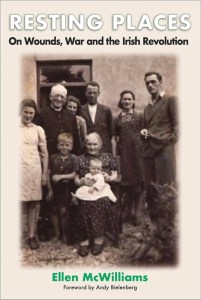
There is an echo of Martin Doyle’s book, Dirty Linen, in Ellen McWilliams’ Resting Places. Like Doyle, McWilliams also uses the literature of Ireland and Britain, experiences from her professional career, and the local history of her home place, in County Cork rather than in County Down, to reflect on wider issues of Irish history and Anglo-Irish relations. 

But McWilliams doesn’t stop there. Resting Places is also a remarkably personal work. Her insights on the “big” themes are also prompted by the most domestic ones: by reflections on her relationships with family – both the Cork ones and the English lot – and from her experiences of her own body in her most private moments as a lover and as a mother.

This is apposite: Women and girls were, as McWilliams reminds us, the subject of institutionalised systems of abuse and enslavement, including the Magdalene Laundries and the Mother and Baby Homes, for much of the 20th Century in Ireland. In writing of her own body with such candour she reminds the reader of the strength and fragility of human flesh and how this can be so easily desecrated by bigotry masquerading as righteousness. 

By pondering these very intimate aspects of life McWilliams also comes to some of her most important historical insights, ones that can be lost or overlooked in more traditional narrative or political histories. Because so many of the dynamics of war, and particularly of war-crimes, in revolutionary and civil wars have their sources in the domestic sphere: around hearths and kitchen tables, in whispered conversations the memories of ancient ills – of land expropriations, of scorched earth and famine – are kept alive. 

And it is one atrocity that perhaps grew from such conversations, the Dunmanway massacre, that lurks at the heart of this book. The country was meant to be at Truce when these killings occurred. But there is no truce on bitter memories. 

Between 26 and 28 April 1922, fourteen Protestant men and boys were killed or disappeared around Dunmanway and the Bandon Valley, in the very roads and fields around which McWilliams grew up. These were the families of neighbours killed by the families of neighbours, and indeed the comrades of her own family, which was deeply involved in the struggle for Irish independence. 

The fate of two 16 year old boys, Robert Nagle and Alexander McKinley, are particularly difficult for McWilliams to contemplate. A new mother when writing this book, she writes of these boys with an agony of empathy, knowing what it is to carry a child for nine months, tend to him as he grows into his own little person, and to worry that something awful might happen to him. For these boys’ mothers, they awakened to that nightmare.

Perhaps there are still whispered conversations telling new generations why these murders “had to be done.” But McWilliams remembering how Greek tragedy reminds us that crimes that stay buried poison the water of the living, shows true patriotism in confronting this vile aspect of the Irish revolution.

McWilliams is an exquisite writer, warm and frequently very funny. At one point she muses if, in marrying an English scholar of the English civil war, she has actually ended up – at some psychic or metaphorical level – marrying Cromwell himself. 

On the evidence of her book, I think the answer is a resounding “NO”. I can’t imagine Cromwell ever fretting over the recipe for soda bread, which her lovely-sounding husband does. Feeding other people is antipathetic to genocide. Cromwell would have hated him. 

McWilliams book is an incredibly rich one, fizzing with more ideas that any review can do proper justice to. Read it!

Dirty Linen: The Troubles in my home place, by Martin Doyle

Summary: An outstanding portrait of the pity of war

Margaret Yeaman has never seen her grandchildren. She lost her sight on 15 March 1982 when a no-warning car bomb exploded close to her workplace in Banbridge, County Down, causing splintering glass to lacerate her face. 

Margaret’s story, of being in the “wrong place at the wrong time” is just one amongst many that Martin Doyle explores in his book, Dirty Linen. The book also takes exception to that “wrong place, wrong time,” line. So many of the people whose stories Doyle recounts were just doing their jobs, providing for family and community, or just trying to have a bit of craic. It was the paramilitaries who were in the wrong place at the wrong time for these ordinary people.

Some will still argue that atrocities such as the ones recounted in this book were necessary to advance justice in the North of Ireland. But as Margaret and people like her tell their stories of how their families were devastated by violence, these should bring shame to that notion: as if the British government was ever going to be moved to change policy by Paddies butchering Paddies on the country roads of Ireland. It’s why they introduced “Ulsterisation” to begin with.

Dirty Linen is, in part a memoir, and Doyle gives an honest accounting of his experiences coming of age amidst such carnage, including the miserable abuse he sometimes suffered as a young Catholic in that religiously mixed part of County Down. 

This book could also act as something of an introduction to the art of the North of Ireland. As literary editor of the Irish Times, Doyle is able to draw upon the work of so many writers and artists, from Seamus Heaney to F E McWilliams and Colin Davidson, to help him give voice to the depth of the human tragedy that the Troubles represented.

But, as a result of Doyle’s sensitive interviews with Margaret and people like her, his book is also an exemplary work of journalism and a deeply important contribution to understanding the history of the Troubles. It offers an unflinching portrait of the pity of war by exploring the trauma and courage of the victims of both loyalist and “republican” paramilitaries. 

Some of those victims whose stories Doyle explores also became perpetrators, or at least sympathetic to the idea of revenge. But so many more refused to become as twisted as those who mutilated them and their families. Instead. they often begged for no retaliation and strove for forgiveness, or at least toleration. Theirs are stories that are so much more heroic than anything that could ever be written about the paramilitaries who pressed the triggers or planted the bombs.  

If this was all that Doyle did, then the book would be a marvel. But his painstaking accumulation of detail across the book also builds a picture of the pervasiveness of collusion between British state forces and the loyalist Glenanne gang. Perhaps other writers and researchers have done similar work. But I have not read such a convincing indictment of the breadth of British collusion anywhere else. So, if you want to understand why the British government is so keen to stop Troubles era criminal investigations, read this book.

At a time when the Troubles seem to be giving rise to some exemplary non-fiction, Doyle’s book could well stand out as a classic. 


Brotherhood: when West Point rugby went to war, by Martin Pengelly

Summary: an important insight into American war-making

Before 9/11, Martin Pengelly, with his amateur English rugby team, played against West Point in a friendly game when they toured the UK. Pengelly’s team won. In subsequent West Point legend Pengelly’s team was described as “semi-professional”. They were not.

Rugby in West Point is something of an outsiders’ sport. So, the West Point rugby team was populated by students who, by and large, were not quite good enough to get on the American football team. Still, some disadvantages turn out to be advantages by introducing these young men to a much finer sport.

Over twenty years since his on-pitch encounter with these young men Pengelly revisits them and explores how they fared in the subsequent “9/11wars” in which they fought.

The book is an interesting study of a subculture – rugby – of a subculture – West Point, and of American officers’ experiences in twenty-first century war and counter insurgency.

It is perhaps churlish to note that there is negligible consideration of the impact of these wars on Iraqi and Afghan civilians. Pengelly was not a combatant and the politics and humanitarian consequences of US policy, whether astute or blundering, does not seem to be at the forefront of the minds of any of those whose story he is telling. So, there is little of the sort of empathy and soul searching that Tim O’Brien, for example, brought to his writings on Vietnam.

Still, it would take a heart of stone not to be moved by the waste of life, in training and in combat, that Pengelly describes his subjects enduring.

Overall, this is an elegantly written book, and an important insight into what goes into the make-up of a revered portion of American society, one that will continue to exert its influence nationally and internationally into the foreseeable future.

The Kidnapping: A hostage, a desperate manhunt and a bloody rescue that shocked Ireland, by Tommy Conlon and Ronan McGreevy

Summary: a lucid and gripping account of an important aspect of the Troubles.

On 24 November 1983, Don Tidey, a supermarket executive, was kidnapped from outside his home by a unit of the Provisional IRA. Twenty-three days later, on 16 December, he was rescued in Derrida Wood, County Leitrim, by a joint operation of the Irish Army and the Garda. In the course of the rescue the IRA unit killed two people: 23 year-old Garda recruit Gary Sheehan, and Private Patrick Kelly of the Irish Army.

The authors trace the origins of this tragedy to the early 1980s when the IRA came up with a new fundraising strategy: kidnapping for ransom. It began with the legendary racehorse, Shergar. Seemingly temperamental stallions do not submit to the same sort of intimidation techniques that the IRA found worked so well on innocent German factory managers and single mothers from Divis Flats. So, unable to keep the horse placid, they killed and disappeared the beast before moving on to vulnerable human targets. Conlon and McGreevy recount the series of kidnapping and extortion operations that followed before the abduction of Tidey.

It is sometimes easy for a Northerner like myself to forget the dreadful impact that the Troubles had upon the South. With this book the authors seek to redress this historical amnesia. Both Leitrim men, they also expose the prejudices that other parts of Ireland, with their crass ignorance of what it means to have a significant paramilitary presence in one’s community, developed against their county.

There is a palpable and justifiable thread of disgust at the paramilitaries’ attitudes and actions running through this book. At one point the authors quote John Hume who observed that many Provos seemed to regard Irish citizens who did not support their bloody campaign as lesser beings.That may well have eased their qualms about pressing triggers on people like Gary Sheehan and Paddy Kelly who were doing nothing more than trying to protect the innocent. Conlon and McGreevy also trace the devastation wreaked by the trauma of those deaths on their surviving families. Meanwhile the probable killers continue to be feted in Sinn Fein circles, and those they killed ignored.

The Kidnapping is a superb book that helps strip away any romantic hue forming around the Troubles and helps all Ireland face up to another vital piece in the totality of our history.

Killing Thatcher: the IRA, the manhunt, and the long war on the Crown, by Rory Carroll

Summary: insight on the Troubles through the prism of a gripping account of one bloody incident

Patrick Magee did not kill Thatcher when the bomb he planted in the Grand Hotel, Brighton exploded. She emerged from the wreckage with her reputation burnished by an extraordinary display of courage and self-possession for one who had just survived an assassination attempt.

Magee did kill Jeanne Shattock, Anthony Berry, Eric Taylor, Muriel Maclean and Roberta Wakeham. Most were sleeping when the bomb exploded but were not killed instantly. Instead they suffocated, terrified and alone, in the rubble that scythed through the hotel, unleashed by the explosion. Others were grievously injured, including former nurse, Margaret Tebbitt, who was left quadriplegic. More would probably have died were it not for the startling courage of the firefighters who attended the scene and broke protocol by insisting on searching for survivors before the building was declared free of explosives.

Killing Thatcher is Rory Carroll’s gripping narrative of the events leading up to this 1984 bombing and the subsequent hunt for the bombers. Its principal focus is on Magee, but it is also an account of the others, from Magee’s victims to the bomb disposal experts and cops who he came into interaction with during the course of his involvement in the IRA’s often vicious campaign in England.

Magee is in many respects a hugely impressive individual. After release from prison, in which he earned a PhD, he showed considerable moral courage in meeting and subsequently working with Anthony Berry’s amazing daughter, Jo. This initial meeting, he admitted, was the first time he realised that he had been responsible for the death of a fine person. But in spite of his apparently genuine regrets, he continues to insist that the Brighton bombing was a legitimate act of war.

Following her callous handling of the 1981 hunger strikes, Thatcher was a hate figure in much of Ireland. So, the Brighton bombing was principally an act of revenge rather than a strategic move coolly calculated to advance war aims. Justice in Ireland was instead advanced by the diplomacy of Taoiseach Garret Fitzgerald, who convinced Thatcher to sign the Anglo-Irish agreement the year after the bombing. This laid the foundations for the Good Friday Agreement of 1998.

Reading this book as thousands of women, children and men are suffocating to death in the bombed out rubble of Gaza, I imagine that, like Magee before he met Jo Berry, Netanyahu, Hamas and their cheerleaders in the British parliament and American Congress do not trouble themselves to think of the dying as fine human beings. But I doubt that any of them would have the integrity of the likes of Patrick Magee to face their victims, or of Thatcher to put in the groundwork for a political solution, in spite of personal feelings.

So, for all that is repellent about British and IRA policy and actions during the Troubles, Magee and Thatcher appear now as moral paragons by comparison with many contemporary political figures with their weasel words in defence of war crimes.