Regime Change: Inside the Imperial Presidency of Donald Trump, by Maggie Haberman and Jonathan Swan

Summary: A chilling account of what happens when the American presidency ceases to recognise meaningful limits on its own power.

In her 2022 Confidence Man: The Making of Donald Trump and the Breaking of America, Maggie Haberman provided both an explanation of what makes Donald Trump and a warning about what he might do if given power again.

Regime Change, written with Jonathan Swan, describes what happened when he was.
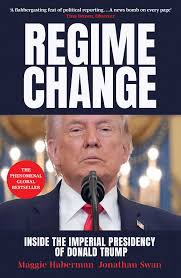
Drawing on hundreds of interviews and extraordinary access to the second Trump administration, Haberman and Swan document something more profound than the familiar chaos of Trump’s first presidency. This time Trump entered office understanding much better how the machinery of government worked, surrounded by people more willing to execute his wishes, and determined that the presidency should be constrained neither by the institutional conventions that frustrated him during his first term nor, frequently, by conventional understandings of the law itself.

The resulting picture is breathtaking: federal immigration agents and National Guard troops deployed into American cities; presidential power brought directly to bear upon businesses and institutions; and a war against Iran launched without specific congressional or UN authorization and accompanied by rhetoric and military conduct raising profound questions under both national and international law. 

The virtue of Haberman and Swan’s reporting is that they rarely need to editorialise. The accumulation of detail makes the argument for them. What emerges is not simply an unusually aggressive presidency but a different understanding of the office: one in which personal will increasingly substitutes for institutional process and the traditional distinction between the interests of the president and those of the state becomes progressively harder to discern.

Perhaps the only reassuring thing that can be said about Trump is that he is mortal. After reading Regime Change, it is considerably less clear that the American republic as we have known it will outlive him

Original Sin: President Biden’s decline, its cover-up, and his disastrous choice to run again, by Jake Tapper and Alex Thompson

Summary: American Hastings Banda

On a human level, this book is a very sad one. Across it, informants repeatedly refer to how their encounters with Joe Biden in the later stages of his presidency reminded them of their own impaired elderly relatives. Indeed, the descriptions of Biden’s deterioration within this book reminded me more than once of my father’s decline.

Of course, devastating as that was, I can be confident that no matter how afflicted my father became, unlike Biden, he would never have added his support to a genocide. 

I counted four references to the violence in Palestine across this book, starting with a brief mention of the Hamas atrocity on 7 October 2023, and ending with another brief mention that Biden’s Gaza policy was the area of most substantial disagreement, in private, between Biden and his Vice President Kamala Harris. 

This lack of discussion of one of the great moral issues of our day is, perhaps, unsurprising. Tapper and Thompson’s interests, like those of most Americans, are wholly US-centric. For them American preoccupations are paramount. And so they focus on the threat to American democracy posed by Biden’s cogitative decline and the opportunities that this gave to a resurgent Trump. They are uninterested in consequences of the moral collapse in international affairs of Biden and the swathes of the US political establishment that were their sources for this book. That doesn’t directly affect Americans.

This is somewhat disingenuous. There are occasional references through the book to Biden’s loss of support amongst young people. This is attributed solely to Biden’s age. Tapper and Thompson do not consider the possibility that abject disgust at Biden’s support for a racist and genocidal government in Israel could have deprived Harris of the small margins she needed in key battleground states to keep the presidency out of Trump’s hands.

In many respects Original Sin is a fine work of investigative reporting, and it does give important insight into the nature of power in the United States: Biden’s presidency gave power to a small cadre of advisers around him known, behind their backs at least, as the Politbureau. It was in this group’s selfish interest to deny to the world the fact that Biden was no longer physically or mentally fit to be president. To have done otherwise would have been a surrender of the power that they craved.

But the authors’ disinterest in the most murderous of Biden’s policies is reflective of one of the two original sins of the United States: that it was built on genocide and that many in the highest echelons of government still seem to regard this as a legitimate policy option. As a republic it has never quite grasped that human rights are meant to be universal. 

Given this, it is difficult sometimes not to feel that in some grand Karmic way the United States deserves Trump: they reap now for themselves what they sowed so long for others.