Guest blog: Still collateral? Trafficking survivors lack basic human rights protections, by Klara Skrivankova

Summary: In spite of the self congratulations by politicians regarding their stance on slavery, muddled government policies on trafficking, migration and labour rights render those vulnerable to slavery at continuing risk of abuse and exploitation.

October is usually a month filled with noise on “modern” slavery. It has been thus for over a decade now. Since 2007, 18th October has been designated the EU Anti-Trafficking Day and in 2010 the made it its UK Anti-Slavery Day. Organisations that work on the issue throughout the year tend to use the day to highlight campaigns, while politicians usually search for a photo op.  In 2020 photo ops are not really possible as events are largely held online.

Klara Skrivankova

As, in Europe at least, we are not busy flying from conference to a conference this October 2020 should be a reminder that the international community has been trying to deal with the issue for a long time. This year marks the 90th anniversary of the introduction of the ILO Forced Labour Convention; 20 years since the UN “Palermo Protocol”, 15 years since the Council of Europe Trafficking Convention, and six years since the ILO’s Forced Labour Protocol. Importantly, it has also been 70 years since the European Convention on Human Rights was first introduced, prohibiting forced labour and slavery.

When I first started working on trafficking 20 years ago, convincing governments that trafficking exists was a challenge. Later the task was to persuade them that trafficking for forced labour was an issue. Today, the level of awareness and the number of people that work on the issue are unprecedented, at least since the heights of the anti-slavery struggle in the 19th Century. Dedicated funds exist, as do masters courses. Trafficking and modern slavery are for all intents and purposes talked about as serious problems of our times. Some could see this as the ultimate success of campaigns and advocacy of 1990’s and 00’s.

Yet, we are far from being able to declare success.

Human trafficking and people smuggling are still confused and used as interchangeable terms by media and politicians, reflecting muddled and often contradictory policy on these matters. This is despite that the above mentioned two “Palermo Protocols” distinguishes between trafficking – the rendering someone into a situation of exploitation and a crime against a person, and smuggling – the facilitation of clandestine crossing of international borders and a crime against the state.

With the exception of a few specialist journalists, such as Kieran Guilbert and dedicated projects like the ones by the Guardian and Thompson Reuters Foundation, much of the reporting on human trafficking remains flat and simplistic.

For the most part, policies designed to deal with modern slavery fail to engage with the difficult questions about underlying causes that are deeply embedded in our political economies. Civil society is increasingly rendered into the role of a service provider, gagged through government contract and prevented from acting as critical friend holding government to account.  There is a dearth intersectional analysis examining how policies and actions by governments and sometimes also NGOs perpetuate the very circumstances that lead to exploitation.

Collateral Damage  was the title of a report published in 2007 by the Global Alliance against Traffic in Women. The publication reflected on the previous decade of anti-trafficking efforts and how these impacted on the rights of trafficked women. The title was chosen as it summed up well what we found – that peoples’ rights were often the casualty of anti-trafficking efforts.

Collateral damage is felt by trafficked people. For many, getting out of a situation of exploitation does not lead to “freedom”, but to a different kind of unfreedom. A trajectory from being enslaved to being processed by authorities, detained, disbelieved, deported, faced with destitution, debt and an uphill struggle to show that they are deserving victims.

Since 2007, laws have changed and arguably there have been some improvements in the way countries and civil society organisations respond. Trafficking for forced labour is now a strong focus and businesses are a key stakeholder in anti-slavery efforts. Yet I am struck that the overall argument of that report still stands and systemic failures described in it remain.

Let’s look at the UK for example. In 2007 I wrote in a chapter examining the UK’s response: “…. the authorities seemed to have failed to assess the implications that migration and labour market polices have for trafficking and on the vulnerability of certain groups to being trafficked.”

This statement rings true in 2020. In fact, I would argue that the implications of those policies are likely to be more significant today that they were in 2007.

Hostile environment has been a flagship UK policy for almost a decade now. The policy was designed to make the UK unwelcoming to migrants who do not have regular status in the country. Consequently, anyone who cannot immediately show their right to be here should be viewed with suspicion. Anti-migrant rhetoric and government campaigns such as the infamous go-home vans and vilification of lawyers have led to irregular migrants being labelled as criminals.  At the same time, most victims of modern slavery in the UK are migrants. The Home Office is the department in charge of both policies – one that is designed to remove as many foreigners as swiftly as possible, and the modern slavery strategy that is meant to provide victims with a recovery and reflection period, including a temporary permission to stay in the UK. The conflict between these two policies is glaring. Nevertheless, one would search in vain to find a recognition by the government that this contradiction exists. A new report by ECPAT UK shows what this policy dissonance means – life of insecurity and possible removals experienced by thousands of child victims of trafficking.

Labour exploitation too is, to a large extent, enabled by government policy. Deregulation, promoting ultra-flexible labour market and cuts in budgets of inspection bodies have led to increasing precarity in the UK labour market. Vast swathes of workers on zero-hour contracts, subcontracted through chains of labour brokers face uncertainty, poverty wages, poor conditions and in some cases forced labour. Flexibility and complexity in the labour market, where the rights of workers are secondary to the constant growth agenda, bring about situations where forced labour is found in value chains of well know companies.

Then there is the intersection between the labour market policies and immigration policies such as the criminal offence of illegal working. The impact of the new post-Brexit UK immigration tier system, to be introduced in 2021, is yet to seen. COVID19 has not only shone the light on underlying issues of inequality, but is expected to lead to more insecurity and precarity.

Back in 2007 the Collateral Damage report caused a bit of a stir. Rereading it today, I think it is time for volume two as the rights of migrants and rights of workers are under renewed assault, to serve as a reminder what governments and broader international community ought to do to seriously take on the issue of “modern” slavery.
Covid-19: lessons from war and humanitarian response

Summary: With COVID-19 Boris Johnson has been faced with a once in a lifetime crisis. He has failed the test.

Boris Johnson does love his military metaphors. They are intrinsic to his whole cod-Churchillian shtick. So, this past nine-months, at least after he finally bothered to show up to the COBRA crisis meetings, he’s been “wrestling” Covid-19, “whacking” it, “fighting” and “doing battle” with it.

Covid-19 doesn’t seem that bothered. Because it’s a virus. In these circumstances Johnson cosplaying a war leader is rather like, to borrow from Milan Kundera, attacking a panzer division with a mime troupe.

In truth, unlike other “natural disasters”, such as an earthquake or a tsunami, the effects of Covid-19 do bear some resemblance to a war induced emergency. Like the Troubles in the North of Ireland, or the civil war in Angola, wars ebb and flow like this pandemic. At different times they are more lethal in some places rather than others. Like this pandemic, wars also tend to be protracted crises in which we have to learn how to survive until a solution is in place.

Some research scientists working on treatments and vaccines, and the health professionals working in critical care, are fighting the virus. But the rest of us are effectively bystanders, just trying to survive it until, hopefully, the efforts of these professionals bear fruit. Unfortunately, in my experience, as we await a solution some people will always court risky behaviour as they become bored with the restrictions on life that health or human security concerns impose.

So the role then of a sane prime minister in these circumstances must be more akin to a humanitarian manager, trying to keep as many people alive until a resolution comes, rather than a general confronting an enemy. In such circumstances the language of battles and campaigning becomes redundant. Instead the priorities of humanitarian response are the relevant ones: Avoidance of risk and protection from harm, first for critical workers, then for the rest of us.

Jacinda Arden seems to have understood that. Boris Johnson has not. Arden has led by example. Johnson, with the not inconsiderable assistance of his father and Dominic Cummings, has shown that he expects different rules to apply to his coterie than to the rest of us.

Hence Johnson’s leadership in this crisis has been typified by muddle and confusion. Whenever there has been a hard choice to be made, he has routinely fluffed it. It is ironic that the government that so fetishized control of its borders in their fevered flight from the European Union, did not, unlike just about every other country in the EU, close its borders to prevent reimporting of the virus. Like the last lock down Johnson will show up to the next one three weeks late and, it appears, millions of dollars short.

The Covid-19 pandemic has thrown into sharp focus the fact that Boris Johnson is in possession of the single most dangerous trait in any leader: He wants to be popular. Hence he will tell any lie, fudge any choice if it just buys him another fleeting moment of the illusion of popularity. Every time a lie or an inadequacy is exposed he simply tells another, bigger lie to distract from his last failure. Hence his escalating promises of “world-beating” testing, track and trace. Lying having worked to deliver Brexit, it’s a trait that now seems to pervade the government with lethal consequences for the vulnerable.

When Johnson was just a philandering journalist this sort of behaviour only hurt those unfortunate enough to have loved or trusted him. As prime minister this has directly resulted in the UK having the highest death toll in Europe and the worst economic performance during this crisis.

As we are now poised on the brink of a second surge in Covid-19 infections it is critical that the UK government fundamentally rethink their approach to this crisis, learning from New Zealand, and the countries of South East Asia how they have managed to keep their populations safe from this disease.

Certainly, one critical issue, as Jacinda Arden has shown, is leadership. When human lives are at stake, any credible humanitarian response demands serious leaders for whom this will be the overriding priority. Johnson has failed in that test already. He should resign.

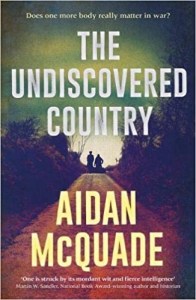
The Undiscovered Country

“The tree was in the river and the kid was in the tree… The kid couldn’t have been more than ten or eleven. He looked like a ragdoll caught in the branches.”

So begins my novel, The Undiscovered Country, which, after a long road to publication, is finally out in time for Second Lockdown/ Christmas. The Irish Times has called it, “‘A smart and pacy debut that details a historical period that deserves further exploration.”

For Hamlet, the “undiscovered country” was death. That lurks within these pages alongside reflections on Dutch people’s relationship with beer and cheese, the origins of the idea of the rule of law, and the true meaning of red-headed women in Renaissance paintings. These ruminations are my protagonists’ equivalent of whistling in the dark as they try to get to the truth about a murder that they stumble upon in the midst of a war for another “undiscovered country”, the emergent Irish republic in 1920.

Try it, you might like it. 🙏

It’s available on Hive https://www.hive.co.uk/Product/Aidan-McQuade/The-Undiscovered-Country/24931562

and on Amazon, https://www.amazon.co.uk/dp/1783528079/ref=cm_sw_r_cp_api_i_rSTAFbSQ8WKS0

No more evil geniuses any more

Summary: A Very British Coup

I suppose it comes from watching too much Dangermouse and James Bond as a kid: I came to expect the evil to be geniuses.

Watching Boris Johnson and his even less impressive minions like Nigel Farage, Priti Patel, Mark Francois, Andrew Bridgen, Sally Ann Hart and their ilk on television these days and I’m reminded of Hannah Arendt’s observations on the banality of evil. 

These are people who have not gotten into power because they are positive human exemplars of looks, brains or personality. They simply hate, and they share hatreds with enough others to have an electoral base in what passes for democracy in the gerrymandered U.K.

More than any other European democracy, the UK is an elective dictatorship. Those checks and balances on the excesses of the executive as exist post-Brexit, such as the national courts and remaining international law, the British government is now openly talking about dismantling. So the only constraint on their power grab will be the speed of bureaucratic processes.

Basically, the health of English democracy will be determined by how much and how quickly the government can undermine it in the next four years. So, the only saving grace of Boris Johnson, like Donald Trump, is that he is inordinately lazy. So he might, on his own, not get around to many things.

Even in the most notorious of dictatorships, authoritarianism can creep slowly. Mugabe’s power grab in Zimbabwe was a protracted but relentless affair, done in concert with the scapegoating of portions of the population, starting with the Ndebele, and, later, with the settler farmers.

Boris Johnson has based his political career on scapegoating too: first the European Union, now impoverished migrants trying to cross the English Channel. “Look”, he says, probably astonished that so much of the English population remains gullible enough to swallow his charlatanism whole, “these are the ones who are the causes of your problems, not me! Not the policies me and my pals have advocated and implemented for decades, not the incompetence I have shown in the face of a public health crisis.”

It is in moments like this that journalism’s role in defending democracy becomes most critical. But by fetishizing a notion of “balance” it is possible for even well-meaning media professionals to become cogs in a process aimed at obscuring the true causes of contemporary poverty and conflict. If, like the newspaper editor in The Man Who Shot Liberty Valance, the press chooses in the name of “balance” to print the politicians’ legends while knowing they are untrue, then they become mere henchmen to government, not journalists.

Without sufficient critical appraisal of the Johnson circus’ shenanigans, people can become distracted by the performances. Then they may more easily overlook the growing stench of corruption and cronyism coming from the Prime Minister’s circle as lucrative contracts are awarded to school pals, and foreign intelligence agencies are tolerated in their murder and injury of British citizens because they donate to the Conservative party.

In 1944, the then US vice president Henry Wallace argued that in America fascism could come to power under the auspices of “Americanism.” In England authoritarianism is likely to come to power under the auspices of a form of “patriotism” in which intolerance is practiced in the name of toleration, and the wholesale destruction of human and civil rights accomplished in the name of “British values.”

Those who bring their country to this nadir will, of course, be too stupid to appreciate the irony.

John Hume: reflections on a life well lived

History says, Don’t hope
On this side of the grave,
But then, once in a lifetime
The longed-for tidal wave
Of justice can rise up
And hope and history rhyme.- Seamus Heaney, The Cure at Troy

One of my earliest memories is watching a neighbour being shot. Another was of almost being caught, while on my way to primary school, in a culvert bomb attack launched by the IRA on the British army. The brother of a classmate was murdered by the SAS. A few years ago, I discovered that a bunch of loyalist paramilitaries had planned to massacre the children and staff of my Belleeks primary school. Fortunately for all of us, this was called off. Some war crimes were even too much for the war criminals of the North of Ireland.

I repeat these brushes with violence not to suggest that I am special in any way, but because these were typical life experiences for people living in the North of Ireland during the 70s and 80s. Indeed I was very lucky. Aside from a nasty kicking I once got from Shinners for having the temerity to canvas for the SDLP in West Belfast, my family was notably unscathed by the squalid little war that engulfed the North until John Hume finally managed to organise its ending.

I met John Hume a couple of times, but I doubt he ever remembered my name. I was a minor student activist in the SDLP, gone after a couple of years and never to return. So, it doesn’t matter much in the grand scheme of things that, from the first moment I heard of them, I was in favour of the Hume-Adams talks. It was, it seemed to me, an honourable effort towards peace and the logical extension of the philosophy of dialogue and persuasion that Hume had always advocated and that I had bought into early.

It is true that I did not think that the peace it ultimately brought would lead to Sinn Fein’s regrettable electoral ascendancy, as other more astute observers, such as Seamus Mallon, feared. But even in retrospect I think it a price worth paying. As has been said before: there are people alive today because of what Hume did to obtain peace. As Hume argued at the time, that is more important than the electoral success of any party.

Since his death some commentators have not even been able to wait until Hume was at rest in his grave before resurrecting the attacks that they began on him when he first sat down to talk with the Provos and that bore so heavily on him throughout those ghastly days. The thrust of their attack remains: because the peace process is imperfect, it is reprehensible. 

It is easy to be glib about war when it is not something that is likely to cut short your life or that of someone you love. That is something that the relatives of those butchered at Greysteel understood when one of their daughters told Hume they had prayed over her father’s coffin that he would be successful in his efforts with the Provos so that other families would not have to suffer as they had. 

Today it’s easy to indulge in the sort of maudlin glorifications beloved by Sinn Fein and the British Establishment of those who have taken up arms on their behalf. But I remember war too well to buy that nonsense. Ballymurphy, Bloody Sunday, Bloody Friday, the Miami Showband massacre, Kingsmill, the Shankill Butchers, La Mon, Enniskillen, may be selectively remembered still. But they were just larger examples of the “exchange of murders”, as Malachi O’Doherty once accurately described them, that typified the conflict.

In truth I’ve never found war anything other than a squalid matter, whether practiced in the North of Ireland, Ethiopia, Eritrea, Afghanistan or Angola. The scales of conflict in each place were different. But across the globe and through history each have in common that they enmesh ordinary people in systems of increasingly brutal inhumanity towards other people. This is true for just and unjust wars alike.

Of course as Bono noted in his bleak, beautiful lament for those massacred at Omagh, “hope and history don’t rhyme”. But they do have an assonance: a half rhyme.

Even a failed poet like me knows that the line “sometimes hope and history are in assonance” doesn’t have the quality of Heaney’s phrase or that of Bono. But that is where we are, and it is better than where we were. Musicians no longer have to worry about being targeted for playing to the “wrong” crowds. Dog fanciers no longer have to worry about being burned to death while having an evening out. Protesters for civil rights do not have to worry about being shot down in the streets by a foreign army. 

John Hume understood that imperfect peace is preferable to any war. His monumental life’s achievement in wresting that from the most nihilistic of conflicts is but another stepping-stone to a better society, to a better agreed society. 

It is for the rest of us to continue that journey now, remembering, as John Hume showed us, that no matter how bleak the moment, or imperfect the circumstances, if we put the sweat in, we also can overcome.

On the one road? Thoughts on achieving Irish reunification

Summary: Irish reunification will require difficult compromises for nationalists if there is to be any hope of accommodating unionism

The Good Friday Agreement was built on the foundations of the common memberships of Ireland and the UK in the European Union. Given Brexit the foundations of that agreement have been dealt a grievous blow. Hence it is necessary to contemplate whether new constitutional arrangements can be forged to secure peace in an agreed Ireland. This must include contemplation of the possibility of Irish unity.

In the North of Ireland, the Democratic Unionist Party have already delivered two of the greatest contributions towards a United Ireland of any political organisation since the Good Friday Agreement. First their sweaty, fevered dreams of Brexit backfired spectacularly when, in significant part as result of their ham-fisted triumphalism, Boris Johnson, as should have been expected, betrayed every promise he ever made to them. So instead of the renewed Protestant Supremacy of their dreams the DUP have got a customs border in the Irish Sea between Northern Ireland and Britain.

Second, and more fundamentally, the DUP’s botched Brexit shenanigans have demonstrated to their electoral base the depth of English contempt for them, their culture and the sacrifices that they have made for the Crown over the past decades and centuries. 

Paradoxically, this may not have been a total surprise. Culturally, both the unionist and nationalist communities in the North of Ireland have more in common with Scotland than with the English or Welsh. So, after Scotland’s departure from the UK, Northern Ireland will be in even greater cultural isolation than it currently is, perpetually subject to the disdain of a patronising Little Englander elite.

The greatest barrier to Irish reunification remains the factions of extreme Irish nationalism. These ultras have, since the 20th Century, hijacked the Irish flag as a partisan symbol all the while undermining its national meaning with their fratricidal campaigns. 

The Irish tricolour asserts that the nation is composed of two traditions: the Irish nationalist green, and the British loyalist orange, and that the nation is only complete when these traditions are united together by the white of peace. 

Nevertheless, some of the most vehement flag wavers of the past decades have not been prepared to follow the logic of what Irish nationhood must mean given the different cultures and heritages of the peoples of the island. Rather they want all vestiges of the unionist tradition expunged from the island of Ireland and all to accept their uncompromising visions of their utopian ideals. 

Of course, it is the very nature of utopian ideals that no one can ever live up to them. But this does not stop a few self-appointed guardians of the flame from deciding that that any shortfalls in their ideals of perfection should be dealt with by abuse, and sometimes violence. 

But there can be no single Irish cultural identity. By the first half of the 21st Century there are not just the Orange and Green traditions in Irish society. There are also important mainland European ones, most notably perhaps the Polish-Irish, and there have long been important African-Irish and Asian-Irish communities, enriching every county of the country with their presence. 

But perhaps the most urgent priority in Irish reunification must be in better accommodating the unionist tradition. And there are some obvious and immediate steps that Ireland could take towards this end. 

For a start Ireland could re-join the Commonwealth. This is a proposal that will certainly bring forth frothing fury from many of the flag wavers as a betrayal of the most fundamental ideals of their particular and personal notions of Irish nationhood. Indeed, when the unimpeachably Republican Fianna Fail TD Eamon O’Cuiv suggested this in 1994 that is exactly the sort of response he received. 

However, building a nation requires more than fundamentalist worship of an imagined past. We have seen the Brexity chaos and destruction that such idiocy brings.

Instead the Irish nation as a whole needs to recognise that if we are ever to be truly united then the unionist tradition must feel respected and at home within the New Ireland. That is not something that will ever be achieved by singing “Up the ‘Ra”, and by implication celebrating the wounds inflicted on that community by IRA violence. But it might be brought a small step closer by measures that demonstrate the respect for the symbols and traditions of the unionist community. It is also notable that states as varied as India, Tanzania and South Africa see no compromise in their national ideals by membership of the Commonwealth. Neither will an independent Scotland. Surely Ireland can show similar self-confidence.

Second Ireland could establish a mechanism for proper representation of the North in the Seanad. Over the past decades Taoisigh have on occasion appointed individual Northerners to the Senate. But it has hardly been a consistent practice. It must surely be within the bounds of possibility to do better than this. For example, it should be a straightforward matter to empower individual councils or all the collective councillors in the North of Ireland to elect a panel of representatives to the Seanad. Put simply, a united Ireland means some sort of elected representation of the North in the Oireachtas. Steps can be taken to move in that direction immediately.

Of course, before there is a united Ireland there will need to be much more talking and agreement on constitutional structures with which people can live. Consequently, the SDLP’s idea of a forum for discussion of this is a positive initiative. One must hope that the Irish government will also lead on this, perhaps through the establishment of a citizens’ assembly on the subject composed of people from all 32 counties. 

Perhaps a new Ireland will need a new flag to represent all traditions of the nation, old and new. Perhaps not. But one thing is certain. It is tough decisions and compromise which will bring about a United Ireland if it happens, not flag waving. 

Not even past: establishing the foundations of a New Ireland

Summary: A prerequisite for Sinn Fein being permitted to join a coalition government in Dublin should simply be that they agree to the establishment of, and full cooperation with, a truth commission on the Troubles.Image result for kingsmill massacre

“The past is never dead. It’s not even past.” – William Faulkner

Writing 2,500 years ago about a civil war in Greece, Thucydides, the first great historian of that war between Athens and Sparta, made a vital observation: ‘The people make their recollections fit with their sufferings”.

Given the unchanging realities of war and human nature, what was true then is true now. Hence recollections of the Troubles reflect the sufferings of those recalling them. For example, Britons remember with justifiable grief and anger the civilians slaughtered in the Birmingham and Guildford bombings. But many still cherish the paratroopers who similarly slaughtered and injured so many unarmed civilians in Ballymurphy and Derry.

As with so many other things to do with their history, most Britons are blissfully unaware of their security forces subsequent collusion with Protestant, “Loyalist” paramilitaries who acted as proxies in the commission of later atrocities, such as the Miami Showband massacre.

Loyalist paramilitaries when they called their ceasefire did express “abject and true remorse” for the sufferings of the innocents that they had caused. But elements of their community still clearly cherish the memory of some of the worst perpetrators of that hurt, and still celebrate the pain caused.

Irish “Republicans” keep bright the memory of British and Loyalist atrocities but grow irritable at the mention of their own murderous attacks, particularly those on Irish civilians such as Kingsmill, Enniskillen, and La Mon. Their peevishness is perhaps at its greatest when reminded of the savagery of their post-ceasefire butchery of Robert McCartney and Paul Quinn.

Of course, war crimes such as these and brutality by those inured to war are as old as war itself. But when selective memory is practiced in relation to a civil war, then it impedes the possibility of reconciliation and reunification in its aftermath.

It is the very nature of a civil war that after the guns fall silent the belligerents have to continue living together with those they have so grievously injured. The Good Friday Agreement was an effort to establish a basis on which this could happen. With Brexit striking at the very foundations of this peace settlement new constitutional possibilities must be contemplated, including that of Irish reunification. But true Irish reunification depends on uniting people, not just political territories. Without honesty about not just what each side endured but also what they inflicted then such true reunification becomes impossible.

The ideal of Irish reunification has suffered some quite serious blows in recent weeks with the crass celebrations by some victorious Sinn Fein candidates in the recent Irish general election. Singing “Up the ‘RA” on such occasions demonstrates a spectacular insensitivity to a section of the Irish population who suffered at the hands of the IRA during the Troubles but who must now consent to reunification if a New Ireland is to become a reality.

Martin McGuinness, notably in a speech he gave at the peace centre in Warrington, did show considerable moral courage in confronting the pain caused by IRA operations. Implicitly in that speech he recognised that even a just war is an evil thing.

But, like those Brexiters whose only knowledge of the Second World War comes from watching The Dambusters, many of today’s Sinn Féin activists’ attitude to the Troubles is, appositely enough, troubling. They seem to regard their armed struggle not as a regrettable necessity,  but rather as a moral good and those involved in it as beyond reproach. This is a similarity they have with the British Conservative party who resent the idea that British armed forces should be held to basic human rights standards.

The post-election negotiations to form a new Irish government may yet see Sinn Féin entering government, possibly even holding the office of Taoiseach. Former armed rebels entering the government of an Irish state which they hitherto opposed is hardly an unprecedented departure in history. Fianna Fáil did it. Clann na Poblachta did it. The Workers’ Party did it. Sinn Fein has already done it in Belfast.

But with a senior role in government comes responsibility. And one of the principle responsibilities of Irish government over the next decade is going to be exploring the possibility of Irish reunification and, hopefully, establishing a process by which such unification can happen.

This will be an impossible task for Sinn Féin to lead so long as they continue to refuse to face up to the full truth of their history including its most unpalatable aspects and the unremitting pain that they have inflicted on so many hundreds of their compatriots.

Many of the other parties elected to the Dail have refused to contemplate entering government alongside Sinn Fein such is the distaste that they feel at their history. But the logic of the peace process demands that Sinn Fein should have the opportunity to participate in government should the electorate so deem it.

This is a circle that can only be squared if Sinn Fein faces the truth of its history and ceases revelling in silly songs and slogans. In other words, a prerequisite for Sinn Fein entering government in Dublin should be its agreement that the government establish, and Sinn Fein cooperate fully with, a truth commission, modelled on the South African precedent.

Facing the truth about oneself is always a difficult thing. But, if nothing else, over the past decades Sinn Fein leaders and supporters have demonstrated considerable courage. However, it still remains to be seen whether they have the fortitude to move beyond their current posturing self-righteousness to help establish a process to properly remember our collective past and establish an agreed account of it that acknowledges all our sufferings and not just those of any particular  partisan faction.

After all, a new and reunited Ireland needs a foundation of shared truths.

Responding to child labour in Nespresso’s supply chain

Originally published by Thomson Reuters Foundation News

No one who has ever dealt with the challenges of agricultural livelihoods in the global South should ever be surprised that child labour remains an issue. However a report that Channel 4’s Despatches programme has filmed children picking coffee beans and hauling sacks on six Guatemalan farms believed to supply Nespressogives a shocking glimpse of the cynicism with which some businesses seem to treat this issue.

In responding to the reports Guillaume Le Cunff, Nespresso’s CEO, stated that “Nespresso
has a zero tolerance of child labour”, and the company noted over the past four years only 15 child labour cases had been identified by third-party auditors in Nespresso’s supply chains. All had been “effectively resolved” according to the business.

However, Mr Le Cunff also mentioned that coffee suppliers are given “a day or two days”
advanced notice before spot checks take place. With practices like that, one can only
imagine  Mr Le Cunff’s shock – SHOCK! – to discover there is child labour in his supply chain.

To be fair, audits are used by many big companies to give a façade of transparency rather than actually putting in the hard work that is necessary to more effectively tackle the issue. However, even with the best will in the world, audits are a poor instrument for resolution of child labour.

Unlike child slavery, which is the trafficking of children to a third party for the purposes of exploitation, child labour tends to occur within the family context. In other words, those who practice child labour are often the child’s own parents who are often trying to do their best for their kids in horrendously difficult circumstances.

That their best intentions for their child result in child labour is a consequence of poverty. It is a consequence of the poverty of families who put their children into the fields because they may not have enough money to eat let alone send their kids to school. It is a consequence of the poverty of communities which may not even have schools or, where there are buildings, may not have qualified teachers to staff them.

Audits by their very nature do not address these underlying causes of child labour. As
Nespresso appears to practice them they just make sure that labouring children are not
there to be seen when the inspectors show up with their note pads for fear it puts
consumers off their coffee.

Even where businesses pay premiums to suppliers for the commodities that they purchase, as Nespresso appears to do, this is often insufficient to end child labour in communities: landless labourers will never benefit from premiums; and families with only small parcels of land still may not earn enough from such payments to obtain a living income.

Hence, it would, paradoxically, be a pity if these reports of Nespresso’s failings put people
off buying their coffee. If businesses stop trading with poor communities they will be
impoverished further. Instead of boycotting Nespresso consumers should demand better of it and, as George Clooney, Nespresso’s public face for many years, said “hold everyone’s promise to account.”

So what does “doing better” look like? First it requires that businesses recognise that, like
any human rights or poverty challenge, child labour is a political issue. That is, it relates to the allocations of power and resources within communities and within wider societies. So if businesses want to address child labour in a meaningful way then they must engage with those issues.

Specifically, they need to act to advance gender equity, economic diversification, and child rights within the communities from which they source ensuring that the distinctive
challenges of the landless and, in particular, girls are directly addressed. Current models of trade and audits simply do not tackle these aspects of poverty. Instead there must be
specific focus on women’s political and economic empowerment in communities, establishing effective cultures of child protection, and ensuring that the landless have a
proper stake in the local economy.

Businesses must also work to ensure good governance, both nationally and locally in the
countries with which they do business. For example, businesses pay significant amounts in tax to the countries from which they source their commodities. It is reasonable for them to ask if national governments are using that revenue to effectively reduce poverty in the communities from which they source: Are they providing student grants for needy children? Or do all the schools have enough books and desks?

In spite of the complexities progress is being made. The number of children in child labour fell by 16 million from 168 million to 152 million between 2012 and 2016. Further progress depends on businesses like Nespresso properly engaging with the issue and its underlying causes.

As such Dispatches provides a moment of truth for the business. We all await to see if they rise to the challenge or merely tinker with their public relations.

We shall always overcome: speech to Rally For Our Rights, London, 12 Oct 2019

A couple of weeks ago I was back in Ireland visiting my family in the very place that Boris Johnson wants to reimpose a hard border.

It was a time for remembering and we remembered the dead: the dozens of people, British and Irish, who had died violently mere hundreds of metres from where we met.

There is peace now. It’s a peace that was forged by peaceful protest, by force of argument, by the spilling of sweat not blood. It’s a peace that has European foundations. Britain and Ireland’s common EU membership allowed different identities to be accommodated and old quarrels to be recast. From that new alliances and friendships have formed: before the 2016 referendum Ireland and Britain were the closest allies in the EU.

How things have changed. Now the uppity Irish are the bogey men and women of Brexit, disgracing ourselves in Brexiter eyes by our insistence that our peace is more important than their fantasies of reclaimed imperial glory.

But Boris Johnson and the imbecilic charlatans that form his government have forgotten something. They have forgotten that Britain is not just a land of Empire nostalgists and currency speculators. Like every country it may have a few racists and Blackshirts.

But Britain is also the land of the anti-slavery movement and the first trades unions. It is the land of the suffragettes and campaigns to make poverty history. In other words, this is a country filled with uppity citizens, people who believe in justice and fair play no matter what they are told by those who seek to profit from lies.

Following the corrupted referendum of 2016 the political leaderships of this country, Left and Right, wanted us to go quietly into the darkness. They wanted us to surrender to a far-Right clique the progress that had been made in peace, democracy, human rights, and environmental protections as a result of the UK’s membership of the EU. And they gave us comforting myths to help us on our way: garbage about a “jobs first” Brexit from the Left; nonsense about the Dunkirk spirit from the Right.

But we have not gone quietly. Instead a movement was born of ordinary people showing what Bobby Kennedy called numberless diverse acts of courage and belief and so reshaping the history of these times.

This movement is an expression of that collective sense of outrage that drove the anti-slavery movement and the suffragettes, and that drives still the demands for justice for Grenfell, the Windrush generation and Nazanin Zaghari-Ratcliffe. It is the same sense of outrage that drives every struggle for social justice and human rights across the world.

Each of us here today is saying with our presence that we are not prepared to silently accept the stripping away of the rights of young people to live and study and work and love across Europe.

Each of us is saying with our presence that we are not prepared to silently allow the denial of the rights of our friends and neighbours to contribute to the flourishing of this society simply because they come from a different part of Europe.

Each of us is saying with our presence that we are not prepared to allow the peace forged at great effort in Ireland to be jeopardised through the racist blundering of the buffoons who currently occupy Downing Street: people who for all their crass talk of world wars have never seen the effect of a bullet or a bomb on a human body, or the devastation that a battle can inflict upon a community or a war upon a society.

The spirit of British decency is alive on these streets today. It has forced the political leadership of this country to accept that Brexit is not a done deal. We have shown them all, from Boris Johnson to Jeremy Corbyn, something they should never have forgotten. That when citizens are outraged, united by our common humanity and repudiating the hatred and racism of the bigots around us, then no matter what injustice we may be confronted with, we will always overcome.

Cummings is not getting his Johnson out any time soon: on the decline of British democracy

Johnson

There’s a lot of things Boris Johnson doesn’t like: monogamy; consistency; telling the truth; Paddies… particularly smart Paddies; “picaninnies with watermelon smiles“. But since he became Prime Minister it has become clear that more than anything else Johnson detests scrutiny. Foghorn Leghorn is less chicken than Johnson faced with evidence of his lies, duplicities and stupidities.

Of course this would be fine in a totalitarian society. You know: one that does not have a parliamentary system like the one Johnson has just decided to shut down. There Johnson would make a passable Mussolini, or a Ceausescu at a pinch.

But it is a terrible problem in a society that is meant to be democratic: in such societies the executive are meant to be accountable to the citizenry through parliament, and citizens can only fulfil our responsibilities in the system if parliament is functioning and we know what is going on.

This is what Edmund Burke was getting at in 1787 during a parliamentary debate on opening up of press reporting of the House of Commons. Then he refered to the press as the “fourth estate“, thereby alluding to the vital role they had in ensuring that the people of a nation knew what was afoot with their government.

Cummings

So one can at least see consistency when, in addition to shutting down parliament, Johnson and his minion Dominic Cummings establish a policy of refusing Channel 4 News and BBC Newsnight requests for interviews. Just like House of Commons select committees, these are the few remaining places in the UK where Johnson and his spectacularly dim ministers might get asked hard questions. Like: It’s just that you really don’t care if bloodshed returns to the British border in Ireland, isn’t it? Or: How many ruined lives would you deem as too many for a proper British Brexit?

You might think that voters have a right to know Johnson’s answers to such questions. But understand it from his point of view. Honest answers would make him look bad. And, as Eddie Mair showed, he really isn’t a good enough liar to blag his way when faced by a competent interviewer.

No! It’s better for Johnson if he just bunkers in and avoids the nasty hard questions that make him look like the callous eejit that he really is.

Johnson’s hero Churchill may have eschewed the safety of the bunker during crises, but there’s no reason why Johnson should. After all, its not like Herman Goering gave interviews to to the Manchester Guardian when he was also trying to trash British democracy.

Given this, it would probably not cut much ice with Johnson or Cummings to remind them of what that smart Paddy President Jack Kennedy once said:

“there is a terrific disadvantage not having the abrasive quality of the press applied to you daily, to an administration, even though we never like it, and… even though we disapprove, there isn’t any doubt that we could not do the job at all in a free society without a very, very active press.“

Such ideals are not to be allowed in Johnson’s Airstrip One. Here “ignorance is strength”, and that is how the tinpot have always liked it.